
 A SCHOLARLY BOOK REPOSITORY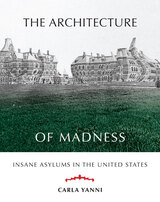
Elaborately conceived, grandly constructed insane asylums—ranging in appearance from classical temples to Gothic castles—were once a common sight looming on the outskirts of American towns and cities. Many of these buildings were razed long ago, and those that remain stand as grim reminders of an often cruel system. For much of the nineteenth century, however, these asylums epitomized the widely held belief among doctors and social reformers that insanity was a curable disease and that environment—architecture in particular—was the most effective means of treatment.
In The Architecture of Madness, Carla Yanni tells a compelling story of therapeutic design, from America’s earliest purpose—built institutions for the insane to the asylum construction frenzy in the second half of the century. At the center of Yanni’s inquiry is Dr. Thomas Kirkbride, a Pennsylvania-born Quaker, who in the 1840s devised a novel way to house the mentally diseased that emphasized segregation by severity of illness, ease of treatment and surveillance, and ventilation. After the Civil War, American architects designed Kirkbride-plan hospitals across the country.
Before the end of the century, interest in the Kirkbride plan had begun to decline. Many of the asylums had deteriorated into human warehouses, strengthening arguments against the monolithic structures advocated by Kirkbride. At the same time, the medical profession began embracing a more neurological approach to mental disease that considered architecture as largely irrelevant to its treatment.
Generously illustrated, The Architecture of Madness is a fresh and original look at the American medical establishment’s century-long preoccupation with therapeutic architecture as a way to cure social ills.
Carla Yanni is associate professor of art history at Rutgers University and the author of Nature’s Museums: Victorian Science and the Architecture of Display.

This illustrated collection of annotated newspaper articles and memorials by Dorothea Dix provides a forum for the great mid-nineteenth-century humanitarian and reformer to speak for herself.
Dorothea Lynde Dix (1802–87) was perhaps the most famous and admired woman in America for much of the nineteenth century. Beginning in the early 1840s, she launched a personal crusade to persuade the various states to provide humane care and effective treatment for the mentally ill by funding specialized hospitals for that purpose. The appalling conditions endured by most mentally ill inmates in prisons, jails, and poorhouses led her to take an active interest also in prison reform and in efforts to ameliorate poverty.
In 1846–47 Dix brought her crusade to Illinois. She presented two lengthy memorials to the legislature, the first describing conditions at the state penitentiary at Alton and the second discussing the sufferings of the insane and urging the establishment of a state hospital for their care. She also wrote a series of newspaper articles detailing conditions in the jails and poorhouses of many Illinois communities.
These long-forgotten documents, which appear in unabridged form in this book, contain a wealth of information on the living conditions of some of the most unfortunate inhabitants of Illinois. In his preface, David L. Lightner describes some of the vivid images that emerge from Dorothea Dix's descriptions of social conditions in Illinois a century and a half ago: "A helpless maniac confined throughout the bitter cold of winter to a dark and filthy pit. Prison inmates chained in hallways and cellars because no more men can be squeezed into the dank and airless cells. Aged paupers auctioned off by county officers to whoever will maintain them at the lowest cost."
Lightner provides an introduction to every document, placing each memorial and newspaper article in its proper social and historical context. He also furnishes detailed notes, making these documents readily accessible to readers a century and a half later. In his final chapter, Lightner assesses both the immediate and the continuing impact of Dix's work.

Brian Brace Taylor draws on extensive archival research to reconstruct each step of the architect's attraction to the commission, his design process and technological innovations, the social and philosophical compatibility of the Salvation Army with Le Corbusier's own ideas for urban planning, and finally, the many modifications required, first to eliminate defects and later to accommodate changes in the services the building provided. Throughout, Taylor focuses on Le Corbusier's environmental, technological, and social intentions as opposed to his strictly formal intentions. He shows that the City of Refuge became primarily a laboratory for the architect's own research and not simply a conventional solution to residents' requirements or the Salvation Army's program.
READERS
Browse our collection.
PUBLISHERS
See BiblioVault's publisher services.
STUDENT SERVICES
Files for college accessibility offices.
RECENTLY PUBLISHED







UChicago Accessibility Resources
home | accessibility | search | about | contact us
BiblioVault ® 2001 - 2026
The University of Chicago Press