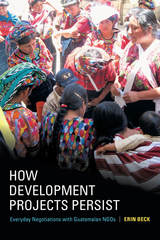
front cover of How Development Projects Persist
How Development Projects Persist
Everyday Negotiations with Guatemalan NGOs
Erin Beck
Duke University Press, 2017
In How Development Projects Persist Erin Beck examines microfinance NGOs working in Guatemala and problematizes the accepted wisdom of how NGOs function. Drawing on twenty months of ethnographic fieldwork, she shows how development models and plans become entangled in the relationships among local actors in ways that alter what they are, how they are valued, and the conditions of their persistence. Beck focuses on two NGOs that use drastically different methods in working with poor rural women in Guatemala. She highlights how each program's beneficiaries—diverse groups of savvy women—exercise their agency by creatively appropriating, resisting, and reinterpreting the lessons of the NGOs to match their personal needs. Beck uses this dynamic—in which the goals of the developers and women do not often overlap—to theorize development projects as social interactions in which policymakers, workers, and beneficiaries critically shape what happens on the ground. This book displaces the notion that development projects are top-down northern interventions into a passive global south by offering a provocative account of how local conditions, ongoing interactions, and even fundamental tensions inherent in development work allow such projects to persist, but in new and unexpected ways.
[more]

logo for Duke University Press
Seeking Justice for Gendered Violence
Courts, Communities, and Care in Guatemala
Erin Beck and Lynn Stephen
Duke University Press, 2026
Guatemala is one of the first countries in Latin America to codify femicide as a crime and to establish separate victim-centric institutions of justice to address Violence Against Women and Girls (VAWG), including specialized courts and public prosecutors. Despite these pathbreaking legal reforms, Indigenous women in Guatemala face formidable barriers to seeking justice for and escaping the multiple overlapping forms of violence that they confront. Seeking Justice for Gendered Violence dissects the efficacy of VAWG legislative reforms, examining how they both challenge and perpetuate vicious cycles of impunity and gender-based violence on the ground. Drawing on extensive case studies developed over Erin Beck and Lynn Stephen’s ten years of ethnographic research with an Indigenous research team focused on Indigenous communities, activists, public prosecutors, and government officials, Seeking Justice for Gendered Violence investigates how VAWG reforms in Guatemala interact with preexisting societal structures and local communities, exposing the advances and limits of state-driven solutions while illuminating how Indigenous women leverage grassroots knowledge to survive and resist violence, and to support one another in reformed but flawed systems.
[more]


Send via email Share on Facebook Share on Twitter