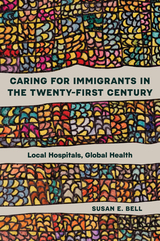
front cover of Caring for Immigrants in the Twenty-First Century
Caring for Immigrants in the Twenty-First Century
Local Hospitals, Global Health
Susan E. Bell
Rutgers University Press, 2027

In Permeable Hospitals, medical sociologist Susan E. Bell makes an original contribution to understanding a complex and urgent global health issue – caring for an increasingly diverse and mobile patient population. Bell identifies the twenty-first-century hospital as the center of a complex network of social and health care interactions among patients and medical communities that are distinguished by transnational movement. She examines how culture and language are negotiated during face-to-face interactions in outpatient visits at one Maine hospital and shows how caring is done for refugee and immigrant patients. To capture this process, Bell advances a new theoretical framework, that twenty-first-century hospitals are nodes in transnational social networks. During appointments, temporary combinations of people, objects, practices, and ideas assemble at the hospital and disperse at the appointment’s end. Because the interactions take place in a teaching hospital, the thinking that underlies diagnosis and treatment is made explicit and evaluated in backstage teaching areas where residents report about their patients to senior physicians. Bell's landmark book is based on a qualitative study that included nine months at the hospital observing interactions among adult New Mainer patients and clinicians, interpreters, and staff.

[more]

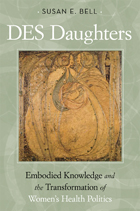
front cover of DES Daughters, Embodied Knowledge, and the Transformation of Women's Health Politics in the Late Twentieth Century
DES Daughters, Embodied Knowledge, and the Transformation of Women's Health Politics in the Late Twentieth Century
Susan E. Bell
Temple University Press, 2009
From the 1940s to the 1970s, millions of women were exposed prenatally to the synthetic estrogen DES, a “wonder drug” intended to prevent miscarriages. However, DES actually had damaging consequences for the women born from DES mothers. The “DES daughters” as they are known, were found to have a rare form of vaginal cancer or were infertile. They were also at risk for miscarriages, stillbirths, and ectopic pregnancies.

In DES Daughters, Susan Bell recounts the experiences of this generation of “victims.” In moving, heartfelt narratives, she presents the voices of those women who developed cancer, those who were cancer-free but have concerns about becoming pregnant, and those who suffered other medical and/or reproductive difficulties.

Bell examines the hierarchy of knowledge and power of scientists, doctors, and daughters, tracing the emergence of a feminist health movement. The “embodied knowledge” of these DES daughters prompted them to become advocates and form a social movement that challenged reproductive medical knowledge specifically, but also the politics of women’s health in general. Bell’s important book chronicles the history and future of these grassroots activists born out of illness, suffering, and uncertainty.

[more]


Send via email Share on Facebook Share on Twitter