
 A SCHOLARLY BOOK REPOSITORY
Results by Title
3 books about Bible and literature
3 books about Bible and literature
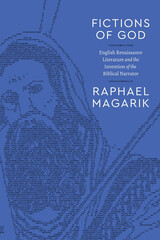
Fictions of God
English Renaissance Literature and the Invention of the Biblical Narrator
Raphael Magarik
University of Chicago Press, 2025
A new history of literary narration rooted in the turmoil of the Protestant Reformation.
We often identify secularization's characteristic literary form as the modern novel: out with divine scripture, in with human fictions. In Fictions of God, Raphael Magarik argues that this story overlooks the cultural upheavals of the Protestant Reformation. Early reformers imagined a Bible that was neither infallible nor inerrant but fictional, composed by a divine counterfactual: God crafted the text, they said, as if it had been written by the prophets. Early modern Protestants now found in their Bibles not a source of foundational truths but a model for unreliable narration, even fiction.
Fictions of God traces how this approach to literature passed from biblical commentators to poets like Abraham Cowley, John Milton, and Lucy Hutchinson amid the violent emergence of a new religious and political order—long before the eighteenth-century rise of the English novel. The result is a transformative account of the Reformation’s effect on imaginative literature and the secularization of the Bible itself.
We often identify secularization's characteristic literary form as the modern novel: out with divine scripture, in with human fictions. In Fictions of God, Raphael Magarik argues that this story overlooks the cultural upheavals of the Protestant Reformation. Early reformers imagined a Bible that was neither infallible nor inerrant but fictional, composed by a divine counterfactual: God crafted the text, they said, as if it had been written by the prophets. Early modern Protestants now found in their Bibles not a source of foundational truths but a model for unreliable narration, even fiction.
Fictions of God traces how this approach to literature passed from biblical commentators to poets like Abraham Cowley, John Milton, and Lucy Hutchinson amid the violent emergence of a new religious and political order—long before the eighteenth-century rise of the English novel. The result is a transformative account of the Reformation’s effect on imaginative literature and the secularization of the Bible itself.
[more]
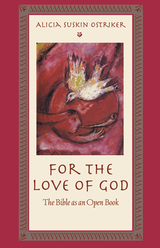
For the Love of God
The Bible as an Open Book
Ostriker, Alicia Suskin
Rutgers University Press, 2009
Quoting King Solomon’s famous prayer to God at the Temple in Jerusalem, “Behold, the heaven of heavens cannot contain thee; how much less this house that I have builded,” Alicia Suskin Ostriker posits a God who cannot be contained by dogma and doctrine. Troubled by the way the Bible has become identified in our culture with a monolithic authoritarianism, Ostriker focuses instead on the extraordinary variability of Biblical writing.
For the Love of God is a provocative and inspiring re-interpretation of six essential Biblical texts: The Song of Songs, the Book of Ruth, Psalms, Ecclesiastes, Jonah, and Job. In prose that is personal and probing, analytically acute and compellingly readable, Ostriker sees these writings as “counter-texts,” deviating from convention yet deepening and enriching the Bible, our images of God, and our own potential spiritual lives. Attempting to understand “some of the wildest, strangest, most splendid writing in Western tradition,” she shows how the Bible embraces sexuality and skepticism, boundary crossing and challenges to authority, how it illuminates the human psyche and mirrors our own violent times, and how it asks us to make difficult choices in the quest for justice.
For better or worse, our society is wedded to the Bible. But according to Talmud, “There is always another interpretation.” Ostriker demonstrates that the Bible, unlike its reputation, offers a plenitude of surprises.
For the Love of God is a provocative and inspiring re-interpretation of six essential Biblical texts: The Song of Songs, the Book of Ruth, Psalms, Ecclesiastes, Jonah, and Job. In prose that is personal and probing, analytically acute and compellingly readable, Ostriker sees these writings as “counter-texts,” deviating from convention yet deepening and enriching the Bible, our images of God, and our own potential spiritual lives. Attempting to understand “some of the wildest, strangest, most splendid writing in Western tradition,” she shows how the Bible embraces sexuality and skepticism, boundary crossing and challenges to authority, how it illuminates the human psyche and mirrors our own violent times, and how it asks us to make difficult choices in the quest for justice.
For better or worse, our society is wedded to the Bible. But according to Talmud, “There is always another interpretation.” Ostriker demonstrates that the Bible, unlike its reputation, offers a plenitude of surprises.
[more]
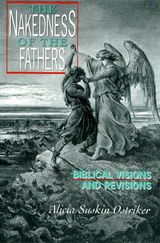
The Nakedness of the Fathers
Biblical Visions and Revisions
Ostriker, Alicia Suskin
Rutgers University Press, 1997
Like much twentieth-century feminist writing today, this book crosses the boundaries of genre. Biblical interpretation combines with fantasy, autobiography, and poetry. Politics joins with eroticism. Irreverence coexists with a yearning for the sacred. Scholarship contends with heresy. Most excitingly, the author continues and extends the tradition of arguing with God that commences in the Bible itself and continues now, as it has for centuries, to animate Jewish writing. The difference here is that the voice that debates with God is a woman's.
In her introduction, "Entering the Tents, " Ostriker defines the need to struggle against a tradition in which women have been silenced and disempowered - and to recover the female power buried beneath the surface of the biblical texts. In "The Garden, " she reinterprets the mythically complex stories of Creation. Then she considers the stories of "The Fathers, " from Abraham and Isaac to Moses, David, and Solomon - and their wives, mothers, and sisters. In "The Return of the Mothers, " she begins with a radical new interpretation of the book of Esther, includes a meditation on the silenced wife of Job and the idea of justice, and concludes with a fable on the death of God and a prayer to the Shekhinah, the feminine aspect of God. Ostriker refuses to dismiss the Bible as meaningless to women. Instead, in this angry, eloquent, visionary book, she attempts to recover what is genuinely sacred in these sacred texts.
In her introduction, "Entering the Tents, " Ostriker defines the need to struggle against a tradition in which women have been silenced and disempowered - and to recover the female power buried beneath the surface of the biblical texts. In "The Garden, " she reinterprets the mythically complex stories of Creation. Then she considers the stories of "The Fathers, " from Abraham and Isaac to Moses, David, and Solomon - and their wives, mothers, and sisters. In "The Return of the Mothers, " she begins with a radical new interpretation of the book of Esther, includes a meditation on the silenced wife of Job and the idea of justice, and concludes with a fable on the death of God and a prayer to the Shekhinah, the feminine aspect of God. Ostriker refuses to dismiss the Bible as meaningless to women. Instead, in this angry, eloquent, visionary book, she attempts to recover what is genuinely sacred in these sacred texts.
[more]
READERS
Browse our collection.
PUBLISHERS
See BiblioVault's publisher services.
STUDENT SERVICES
Files for college accessibility offices.
RECENTLY PUBLISHED






UChicago Accessibility Resources
home | accessibility | search | about | contact us
BiblioVault ® 2001 - 2026
The University of Chicago Press