
 A SCHOLARLY BOOK REPOSITORY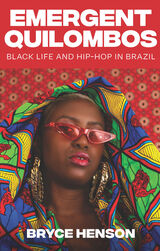
2024 Best Book Award, National Communication Association, Ethnography Division
2024 Roberto Reis Book Prize, First Book category, Brazilian Studies Association
2024 Outstanding Book Award, National Communication Association, Critical and Cultural Studies Division
2024 International and Intercultural Best Book Award, National Communication Association, International and Intercultural Division
How disenfranchised Black Brazilians use hip-hop to reinvigorate the Black radical tradition.
Known as Black Rome, Salvador da Bahia, Brazil, is a predominantly Black city. The local art, food, and dance are closely linked to the population’s African roots. Yet many Black Brazilian residents are politically and economically disenfranchised. Bryce Henson details a culture of resistance and activism that has emerged in response, expressed through hip-hop and the social relations surrounding it.
Based on years of ethnographic research, Emergent Quilombos illuminates how Black hip-hop artists and their circles contest structures of anti-Black racism by creating safe havens and alternative social, cultural, and political systems that serve Black people. These artists valorize and empower marginalized Black peoples through song, aesthetics, media, visual art, and community action that emphasize diasporic connections, ancestrality, and Black identifications in opposition to the anti-Black Brazilian nation. In the process, Henson argues, the Salvador hip-hop scene has reinvigorated and reterritorialized a critical legacy of Black politicocultural resistance: the quilombo, maroon communities of Black fugitives who refused slavery as a way of life, gathered away from the spaces of their oppression, protected their communities, and nurtured Black life in all its possibilities.
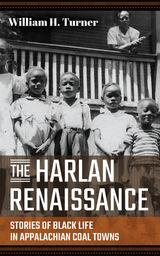
The Harlan Renaissance is an intimate remembrance of kinship and community in eastern Kentucky’s coal towns written by one of the luminaries of Appalachian studies, William Turner. Turner reconstructs Black life in the company towns in and around Harlan County during coal’s final postwar boom years, which built toward an enduring bust as the children of Black miners, like the author, left the region in search of better opportunities.
The Harlan Renaissance invites readers into what might be an unfamiliar Appalachia: one studded by large and vibrant Black communities, where families took the pulse of the nation through magazines like Jet and Ebony and through the news that traveled within Black churches, schools, and restaurants. Difficult choices for the future were made as parents considered the unpredictable nature of Appalachia’s economic realities alongside the unpredictable nature of a national movement toward civil rights.
Unfolding through layers of sociological insight and oral history, The Harlan Renaissance centers the sympathetic perspectives and critical eye of a master narrator of Black life.
From a distance, Matthieu Chapman’s life and accomplishments serve as an example of racial progress in America: the first in his family to go to college, he earns two master’s degrees and a doctorate and then becomes a professor of theater. Despite his personal and academic success, however, the specter of antiblackness continues to haunt his every moment and interaction.
Told through fragments, facets, shards, slivers, splinters, and absences, Shattered places Chapman’s own story in dialogue with US history and structural analysis of race to relay the experience of being very alive in a demonstrably antiblack society—laying bare the impact of the American way on black bodies, black psyches, and black lives. From the Church of Jesus Christ of Latter-day Saints to the offices of higher education, from a Loyal White Knights flyer on his windshield to a play with black students written by a black playwright, Chapman’s life story embodies the resistance that occurs, the shattering, collapsing, and reconfiguring of being that happens in the collisions between conceptions of blackness. Shattered is a heartrending and thought-provoking challenge to narratives of racial progress and postracial America—an important reminder that systemic antiblack racism affects every black person regardless of what they achieve in spite of it.
READERS
Browse our collection.
PUBLISHERS
See BiblioVault's publisher services.
STUDENT SERVICES
Files for college accessibility offices.
RECENTLY PUBLISHED




UChicago Accessibility Resources
home | accessibility | search | about | contact us
BiblioVault ® 2001 - 2025
The University of Chicago Press