
 A SCHOLARLY BOOK REPOSITORY
Results by Title
2 books about Bottles
2 books about Bottles
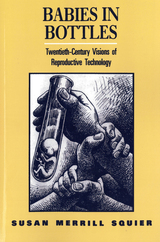
Babies In Bottles
Susan Merrill Squier
Rutgers University Press, 1994
There is a forgotten history to our current debates over reproductive technology - one interweaving literature and science, profoundly gendered, filled with choices and struggles. We pay a price when we accept modern reproductive technology as a scientific breakthrough without a past. Babies in Bottles retrieves some of that history by analyzing the literary and popular science writings of Julian Huxley, J.B.S. Haldane, Charlotte Haldane, Aldous Huxley, and Naomi Mitchison - writings that include representations of reproductive technology from babies in bottles to surrogate mothers. It is to these images, fantasies, practices, and narratives of scientific intervention in reproduction that we must look if we want to understand what acts of ideological construction have been carried out, and are currently being performed, in the name of reproductive technology. Susan Merrill Squier shows how the imaginative construction of reproductive technology helps to shape our contemporary practices. Susan Merrill Squier is Julia Gregg Brill Professor in Women's Studies and English at the Pennsylvania State University, University Park. She is the author of Virginia Woolf and London: The Sexual Politics of the City, editor of Women Writers and the City: Essays in Feminist Literary Criticism, and co-editor of Arms and the Woman: War, Gender, and Literary Representation.
[more]

Portraits in a Nutshell
The Art and History of Coquilla Nut Snuff Boxes and Bottles
Donna S. Sanzone
Brandeis University Press, 2025
A gorgeously illustrated look at snuff boxes and bottles carved from the Brazilian coquilla nut reveals a larger history of commerce, cultural exchange, and power in the Atlantic world.
Portraits in a Nutshell showcases intricately carved snuff boxes and bottles sculpted from the Brazilian coquilla nut between the seventeenth and mid-nineteenth centuries. Both utilitarian and decorative, these bottles and boxes were produced and used by diverse people of wide-ranging geographic origin, racial background, and social standing. As a result, coquilla nut snuff boxes present a rich material archive of the Atlantic world and the central role of Indigenous and Black histories within it.
Despite being just three or four inches long, these coquilla nut snuff boxes encapsulate an early modern history of transoceanic movement and creativity. The carvings depict animals and fantastical creatures, scenes of religious and courtly life, portraits of political and military leaders, abolitionists and activists, and people at the margins of colonial society. These images are available to the public and to scholars for the first time in this book and will be of interest to antique collectors, art historians, social historians, and anyone interested in the unusual and the curious.
Over 250 detailed photographs of snuff bottles and boxes from the unique and wide-ranging collection of David Badger not only illustrate the exceptional skill of their creators but also tell the story of millions of Africans transported to Brazil during centuries of the transatlantic slave trade. The text demonstrates the interconnectedness of the Atlantic world, the movements of peoples and ideas, and the commercial exchange of goods and cultural and material objects in Africa, Brazil, the Caribbean, and North America. In this beautiful book, these objects reveal a story never before told.
With a preface by Matthew Francis Rarey, associate professor of African and Black Atlantic art history at Oberlin College, and an introduction by Gwendolyn DuBois Shaw, professor of art history at the University of Pennsylvania and director of the Arthur Ross Gallery.
Portraits in a Nutshell showcases intricately carved snuff boxes and bottles sculpted from the Brazilian coquilla nut between the seventeenth and mid-nineteenth centuries. Both utilitarian and decorative, these bottles and boxes were produced and used by diverse people of wide-ranging geographic origin, racial background, and social standing. As a result, coquilla nut snuff boxes present a rich material archive of the Atlantic world and the central role of Indigenous and Black histories within it.
Despite being just three or four inches long, these coquilla nut snuff boxes encapsulate an early modern history of transoceanic movement and creativity. The carvings depict animals and fantastical creatures, scenes of religious and courtly life, portraits of political and military leaders, abolitionists and activists, and people at the margins of colonial society. These images are available to the public and to scholars for the first time in this book and will be of interest to antique collectors, art historians, social historians, and anyone interested in the unusual and the curious.
Over 250 detailed photographs of snuff bottles and boxes from the unique and wide-ranging collection of David Badger not only illustrate the exceptional skill of their creators but also tell the story of millions of Africans transported to Brazil during centuries of the transatlantic slave trade. The text demonstrates the interconnectedness of the Atlantic world, the movements of peoples and ideas, and the commercial exchange of goods and cultural and material objects in Africa, Brazil, the Caribbean, and North America. In this beautiful book, these objects reveal a story never before told.
With a preface by Matthew Francis Rarey, associate professor of African and Black Atlantic art history at Oberlin College, and an introduction by Gwendolyn DuBois Shaw, professor of art history at the University of Pennsylvania and director of the Arthur Ross Gallery.
[more]
READERS
Browse our collection.
PUBLISHERS
See BiblioVault's publisher services.
STUDENT SERVICES
Files for college accessibility offices.
RECENTLY PUBLISHED




UChicago Accessibility Resources
home | accessibility | search | about | contact us
BiblioVault ® 2001 - 2026
The University of Chicago Press