
 A SCHOLARLY BOOK REPOSITORY
The biggest bog secret of all, we learn, is the remarkable process of methane gas belching out of the bog. The gas is created by decaying peat moss and forms a bulge in the surface of the moss six inches or taller before breaking through. Does this "belch" make a sound? No one knows, says Root, because no one has ever heard it. In fact, bogs are known as some of the quietest places on earth. Maybe you will be the first to hear the big bog belch!
Illustrated by renowned woodcut artist Betsy Bowen, Big Belching Bog also contains a section of bog facts, including more information about the plants and animals mentioned in the book as well as tips for visiting a bog. Big Belching Bog will stir the imagination of young readers and teach them about the landscape and environment of these mysterious and, ahem, gassy places.

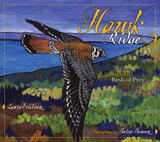
Was Caesar like the eagle because of his aquiline (from aquila, for “eagle” in Latin) nose, or does the eagle seem imperial because of his Caesar-like beak? Does the sharp vision of a “hawk-eyed” observer have any basis in nature? And what the heck is “kettling” to a bird-watcher, or, for that matter, a bird? Raptors have captured the imagination from time immemorial and have an especially rich history in Minnesota. The ancient peoples whose pictographs adorn the rock faces of Lake Superior’s North Shore may well have witnessed the first hawk movements along Lake Superior—the same annual migration that today draws as many as twenty thousand people to Duluth’s Hawk Ridge. These birds, passing through in astounding numbers, are among the hawks and accipiters, buteos and harriers, eagles and ospreys pictured and profiled in detail in this book.
Written by one of Minnesota’s best-known bird authorities, with images by one of the state’s favorite illustrators, Hawk Ridge is as fun as it is informative. It introduces the state’s raptors, from the rare visitor to the most familiar hawk, noting each species’ signature traits—osprey wings, for instance, are crooked to help them catch fish; vultures urinate on their legs to cool themselves—and their nesting, breeding, and migrating habits. Did you know that Sharp-shinned Hawks banded at Hawk Ridge have been found throughout Central America and even into South America, and also, in midwinter, in Wisconsin? Laura Erickson offers a broad perspective (a bird’s-eye view!), making sense of the raptor’s role in the larger ornithological scheme.
With descriptions of various species—and helpful distinctions between species, families, and orders—the book gives readers a clear idea of which raptors might be seen in Minnesota, when, where, and how often. It also includes a hawk migration primer that explains the movements that bring these birds in such awe-inspiring numbers to places like Hawk Ridge. Filled with curious facts and practical information for expert and amateur bird-watcher alike, the book is at once a guide to the hawks of Minnesota and a beautifully illustrated album of the most regal members of the avian kingdom.
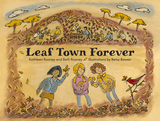
The true story of a Midwestern “town” created with leaves, sticks, and children’s imaginations
Leaf Town suddenly springs up. One day the clearing outside the school is empty, and the next it’s a bustling town complete with a hotel, shop, and mayor. Children gather and find treasures everywhere: feathers, acorns, lost rings, an old medal, and plenty of leaves and pine needles. They even uncover a silver skeleton key in the muddy banks of a nearby creek and proclaim it the heart of Leaf Town. As the town grows, it attracts the attention of the kids up the street, and a colossal fight threatens to destroy everything that was built. But the heart of Leaf Town is saved, and the kids rally to rebuild their city together, expanding to welcome the neighboring kids as well as all sorts of birds and animals. They hang a sign, Leaf Town Forever, and pass the key to the next generation of children who will look after their beloved town.
Based on a true story, Leaf Town Forever is the gentle tale of a town created by children with vivid imaginations. The timeless and universal saga, written in haiku, reminds both kids and adults that some dreams are worth protecting. Unfurling over the cycle of seasons, this is the story of an enchanting place full of tenacity and hope, creativity and fun—a connection to the natural world within reach for us all if we unite to make and maintain it.
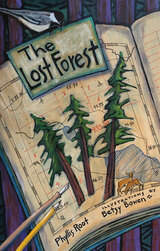
The story of a forest “lost” by a surveying error—and all the flora and fauna to be found there
A forest, of course, doesn’t need a map to know where to grow. But people need a map to find it. And in 1882 when surveyors set out to map a part of Minnesota, they got confused, or tired and cold (it was November), and somehow mapped a great swath of ancient trees as a lake. For more than seventy-five years, the mistake stayed on the map, and the forest remained safe from logging—no lumber baron expects to find timber in a lake, after all.
The Lost Forest tells the story of this lucky error and of the 144 acres of old-growth red and white pine it preserved. With gentle humor, Phyllis Root introduces readers to the men at their daunting task, trekking across Minnesota, measuring and marking the vast land into townships and sections and quarters. She takes us deep into a stand of virgin pine, one of the last and largest in the state, where U.S. history and natural history meet. With the help of Betsy Bowen’s finely observed and beautiful illustrations, she shows us all the life that can be found in the Lost Forest.
Accompanying the story is a wealth of information about the Cadastral Survey and about the plants and animals that inhabit forests—making the book a valuable guide for readers who might want to look even deeper into the history of Minnesota, the flora and fauna of old-growth forests, and the apportioning of land in America.
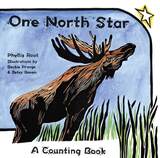
Five toads hop, four brook trout swim, three elk graze, two loons call, and one beaver gnaws on a paper birch tree, all under one North Star. Through bog and marsh, along river and lake, across prairie and into the woods, children learn what lives where by counting the creatures on foot or in flight, swimming or perching in exquisite woodcut and watercolor illustrations created by Beckie Prange and Betsy Bowen in an artistic collaboration. For those looking for more about the pictured wildlife, Phyllis Root includes fascinating facts and information on the state’s ecosystems and the plants and animals that make their homes there.
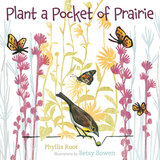
Author Phyllis Root and illustrator Betsy Bowen last explored the vast, boggy peatlands of northern Minnesota in their book Big Belching Bog. Now, in Plant a Pocket of Prairie, Root and Bowen take young readers on a trip to another of Minnesota’s important ecosystems: the prairie.
Once covering almost 40 percent of the United States, native prairie is today one of the most endangered ecosystems in the world. Plant a Pocket of Prairie teaches children how changes in one part of the system affect every other part: when prairie plants are destroyed, the animals who eat those plants and live on or around them are harmed as well. Root shows what happens when we work to restore the prairies, encouraging readers to “plant a pocket of prairie” in their own backyards.
By growing native prairie plants, children can help re-create food and habitat for the many birds, butterflies, and other animals that depend on them. “Plant cup plants,” Root suggests. “A thirsty chickadee might come to drink from a tiny leaf pool. Plant goldenrod. A Great Plains toad might flick its tongue at goldenrod soldier beetles.” An easy explanation of the history of the prairie, its endangered status, and how to go about growing prairie plants follows, as well as brief descriptions of all the plants and animals mentioned in the story.
With Betsy Bowen’s beautiful, airy illustrations capturing the feel of an open prairie and all its inhabitants, readers of all ages will be inspired to start planting seeds and watching for the many fascinating animals their plants attract. What a marvelous transformation could take place if we all planted a pocket of prairie!
READERS
Browse our collection.
PUBLISHERS
See BiblioVault's publisher services.
STUDENT SERVICES
Files for college accessibility offices.
RECENTLY PUBLISHED




UChicago Accessibility Resources
home | accessibility | search | about | contact us
BiblioVault ® 2001 - 2026
The University of Chicago Press