
 A SCHOLARLY BOOK REPOSITORY
Results by Title
3 books about Branche, Jerome C.
3 books about Branche, Jerome C.

Black Writing, Culture, and the State in Latin America
Jerome C. Branche
Vanderbilt University Press, 2015
Imagine the tension that existed between the emerging nations and governments throughout the Latin American world and the cultural life of former enslaved Africans and their descendants. A world of cultural production, in the form of literature, poetry, art, music, and eventually film, would often simultaneously contravene or cooperate with the newly established order of Latin American nations negotiating independence and a new political and cultural balance. In Black Writing, Culture, and the State in Latin America, Jerome Branche presents the reader with the complex landscape of art and literature among Afro-Hispanic and Latin artists. Branche and his contributors describe individuals such as Juan Francisco Manzano, who wrote an autobiography on the slave experience in Cuba during the nineteenth century. The reader finds a thriving Afro-Hispanic theatrical presence throughout Latin America and even across the Atlantic. The role of black women in poetry and literature comes to the forefront in the Caribbean, presenting a powerful reminder of the diversity that defines the region.
All too often, the disciplines of film studies, literary criticism, and art history ignore the opportunity to collaborate in a dialogue. Branche and his contributors present a unified approach, however, suggesting that cultural production should not be viewed narrowly, especially when studying the achievements of the Afro-Latin world.
[more]
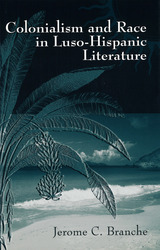
Colonialism and Race in Luso-Hispanic Literature
Jerome C. Branche
University of Missouri Press, 2006
In Colonialism and Race in Luso-Hispanic Literature, Jerome C. Branche examines race naming and race making in the modern period (1415–1948). During this time, racism, a partner to both slavery and colonial exploitation, took myriad discursive forms, ranging from the reflections and treatises of philosophers and scientists to travel writing, novels, poetry, drama, and the grammar of everyday life. Branche’s main premise is that modern race making went hand in hand with European expansion, the colonial enterprise, and the international development of capitalism.
Branche looks at the racially partisan works of the Luso-Hispanic canon to document just how long lasting, widespread, and deep the feelings they expressed were. He also illustrates how important race as narrative has been and continues to be. Branche pays particular attention to the Portuguese travel writing of the mid-fifteenth century, Spanish drama of the sixteenth and seventeenth centuries, Cuban and Brazilian antislavery texts of the nineteenth century, and the Afro-Antillean negrismo movement of the twentieth century.
While Colonialism and Race in Luso-Hispanic Literature complements important studies of the 1970s and 1990s that treat black identity in the Spanish literary tradition, at the same time its range is wider than many other works because of the inclusion of the Luso-Brazilian dimension, its examination of extraliterary texts, and its coverage of a broader time frame. Branche’s marriage of postcolonial and cultural theory with his own close readings of related texts leads to a provocative reconsideration of how the Negro was portrayed in Latin American cultural discourse.
[more]
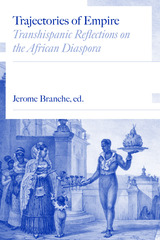
Trajectories of Empire
Transhispanic Reflections on the African Diaspora
Jerome C. Branche
Vanderbilt University Press, 2022
Trajectories of Empire extends from the beginning of the Iberian expansion of the mid-fifteenth century, through colonialism and slavery, and into the twentieth and twenty-first centuries in Latin American republics. Its point of departure is the question of empire and its aftermath as reflected in the lives of contemporary Latin Americans of African descent and of their ancestors in the historical processes of Iberian colonial expansion, colonization, and the Atlantic slave trade.
The book’s chapters explore what Blackness means in the so-called racial democracies of Brazil and Cuba today. Among the historical narratives and themes it covers are the role of medical science in the objectification and nullification of Black female personhood during slavery in nineteenth-century Brazil; the protocols of portraiture in the colonial period that, in including enslaved individuals, pictorially highlight and freeze their supposed inferiority vis-à-vis their owners; and those aspects of discourse that promote colonial capture and oppression in terms of evangelization and the saving of souls, or simply create the discursive template as early as the fifteenth century, for their continued alienation and marginalization across generations.
Trajectories of Empire’s contributions come from the fields of literary criticism, visual culture, history, anthropology, popular culture (rap), and cultural studies. As the product of an interdisciplinary collective, this book will be of interest to scholars in Iberian or Hispanic studies, Africana studies, postcolonial studies, and transatlantic studies, as well as the general public.
The book’s chapters explore what Blackness means in the so-called racial democracies of Brazil and Cuba today. Among the historical narratives and themes it covers are the role of medical science in the objectification and nullification of Black female personhood during slavery in nineteenth-century Brazil; the protocols of portraiture in the colonial period that, in including enslaved individuals, pictorially highlight and freeze their supposed inferiority vis-à-vis their owners; and those aspects of discourse that promote colonial capture and oppression in terms of evangelization and the saving of souls, or simply create the discursive template as early as the fifteenth century, for their continued alienation and marginalization across generations.
Trajectories of Empire’s contributions come from the fields of literary criticism, visual culture, history, anthropology, popular culture (rap), and cultural studies. As the product of an interdisciplinary collective, this book will be of interest to scholars in Iberian or Hispanic studies, Africana studies, postcolonial studies, and transatlantic studies, as well as the general public.
[more]
READERS
Browse our collection.
PUBLISHERS
See BiblioVault's publisher services.
STUDENT SERVICES
Files for college accessibility offices.
RECENTLY PUBLISHED




UChicago Accessibility Resources
home | accessibility | search | about | contact us
BiblioVault ® 2001 - 2026
The University of Chicago Press