
 A SCHOLARLY BOOK REPOSITORY
Results by Title
3 books about Breeds
3 books about Breeds

Breeds of Empire
The Invention of the Horse in Southeast Asia and Southern Africa 1500-1950
Edited by Greg Bankoff and Sandra Swart
National University of Singapore Press, 2007
Ships of empire carried not just merchandise, soldiers and administrators but also equine genes from as far afield as Europe, Arabia, the Americas, China and Japan. In the process, they introduced horses into parts of the world not native to that animal in historical times. As a result, horses in Thailand, the Philippine Horses, the Cape Horse in South Africa and the Basotho Pony in the mountain kingdom of Lesotho share a genetic lineage with the horse found in the Indonesian archipelago.This book explores the 'invention' of specific breeds of horse in the context of imperial design and colonial trade routes. Here, it focuses on the introduction, invention and use of the horse in Thailand, the Philippines and southern Africa as well as examining its roots and evolution within Indonesia. In addition, it examines the colonial trade in horses within the Indian Ocean and discusses the historiographical and methodological problems associated with writing a more species- or horse-centric history. This is a fascinating study that will appeal not only to scholars but also to the broad horse-reading public interested in all things equine.
[more]
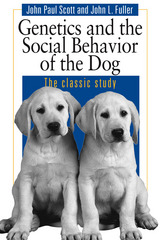
Genetics and the Social Behaviour of the Dog
John Paul Scott and John L. Fuller
University of Chicago Press, 1974
A classic study of dog behavior gathered into one volume, this is the single most important and comprehensive reference work on the behavior of dogs ever complied.
Scott and Fuller’s classic study of dog behavior gathers into one volume the authoritative information that came from their twenty years of research at the Jackson Laboratory. Central to their book is the role heredity plays in the development of behavior. Giving puppies an environment designed on the principles of a well-run school, Scott and Fuller tested five breeds representing the major dog groups and carried out a Mendelian experiment with two of the most different breeds: the basenji and the cocker spaniel.
They found that heredity affects almost every trait tested; that sex affects aggressiveness and the dominance order, but not trainability and problem-solving; that emotional traits profoundly influence performance; that, although breeds differ widely in emotional and motivational characteristics, none shows distinct superiority in problem solving; and that detailed statistical analyses indicate a highly complex pathway between primary gene action and its final effect on behavior.
Included is important information on:
• rearing methods
• the origin and history of dog breeds
• basic behavior patterns
• the physiological and behavioral development of puppies
Scott and Fuller’s classic study of dog behavior gathers into one volume the authoritative information that came from their twenty years of research at the Jackson Laboratory. Central to their book is the role heredity plays in the development of behavior. Giving puppies an environment designed on the principles of a well-run school, Scott and Fuller tested five breeds representing the major dog groups and carried out a Mendelian experiment with two of the most different breeds: the basenji and the cocker spaniel.
They found that heredity affects almost every trait tested; that sex affects aggressiveness and the dominance order, but not trainability and problem-solving; that emotional traits profoundly influence performance; that, although breeds differ widely in emotional and motivational characteristics, none shows distinct superiority in problem solving; and that detailed statistical analyses indicate a highly complex pathway between primary gene action and its final effect on behavior.
Included is important information on:
• rearing methods
• the origin and history of dog breeds
• basic behavior patterns
• the physiological and behavioral development of puppies
[more]

Whose Dog Are You?
The Technology of Dog Breeds and The Aesthetics of Modern Human-Canine Relations
Martin Wallen
Michigan State University Press, 2017
The intriguing question in the title comes from an inscription on the collar of a dog Alexander Pope gave to the Prince of Wales. When Pope wrote the famous couplet “I am his Highness’ Dog at Kew, / Pray tell me Sir, whose Dog are You?” the question was received as an expression of loyalty. That was an era before there were dog breeds and, not coincidentally, before people were generally believed to develop affectionate bonds with dogs. This interdisciplinary study focuses on the development of dog breeds in the eighteenth and nineteenth centuries. Beginning with the Foxhound—the first modern breed—it examines the aesthetic, political, and technological forces that generate modern human-canine relations. These forces have colluded over the past two hundred years to impose narrow descriptions of human-canine relations and to shape the dogs physically into acceptable and recognizable breeds. The largest question in animal studies today—how alterity affects human-animal relations—cannot fully be considered until the two approaches to this question are understood as complements of one another: one beginning from aesthetics, the other from technology. Most of all, the book asks if we can engage with dogs in ways that allow them to remain dogs.
[more]
READERS
Browse our collection.
PUBLISHERS
See BiblioVault's publisher services.
STUDENT SERVICES
Files for college accessibility offices.
RECENTLY PUBLISHED





UChicago Accessibility Resources
home | accessibility | search | about | contact us
BiblioVault ® 2001 - 2026
The University of Chicago Press