
 A SCHOLARLY BOOK REPOSITORY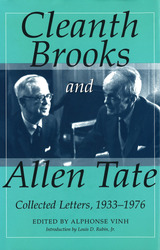
Offering all of the extant letters exchanged by two of the twentieth century's most distinguished literary figures, Cleanth Brooks and Allen Tate: Collected Letters, 1933-1976 vividly depicts the remarkable relationship, both professional and personal, between Brooks and Tate over the course of their lifelong friendship.
An accomplished poet, critic, biographer, and teacher, Allen Tate had a powerful influence on the literary world of his era. Editor of the Fugitive and the Sewanee Review, Tate greatly affected the lives and careers of his fellow literati, including Cleanth Brooks. Esteemed coeditor of An Approach to Literature and Understanding Poetry, Brooks was one of the principal creators of the New Criticism. His Modern Poetry and the Tradition and The Well Wrought Urn, as well as his two-volume study of Faulkner, remain among the classics read by any serious student of literature. The correspondence between these two gentlemen-scholars, which began in the 1930s, extended over five decades and covered a vast amount of twentieth-century literary history.
In the more than 250 letters collected here, the reader will encounter their shared concerns for and responses to the work of their numerous friends and many prominent writers, including T. S. Eliot, William Faulkner, and Robert Lowell. Their letters offer details about their own developing careers and also provide striking insight into the group dynamics of the Agrarians, the noteworthy community of southern writers who played so influential a role in the literature of modernism.
Brooks once said that Tate treated him like a younger brother, and despite great differences between their personalities and characters, these two figures each felt deep brotherly affection for the other. Whether they contain warm invitations for the one to visit the other, genteel or honest commentaries on their families and friends, or descriptions of the vast array of social, professional, and even political activities each experienced, the letters of Brooks and Tate clearly reveal the personalities of both men and the powerful ties of their strong camaraderie.
Invaluable to both students and teachers of literature, Cleanth Brooks and Allen Tate provides a substantial contribution to the study of twentieth-century American, and particularly southern, literary history.
From a 1938 essay by John Crowe Ransom through the work of contemporary scholars, Close Reading highlights the interplay between critics—the ways they respond to and are influenced by others’ works. To facilitate comparisons of methodology, the collection includes discussions of the same primary texts by scholars using different critical approaches. The essays focus on Hamlet, “Lycidas,” “The Rape of the Lock,” Ulysses, Invisible Man, Beloved, Jane Austen, John Keats, and Wallace Stevens and reveal not only what the contributors are reading, but also how they are reading.
Frank Lentricchia and Andrew DuBois’s collection is an essential tool for teaching the history and practice of close reading.
Contributors. Houston A. Baker Jr., Roland Barthes, Homi Bhabha, R. P. Blackmur, Cleanth Brooks, Kenneth Burke, Paul de Man, Andrew DuBois, Stanley Fish, Catherine Gallagher, Sandra Gilbert, Stephen Greenblatt, Susan Gubar, Fredric Jameson, Murray Krieger, Frank Lentricchia, Franco Moretti, John Crowe Ransom, Eve Kosofsky Sedgwick, Helen Vendler
READERS
Browse our collection.
PUBLISHERS
See BiblioVault's publisher services.
STUDENT SERVICES
Files for college accessibility offices.
RECENTLY PUBLISHED



UChicago Accessibility Resources
home | accessibility | search | about | contact us
BiblioVault ® 2001 - 2026
The University of Chicago Press