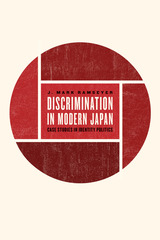
front cover of Discrimination in Modern Japan
Discrimination in Modern Japan
Case Studies in Identity Politics
J. Mark Ramseyer
University of Chicago Press, 2023
An informative rethinking of how Japanese society discriminates against its Korean, Okinawan, and Burakumin populations.
 
In this book, J. Mark Ramseyer, a noted authority on Japan looks at discrimination against groups in Japanese society, focusing on the Korean, Okinawan, and Burakumin groups. Ramseyer asks why they experience discrimination in Japan, an unusually homogeneous society. Is it because of some prejudice on the part of the majority that prevents their integration into mainstream Japanese society? Or is it because some of the dynamics within the group create incentives for the group to stay together and to be on the fringes of society?
 
Ramseyer argues that the real explanation is the latter, and each of these three groups has been victimized by its own leadership. Precisely because the groups are dysfunctional, members of the group cannot control members who would appoint themselves group leaders.  The result has been the capture of leadership positions by people who manipulate the group to their own private advantage and to the detriment of the group as a whole.
[more]


front cover of Waiting for the Cool Moon
Waiting for the Cool Moon
Anti-imperialist Struggles in the Heart of Japan's Empire
Wendy Matsumura
Duke University Press, 2024
In Waiting for the Cool Moon Wendy Matsumura interrogates the erasure of colonial violence at the heart of Japanese nation-state formation. She critiques Japan studies’ role in this effacement and contends that the field must engage with anti-Blackness and anti-Indigeneity as the grounds on which to understand imperialism, colonialism, fascism, and other forces that shape national consciousness. Drawing on Black radical thinkers’ critique of the erasure of the Middle Passage in universalizing theories of modernity’s imbrication with fascism, Matsumura traces the consequences of the Japanese empire’s categorization of people as human and less-than-human as manifested in the 1920s and 1930s, and the struggles of racialized and colonized people against imperialist violence. She treats the archives safeguarded by racialized, colonized women throughout the empire as traces of these struggles, including the work they performed to keep certain stories out of view. Matsumura demonstrates that tracing colonial sensibility and struggle is central to grappling with their enduring consequences for the present.
[more]


Send via email Share on Facebook Share on Twitter