
 A SCHOLARLY BOOK REPOSITORY
Results by Title
6 books about Buss, Fran Leeper
6 books about Buss, Fran Leeper
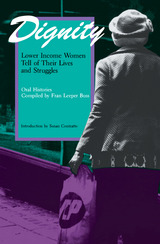
Dignity
Lower Income Women Tell of Their Lives and Struggles
Fran Leeper Buss
University of Michigan Press, 1985
Dignity brings together the stories of ten lower income American women whose backgrounds vary, but who share a struggle for survival and a quest for dignity in the face of hardship. Young or old, urban or rural, welfare recipient or union activist, each relates her life story with rich detail, poignant humor, and remarkable courage.
[more]
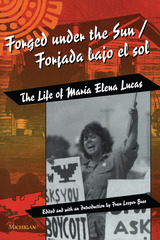
Forged under the Sun/Forjada bajo el sol
The Life of Maria Elena Lucas
Edited and with an Introduction by Fran Leeper Buss
University of Michigan Press, 1993
The compelling oral history of a remarkable woman's life and political struggle
[more]
La Partera
Story of a Midwife
Fran Leeper Buss
University of Michigan Press, 2001
Jesusita Aragon earned the title "la partera," or midwife, at the age of fourteen. Apprenticed to her grandmother, she learned the traditional Hispanic methods of assisting childbirth. She won the coveted title by performing her first delivery when an expectant mother went into labor in her grandmother's absence. In the years that followed, she was often the only source of medical care available in an isolated, mountainous area of New Mexico. Jesusita was so prized for her medical wisdom that she came to deliver more than 12,000 babies in the course of her career.
This is Jesusita's story, told in her own words. She describes her early training as a midwife, her forced departure from home due to two unmarried pregnancies, and her solitary struggle to support her children. La Partera tells how she gradually emerged as a leader in her community, painstakingly building by hand a small maternity center for her patients while gaining the respect of the Anglo medical community.
As Jesusita's story unfolds, so too does the story of the women of the region. Supplemental sections by the author illuminate Jesusita's culture and past, along with a historical account of the network of medical care provided by Hispanic and Anglo female healers. Illustrated with photographs of both people and places, La Partera reflects the culture of an era through the prism of Jesusita's hard and useful life.
Fran Leeper Buss lives and teaches in Tucson, Arizona.
This is Jesusita's story, told in her own words. She describes her early training as a midwife, her forced departure from home due to two unmarried pregnancies, and her solitary struggle to support her children. La Partera tells how she gradually emerged as a leader in her community, painstakingly building by hand a small maternity center for her patients while gaining the respect of the Anglo medical community.
As Jesusita's story unfolds, so too does the story of the women of the region. Supplemental sections by the author illuminate Jesusita's culture and past, along with a historical account of the network of medical care provided by Hispanic and Anglo female healers. Illustrated with photographs of both people and places, La Partera reflects the culture of an era through the prism of Jesusita's hard and useful life.
Fran Leeper Buss lives and teaches in Tucson, Arizona.
[more]
La Partera
Story of a Midwife
Fran Leeper Buss
University of Michigan Press, 1980
Jesusita Aragon earned the title "la partera," or midwife, at the age of fourteen. Apprenticed to her grandmother, she learned the traditional Hispanic methods of assisting childbirth. She won the coveted title by performing her first delivery when an expectant mother went into labor in her grandmother's absence. In the years that followed, she was often the only source of medical care available in an isolated, mountainous area of New Mexico. Jesusita was so prized for her medical wisdom that she came to deliver more than 12,000 babies in the course of her career.This is Jesusita's story, told in her own words. She describes her early training as a midwife, her forced departure from home due to two unmarried pregnancies, and her solitary struggle to support her children. La Partera tells how she gradually emerged as a leader in her community, painstakingly building by hand a small maternity center for her patients while gaining the respect of the Anglo medical community.As Jesusita's story unfolds, so too does the story of the women of the region. Supplemental sections by the author illuminate Jesusita's culture and past, along with a historical account of the network of medical care provided by Hispanic and Anglo female healers. Illustrated with photographs of both people and places, La Partera reflects the culture of an era through the prism of Jesusita's hard and useful life.
[more]
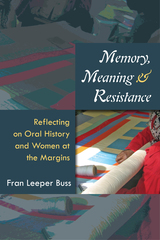
Memory, Meaning, and Resistance
Reflecting on Oral History and Women at the Margins
Fran Leeper Buss
University of Michigan Press, 2017
Fran Leeper Buss, a former welfare recipient who earned a PhD in history and became a pioneer in the field of oral history, has for forty years dedicated herself to the goal of collecting the stories of marginal and working-class U.S. women. Memory, Meaning, and Resistance is based on over 100 oral histories gathered from women from a variety of racial, ethnic, and geographical backgrounds, including a traditional Mexican American midwife, a Latina poet and organizer for the United Farm Workers, and an African American union and freedom movement organizer. Buss now analyzes this body of work, identifying common themes in women’s lives and resistance that unite the oral histories she has gathered. From the beginning, her work has shed light on the inseparable, compounding effects of gender, race, ethnicity, and class on women’s lives—what is now commonly called intersectionality. Memory, Meaning, and Resistance is structured thematically, with each chapter analyzing a concept that runs through the oral histories, e.g., agency, activism, religion. The result is a testament to women’s individual and collective strength, and an invaluable guide for students and researchers, on how to effectively and sensitively conduct oral histories that observe, record, recount, and analyze women’s life stories.
[more]
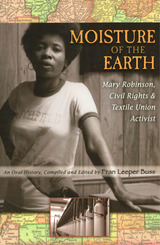
Moisture of the Earth
Mary Robinson, Civil Rights and Textile Union Activist
An Oral History, Compiled and Edited by Fran Leeper Buss
University of Michigan Press, 2009
In Moisture of the Earth, Mary Robinson recounts her journey from picking cotton in rural Alabama to becoming an outspoken community leader and labor activist. The daughter of sharecroppers, Robinson came of age at the peak of the civil rights movement and took a job in J. P. Stevens's Montgomery plant when the textile manufacturing giant was forced to admit African American workers. She soon became part of the historic organizing struggle by the Amalgamated Clothing and Textile Workers Union, finding her voice as an outspoken activist and union organizer. This is a riveting narrative of determination and defiance in the face of poverty and racial injustice, and a rare, behind-the-scenes account of union organizing drives in the South, from the vantage point of a black woman. Based on twenty-three years of interviews between Mary Robinson and oral historian Fran Leeper Buss, this book reveals the intertwined effects of race, class, and gender on the lives of lower-income women during segregation and after; sheds light on African American resistance movements in the twentieth century and the roles of religious traditions and storytelling to struggles for social justice; and highlights women's important roles in community activism and the labor movement.
[more]
READERS
Browse our collection.
PUBLISHERS
See BiblioVault's publisher services.
STUDENT SERVICES
Files for college accessibility offices.
RECENTLY PUBLISHED





UChicago Accessibility Resources
home | accessibility | search | about | contact us
BiblioVault ® 2001 - 2026
The University of Chicago Press