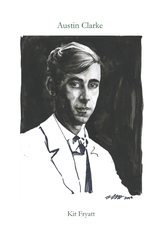
front cover of Austin Clarke
Austin Clarke
Kit Fryatt
Aberdeen University Press, 2020
This is the first book to examine the work of Austin Clarke (1896-1974) in the light of modern critical and theoretical perspectives. Clarke was one of Ireland's major writers whose career was devoted as much to fiction, drama and autobiography as to poetry.

Kit Fryatt assesses Clarke's work in its entirety but focuses on key works which reveal how resourcefully Clarke explored themes such as the coherence of the personality, the inner lives of women and the roots of repression.
[more]

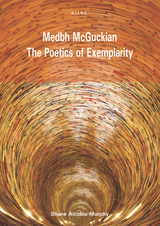
front cover of Medbh McGuckian
Medbh McGuckian
The Poetics of Exemplarity
Shane Alcobia-Murphy
Aberdeen University Press, 2012
This is the first monograph wholly devoted to the poetry of Medbh McGuckian and it presents pathways into her work that have thus far remained largely unexplored. The chapters examine the ways in which McGuckian uses literary exemplars to explore the psychodramas of female literary authorship and ways of approaching issues of memory, trauma and elegiac remembrance.

This monograph provides an excellent introduction to McGuckian’s poetry and argues that her work self-reflexively presents a deeply felt belief in the primacy (and efficacy) of poetry in the modern world.
[more]

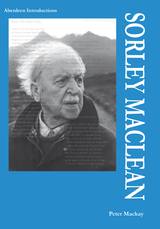
front cover of Sorley MacLean
Sorley MacLean
Peter Mackay
Aberdeen University Press, 2010
Sorley MacLean (1911-1996) was the greatest Gaelic poet of the 20th Century and one of the leading figures in the Scottish literary Renaissance. He is best known for his love poetry, for poems written while he was serving in Africa during the Second World War, forpoems exploring place and history, and for the long political poem ‘An Cuilithionn’. His 1943 Dàin do Eimhir agus Dàin Eile is generally regarded the single-most important book published in Gaelic in the last century.

This book offers the first single authored English language introduction to MacLean’s work. It places MacLean’s poetry in poetic, political and historical contexts, exploring its engagement with Gaelic traditions and other language literatures and also with contemporary philosophical and political movements. Discussing the entirety of MacLean’s oeuvre – and offering in-depth case studies of individual poems and groups of poems – this introduction raises questions about translation and cultural ownership in modern Scotland, and shows how and why MacLean’s work continues to resonate.
[more]


Send via email Share on Facebook Share on Twitter