
 A SCHOLARLY BOOK REPOSITORY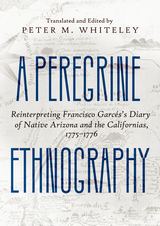
In 1775–1776, Francisco Garcés, O.F.M., undertook a remarkable three-thousand-kilometer journey through modern Arizona and the Californias. As a participant in a side-branch of Juan Bautista de Anza’s colonizing expedition to San Francisco, Garcés recorded a diary that provides a fascinating glimpse of Native peoples, several who had minimal or no prior contact with the Spanish empire. Garcés described customs, detailed alliances and enmities, and offered recommendations, both missionary and military. When he reached Hopi from the west (the first European to do so), Garcés completed a route between Monterey and Santa Fe, in effect completing a road across North America a generation before Lewis and Clark. The Hopi leaders, who clearly understood the implications, expelled him, declaring their independence on July 4, 1776.
Garcés’s diary remains vital for the Indigenous history of western North America. Yet the standard translation is flawed, not least owing to the state of ethnographic knowledge when it was made (1900), resulting in more than a century of reiterated misinterpretations of Indigenous history by anthropologists and historians. Peter M. Whiteley identifies the ur-version of Garcés's diary—a previously unknown copy written up by Pedro Font—and offers a new translation focusing on ethnographic significance in geographic context. Presenting also the Spanish text, Whiteley engages directly with Garcés’s account and provides readers with new interpretation and context.
Garcés was a genuine ethnographer and his accounts of Hopi, River Yumans, Takic, Yokuts, Numic, and Pai peoples, contain unparalleled and foundational insights.
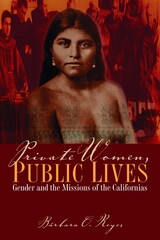
Through the lives and works of three women in colonial California, Bárbara O. Reyes examines frontier mission social spaces and their relationship to the creation of gendered colonial relations in the Californias. She explores the function of missions and missionaries in establishing hierarchies of power and in defining gendered spaces and roles, and looks at the ways that women challenged, and attempted to modify, the construction of those hierarchies, roles, and spaces.
Reyes studies the criminal inquiry and depositions of Barbara Gandiaga, an Indian woman charged with conspiracy to murder two priests at her mission; the divorce petition of Eulalia Callis, the first lady of colonial California who petitioned for divorce from her adulterous governor-husband; and the testimonio of Eulalia Pérez, the head housekeeper at Mission San Gabriel who acquired a position of significant authority and responsibility but whose work has not been properly recognized. These three women's voices seem to reach across time and place, calling for additional, more complex analysis and questions: Could women have agency in the colonial Californias? Did the social structures or colonial processes in place in the frontier setting of New Spain confine or limit them in particular gendered ways? And, were gender dynamics in colonial California explicitly rigid as a result of the imperatives of the goals of colonization?
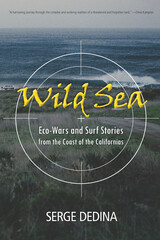
Dedina grew up in Imperial Beach, California, just north of the Mexican border, and he feels equally at home in Mexico and the States. An expert on gray whales, he eloquently describes the fight he helped to lead against the Mitsubishi Corporation, whose plan to build a salt-processing plant in the San Ignacio Lagoon in Baja California would have destroyed the world’s last undeveloped gray whale lagoon. With similar fervor, Dedina describes helping to construct the unlikely coalition that succeeded in defeating a proposed toll road that would have decimated a legendary California surf spot.
In between, he writes about the first surfers in Baja, the Great Baja Land Rush of the 1990s, Tijuana’s punk music scene, the pop-culture wrestling phenomenon lucha libre, the reasons why ocean pollution must be stopped, and the way HBO took over his hometown. Anyone interested in what’s happening to our natural places or just yearning to read about someone really making a difference in the world will find this a book worth sinking their teeth into.
READERS
Browse our collection.
PUBLISHERS
See BiblioVault's publisher services.
STUDENT SERVICES
Files for college accessibility offices.
RECENTLY PUBLISHED


UChicago Accessibility Resources
home | accessibility | search | about | contact us
BiblioVault ® 2001 - 2026
The University of Chicago Press