logo for Michigan State University Press
Modernity in Motion
Reading Gerald Vizenor in Global Contexts
David J. Carlson
Michigan State University Press, 2026

Modernity in Motion offers a groundbreaking exploration of Anishinaabe writer Gerald Vizenor’s richly layered body of work spanning fiction, nonfiction, and poetry. Through the lens of transnational Indigenous studies, this compelling study reveals how Vizenor’s concept of transmotion, which he defines as the interplay between local and global identities, reconstructs modernity as a dynamic force of transformation.

Close readings illuminate Vizenor’s radical storytelling, which bridges seemingly disparate worlds: the White Earth Reservation, Nazi-occupied Paris, post-Hiroshima Japan, and beyond. By weaving these far-flung geographies into unexpected constellations, Vizenor challenges readers to rethink Indigenous history, sovereignty, and creative expression within a global framework.

Positioned at the intersection of tribal-centric and world literature paradigms, Modernity in Motion is essential reading for scholars of Indigenous studies and comparative literature.


[more]

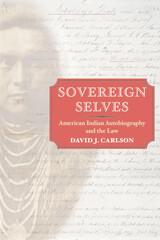
front cover of Sovereign Selves
Sovereign Selves
American Indian Autobiography and the Law
David J. Carlson
University of Illinois Press, 2005
This book is an exploration of how American Indian autobiographers' approaches to writing about their own lives have been impacted by American legal systems from the Revolutionary War until the 1920s. Historically, Native American autobiographers have written in the shadow of "Indian law," a nuanced form of natural law discourse with its own set of related institutions and forms (the reservation, the treaty, etc.). In Sovereign Selves, David J. Carlson develops a rigorously historicized argument about the relationship between the specific colonial model of "Indian" identity that was developed and disseminated through U.S. legal institutions, and the acts of autobiographical self-definition by the "colonized" Indians expected to fit that model.

Carlson argues that by drawing on the conventions of early colonial treaty-making, nineteenth- and early twentieth-century Indian autobiographers sought to adapt and redefine the terms of Indian law as a way to assert specific property-based and civil rights. Focusing primarily on the autobiographical careers of two major writers (William Apess and Charles Eastman), Sovereign Selves traces the way that their sustained engagement with colonial legal institutions gradually enabled them to produce a new rhetoric of "Indianness."

[more]


Send via email Share on Facebook Share on Twitter