front cover of For Emplacement
For Emplacement
Political Ontology in Two Acts
Mario Blaser
Duke University Press, 2025
In For Emplacement, Mario Blaser proposes a new lens for contending with the momentous challenges facing the world, from anthropogenic climate change to rampant socioeconomic inequalities to the rise of neofascism. Blaser shows that the prevalent solutions to these problems—which often depend on intensifying globalization, technological development, and extractivism—only deepen these crises. Effectively addressing these issues, he suggests, might require grounding our ways of being in the specificities of place. Drawing on decades of ethnographic experience in South America and the Canadian subarctic, and engaging with material semiotics, Blaser recasts the fundamental political question of how to live together well as a cosmopolitical one: how to become emplaced with others, in divergence. Ultimately, he presents a political ontology where visions of the good life oriented to the specificities of place guide us through the promises and challenges that a journey toward emplacement holds.
[more]


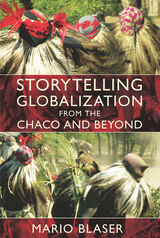
front cover of Storytelling Globalization from the Chaco and Beyond
Storytelling Globalization from the Chaco and Beyond
Mario Blaser
Duke University Press, 2010
For more than fifteen years, Mario Blaser has been involved with the Yshiro people of the Paraguayan Chaco as they have sought to maintain their world in the face of conservation and development programs promoted by the state and various nongovernmental organizations. In this ethnography of the encounter between modernizing visions of development, the place-based “life projects” of the Yshiro, and the agendas of scholars and activists, Blaser argues for an understanding of the political mobilization of the Yshiro and other indigenous peoples as part of a struggle to make the global age hospitable to a “pluriverse” containing multiple worlds or realities. As he explains, most knowledge about the Yshiro produced by non-indigenous “experts” has been based on modern Cartesian dualisms separating subject and object, mind and body, and nature and culture. Such thinking differs profoundly from the relational ontology enacted by the Yshiro and other indigenous peoples. Attentive to people’s unique experiences of place and self, the Yshiro reject universal knowledge claims, unlike Western modernity, which assumes the existence of a universal reality and refuses the existence of other ontologies or realities. In Storytelling Globalization from the Chaco and Beyond, Blaser engages in storytelling as a knowledge practice grounded in a relational ontology and attuned to the ongoing struggle for a pluriversal globality.
[more]


Send via email Share on Facebook Share on Twitter