
 A SCHOLARLY BOOK REPOSITORY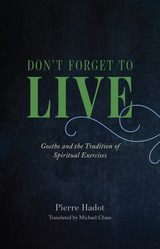
With a foreword by Arnold I. Davidson and Daniele Lorenzini.
In his final book, renowned philosopher Pierre Hadot explores Goethe’s relationship with ancient spiritual exercises—transformative acts of intellect, imagination, or will. Goethe sought both an intense experience of the present moment as well as a kind of cosmic consciousness, both of which are rooted in ancient philosophical practices. These practices shaped Goethe’s audacious contrast to the traditional maxim memento mori (Don’t forget that you will die) with the aim of transforming our ordinary consciousness. Ultimately, Hadot reveals how Goethe cultivated a deep love for life that brings to the forefront a new maxim: Don’t forget to live.

The Meditations of Marcus Aurelius are treasured today—as they have been over the centuries—as an inexhaustible source of wisdom. And as one of the three most important expressions of Stoicism, this is an essential text for everyone interested in ancient religion and philosophy. Yet the clarity and ease of the work’s style are deceptive. Pierre Hadot, eminent historian of ancient thought, uncovers new levels of meaning and expands our understanding of its underlying philosophy.
Written by the Roman emperor for his own private guidance and self-admonition, the Meditations set forth principles for living a good and just life. Hadot probes Marcus Aurelius’s guidelines and convictions and discerns the hitherto unperceived conceptual system that grounds them. Abundantly quoting the Meditations to illustrate his analysis, the author allows Marcus Aurelius to speak directly to the reader. And Hadot unfolds for us the philosophical context of the Meditations, commenting on the philosophers Marcus Aurelius read and giving special attention to the teachings of Epictetus, whose disciple he was.
The soul, the guiding principle within us, is in Marcus Aurelius’s Stoic philosophy an inviolable stronghold of freedom, the “inner citadel.” This spirited and engaging study of his thought offers a fresh picture of the fascinating philosopher-emperor, a fuller understanding of the tradition and doctrines of Stoicism, and rich insight on the culture of the Roman empire in the second century. Pierre Hadot has been working on Marcus Aurelius for more than twenty years; in this book he distills his analysis and conclusions with extraordinary lucidity for the general reader.
Cult classics.
Orpheus is familiar from Greek mythology as a peerless bard, the Thracian son of a Muse with superhuman musical abilities that enabled him to win the release of his young wife Eurydice from Hades, only to lose her on the way back. But he was also considered an authentic poet preceding Hesiod and Homer and on a par with Musaeus, and was credited with poems, oracles, and the foundation of rituals in a tradition that remained vital and creative from Archaic Greece through to the Roman Empire and beyond. Essentially Dionysiac, but without the violence and blood sacrifice, and with a focus on theogony, cosmogony, and the origin and destiny of souls, Orphism was at once a distinctive and an open tradition, with significant change and development over time but with features that made the works and rituals cumulatively attributed to Orpheus identifiable to followers. This tradition endowed them with a lasting coherence despite the absence of dogma or control by priests or cult. Although Orphism departed in profound and fascinating ways from conventional accounts, it proved highly adaptable to various religious and philosophical systems, especially Pythagorean and Neoplatonist but also Judaic and Christian.
This edition collects works representing the most ancient Orphic literature, excluding later mythological, scientific, and pseudo-scientific poems opportunistically attributed to him.
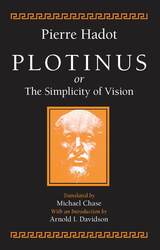
Pierre Hadot's lively philosophical portrait of Plotinus is the preeminent introduction to the man and his thought. Michael Chase's lucid translation—complete with a useful chronology and analytical bibliography—at last makes this book available to the English-speaking world.
Hadot carefully examines Plotinus's views on the self, existence, love, virtue, gentleness, and solitude. He shows that Plotinus, like other philosophers of his day, believed that Plato and Aristotle had already articulated the essential truths; for him, the purpose of practicing philosophy was not to profess new truths but to engage in spiritual exercises so as to live philosophically. Seen in this light, Plotinus's counsel against fixation on the body and all earthly matters stemmed not from disgust or fear, but rather from his awareness of the negative effect that bodily preoccupation and material concern could have on spiritual exercises.

Alfred North Whitehead has never gone out of print, but for a time he was decidedly out of fashion in the English-speaking world. In a splendid work that serves as both introduction and erudite commentary, Isabelle Stengers—one of today’s leading philosophers of science—goes straight to the beating heart of Whitehead’s thought. The product of thirty years’ engagement with the mathematician-philosopher’s entire canon, this volume establishes Whitehead as a daring thinker on par with Gilles Deleuze, Felix Guattari, and Michel Foucault.
Reading the texts in broadly chronological order while highlighting major works, Stengers deftly unpacks Whitehead’s often complicated language, explaining the seismic shifts in his thinking and showing how he called into question all that philosophers had considered settled after Descartes and Kant. She demonstrates that the implications of Whitehead’s philosophical theories and specialized knowledge of the various sciences come yoked with his innovative, revisionist take on God. Whitehead’s God exists within a specific epistemological realm created by a radically complex and often highly mathematical language.
“To think with Whitehead today,” Stengers writes, “means to sign on in advance to an adventure that will leave none of the terms we normally use as they were.”

Nearly twenty-five hundred years ago the Greek thinker Heraclitus supposedly uttered the cryptic words "Phusis kruptesthai philei." How the aphorism, usually translated as "Nature loves to hide," has haunted Western culture ever since is the subject of this engaging study by Pierre Hadot. Taking the allegorical figure of the veiled goddess Isis as a guide, and drawing on the work of both the ancients and later thinkers such as Goethe, Rilke, Wittgenstein, and Heidegger, Hadot traces successive interpretations of Heraclitus' words. Over time, Hadot finds, "Nature loves to hide" has meant that all that lives tends to die; that Nature wraps herself in myths; and (for Heidegger) that Being unveils as it veils itself. Meanwhile the pronouncement has been used to explain everything from the opacity of the natural world to our modern angst.
From these kaleidoscopic exegeses and usages emerge two contradictory approaches to nature: the Promethean, or experimental-questing, approach, which embraces technology as a means of tearing the veil from Nature and revealing her secrets; and the Orphic, or contemplative-poetic, approach, according to which such a denuding of Nature is a grave trespass. In place of these two attitudes Hadot proposes one suggested by the Romantic vision of Rousseau, Goethe, and Schelling, who saw in the veiled Isis an allegorical expression of the sublime. "Nature is art and art is nature," Hadot writes, inviting us to embrace Isis and all she represents: art makes us intensely aware of how completely we ourselves are not merely surrounded by nature but also part of nature.

A magisterial mappa mundi of the terrain that Pierre Hadot has so productively worked for decades, this ambitious work revises our view of ancient philosophy—and in doing so, proposes that we change the way we see philosophy itself. Hadot takes ancient philosophy out of its customary realm of names, dates, and arid abstractions and plants it squarely in the thick of life. Through a meticulous historical reading, he shows how the various schools, trends, and ideas of ancient Greek and Roman philosophy all tended toward one goal: to provide a means for achieving happiness in this life, by transforming the individual’s mode of perceiving and being in the world.
Most pressing for Hadot is the question of how the ancients conceived of philosophy. He argues in great detail, systematically covering the ideas of the earliest Greek thinkers, Hellenistic philosophy, and late antiquity, that ancient philosophers were concerned not just to develop philosophical theories, but to practice philosophy as a way of life—a way of life to be suggested, illuminated, and justified by their philosophical “discourse.” For the ancients, philosophical theory and the philosophical way of life were inseparably linked.
What Is Ancient Philosophy? also explains why this connection broke down, most conspicuously in the case of academic, professional philosophers, especially under the influence of Christianity. Finally, Hadot turns to the question of whether and how this connection might be reestablished. Even as it brings ancient thoughts and thinkers to life, this invigorating work provides direction for those who wish to improve their lives by means of genuine philosophical thought.
READERS
Browse our collection.
PUBLISHERS
See BiblioVault's publisher services.
STUDENT SERVICES
Files for college accessibility offices.
RECENTLY PUBLISHED




UChicago Accessibility Resources
home | accessibility | search | about | contact us
BiblioVault ® 2001 - 2025
The University of Chicago Press