
 A SCHOLARLY BOOK REPOSITORY
4 start with A start with A

Matthew Smith asserts that those scientific conclusions were, in fact, flawed. An Alternative History of Hyperactivity explores the origins of the Feingold diet, revealing why it became so popular, and the ways in which physicians, parents, and the public made decisions about whether it was a valid treatment for hyperactivity. Arguing that the fate of Feingold's therapy depended more on cultural, economic, and political factors than on the scientific protocols designed to test it, Smith suggests the lessons learned can help resolve medical controversies more effectively.
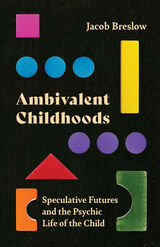
Explores childhood in relation to blackness, transfeminism, queerness, and deportability to interrogate what “the child” makes possible
The concept of childhood contains many contested and ambivalent meanings that have extraordinary implications, particularly for those staking their claim for belonging and justice on the wish for inclusion within it. In Ambivalent Childhoods, Jacob Breslow examines contemporary U.S. social justice movements (including Black Lives Matter, transfeminism, queer youth activism, and antideportation movements) to discover and reveal how childhood operates within and against them.
Ambivalent Childhoods brings together critical race, trans, feminist, queer, critical migration, and psychoanalytic theories to explore the role of childhood in shaping and challenging the disposability of young black life, the steadfastness of the gender binary, the queer life of children’s desires, and the precarious status of migrants. Through an engagement with“the psychic life of the child” that combines theoretical discussions of childhood, blackness, transfeminism, and deportability with critical readings of films, narrative, images, and social justice movements, Breslow demonstrates how childhood requires sustained attention as a complex and ambivalent site for contesting the workings of power, not only for the young.
Ambivalent Childhoods is a forward-thinking and intersectional analysis of how childhood affects activism, national belonging, and the violence directed against queer, trans, and racialized people.
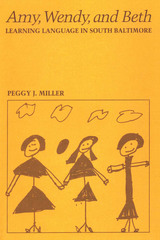
Amy, Wendy, and Beth, the 1980 recipient of the New York Academy of Sciences Edward Sapir Award, is a lively in-depth study of how three young children from an urban working-class community learned language under everyday conditions. It is a sensitive portrayal of the children and their families and offers an innovative approach to the study of language development and social class.
A major conclusion of the study is that the linguistic abilities of working-class children are consistent with previous cross-cultural accounts of the development of communicational skills and, as such, lend no support to past claims that children from the lower classes are linguistically deprived. Instead, Amy, Wendy, and Beth emerge as able and enthusiastic language learners; their families, as caring and competent partners in the language socialization process.
Sound scholarship and original findings about a hitherto neglected population of children lend special value to this work not only for scholars in psychology, linguistics, and anthropology, but for educators and policymakers as well.

What can the study of young monkeys and apes tell us about the minds of young humans? In this fascinating introduction to the study of primate minds, Juan Carlos Gómez identifies evolutionary resemblances—and differences—between human children and other primates. He argues that primate minds are best understood not as fixed collections of specialized cognitive capacities, but more dynamically, as a range of abilities that can surpass their original adaptations.
In a lively overview of a distinguished body of cognitive developmental research among nonhuman primates, Gómez looks at knowledge of the physical world, causal reasoning (including the chimpanzee-like errors that human children make), and the contentious subjects of ape language, theory of mind, and imitation. Attempts to teach language to chimpanzees, as well as studies of the quality of some primate vocal communication in the wild, make a powerful case that primates have a natural capacity for relatively sophisticated communication, and considerable power to learn when humans teach them.
Gómez concludes that for all cognitive psychology’s interest in perception, information processing, and reasoning, some essential functions of mental life are based on ideas that cannot be explicitly articulated. Nonhuman and human primates alike rely on implicit knowledge. Studying nonhuman primates helps us to understand this perplexing aspect of all primate minds.
READERS
Browse our collection.
PUBLISHERS
See BiblioVault's publisher services.
STUDENT SERVICES
Files for college accessibility offices.
RECENTLY PUBLISHED




UChicago Accessibility Resources
home | accessibility | search | about | contact us
BiblioVault ® 2001 - 2025
The University of Chicago Press