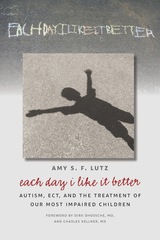
front cover of Each Day I Like It Better
Each Day I Like It Better
Autism, ECT, and the Treatment of Our Most Impaired Children
Amy S. F. Lutz
Vanderbilt University Press, 2014
In the fall of 2009, Amy Lutz and her husband, Andy, struggled with one of the worst decisions parents could possibly face: whether they could safely keep their autistic ten-year-old son, Jonah, at home any longer. Multiple medication trials, a long procession of behavior modification strategies, and even an almost year-long hospitalization had all failed to control his violent rages. Desperate to stop the attacks that endangered family members, caregivers, and even Jonah himself, Amy and Andy decided to try the controversial procedure of electroconvulsive therapy or ECT. Over the last three years, Jonah has received 136 treatments. His aggression has greatly diminished, and for the first time Jonah, now fourteen, is moving to a less restricted school.


Each Day I Like It Better recounts the journeys of Jonah and seven other children and their families (interviewed by the author) in their quests for appropriate educational placements and therapeutic interventions. The author describes their varied, but mostly successful, experiences with ECT.


A survey of research on pediatric ECT is incorporated into the narrative, and a foreword by child psychiatrist Dirk Dhossche and ECT researcher and practitioner Charles Kellner explains how ECT works, the side effects patients may experience, and its current use in the treatment of autism, catatonia, and violent behavior in children.


[more]

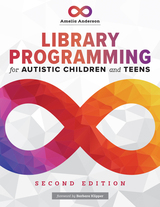
front cover of Library Programming for Autistic Children and Teens
Library Programming for Autistic Children and Teens
Amelia Anderson and Barbara Klipper
American Library Association, 2021
Foreword by Barbara Klipper

Since the first edition of this landmark guide was published, there has been increased interest in services for library patrons on the autism spectrum; indeed, more people of all ages now self-identify as autistic. Those who understand the unique characteristics of autistic young people know that ordinary library programming guides are not up to the task of effectively serving these library users. Well qualified to speak to this need, Anderson is an educator, library researcher, and former public librarian who has helped to develop two IMLS funded initiatives that train library workers to better understand and serve autistic patrons. Here, she offers librarians who work with children and teens in both public library and K-12 educational settings an updated, comprehensive resource that includes

  • an updated introduction to the basics of autism, including language, symbolism, and best practices in the library rooted in the principles of Universal Design;
  • step-by-step programs from librarians across the country, adaptable for both public and school library settings, that are cost-effective and easy to replicate;
  • contributions from autistic self-advocates throughout the text, demonstrating that the program ideas included are truly designed with their preferences in mind;
  • suggestions for securing funding and establishing partnerships with community organizations; and
  • many helpful appendices, with handy resources for training and education, building a collection, storytimes, sensory integration activities, and a “Tips for a Successful Library Visit” template.
[more]

logo for American Library Association
Library Services for Youth with Autism Spectrum Disorders
Lesley S. J. Farmer
American Library Association, 2013

logo for American Library Association
Programming for Children and Teens with Autism Spectrum Disorder
Barbara Klipper
American Library Association, 2014


Send via email Share on Facebook Share on Twitter