
 A SCHOLARLY BOOK REPOSITORY
9 start with A start with A

Described as “all under Heaven,” the Chinese empire might have extended infinitely, covering all worlds and cultures. That ideology might have been convenient for the state, but what did late imperial people really think about the scope and limits of the human community?
Writers of late imperial fiction and drama were, the author argues, deeply engaged with questions about the nature of the Chinese empire and of the human community. Fiction and drama repeatedly pose questions concerning relations both among people and between people and their possessions: What ties individuals together, whether permanently or temporarily? When can ownership be transferred, and when does an object define its owner? What transforms individual families or couples into a society?
Tina Lu traces how these political questions were addressed in fiction through extreme situations: husbands and wives torn apart in periods of political upheaval, families so disrupted that incestuous encounters become inevitable, times so desperate that people have to sell themselves to be eaten.
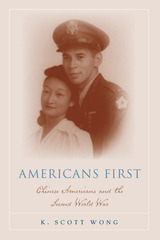
In Americans First, K. Scott Wong uses archival research and oral histories to provide the first detailed account of Chinese Americans in the American military. Wong traces the history of the 14th Air Service Group, a segregated outfit of Chinese Americans sent to China in support of the American Army Air Corps and the Chinese Air Force. His ethnic history of inclusion shows how this new generation of Chinese Americans was more socially accepted, moving from the margins of society into the American mainstream during a time of pervasive racism.
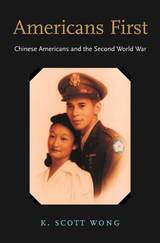
World War II was a watershed event for many of America's minorities, but its impact on Chinese Americans has been largely ignored. Utilizing extensive archival research as well as oral histories and letters from over one hundred informants, K. Scott Wong explores how Chinese Americans carved a newly respected and secure place for themselves in American society during the war years.
Long the victims of racial prejudice and discriminatory immigration practices, Chinese Americans struggled to transform their image in the nation's eyes. As Americans racialized the Japanese enemy abroad and interned Japanese Americans at home, Chinese citizens sought to distinguish themselves by venturing beyond the confines of Chinatown to join the military and various defense industries in record numbers. Wong offers the first in-depth account of Chinese Americans in the American military, tracing the history of the 14th Air Service Group, a segregated unit comprising over 1,200 men, and examining how their war service contributed to their social mobility and the shaping of their ethnic identity.
Americans First pays tribute to a generation of young men and women who, torn between loyalties to their parents' traditions and their growing identification with America and tormented by the pervasive racism of wartime America, served their country with patriotism and courage. Consciously developing their image as a "model minority," often at the expense of the Japanese and Japanese Americans, Chinese Americans created the pervasive image of Asian Americans that still resonates today.
This volume explores commercial relations between the United States and China from the eighteenth century until 1949, fleshing out with facts the romantic and shadowy image of "the China trade." These nine chapters by specialists in the field have developed from papers they presented at a conference supported by the national Committee on American-East Asian Relations.
The work begins with an Introduction by John K. Fairbank, then moves on to analysis of the old China trade up to the American Civil War, centering on traditional Chinese exports of tea and silk. A second section deals with American imports into China--cotton textiles and textile-related goods, cigarettes, kerosene. Finally, the impact of the trade on both countries is assessed and the operations of American-owned and multinational companies in China are examined. For both the United States and China, the economic importance of the trade proves to have been less than the legend might suggest.
During the Cultural Revolution, Mao exhorted the Chinese people to “smash the four olds”: old customs, old culture, old habits, and old ideas. Yet when the Red Guards in Tiananmen Square chanted “We want to see Chairman Mao,” they unknowingly used a classical rhythm that dates back to the Han period and is the very embodiment of the four olds. An Anatomy of Chinese reveals how rhythms, conceptual metaphors, and political language convey time-honored meanings of which Chinese speakers themselves may not be consciously aware, and contributes to the ongoing debate over whether language shapes thought, or vice versa.
Perry Link’s inquiry into the workings of Chinese reveals convergences and divergences with English, most strikingly in the area of conceptual metaphor. Different spatial metaphors for consciousness, for instance, mean that English speakers wake up while speakers of Chinese wake across. Other underlying metaphors in the two languages are similar, lending support to theories that locate the origins of language in the brain. The distinction between daily-life language and official language has been unusually significant in contemporary China, and Link explores how ordinary citizens learn to play language games, artfully wielding officialese to advance their interests or defend themselves from others.
Particularly provocative is Link’s consideration of how Indo-European languages, with their preference for abstract nouns, generate philosophical puzzles that Chinese, with its preference for verbs, avoids. The mind-body problem that has plagued Western culture may be fundamentally less problematic for speakers of Chinese.
Ancestors, Kings, and the Dao outlines the evolution of musical performance in early China, first within and then ultimately away from the socio-religious context of ancestor worship. Examining newly discovered bamboo texts from the Warring States period, Constance A. Cook compares the rhetoric of Western Zhou (1046–771 BCE) and Spring and Autumn (770–481 BCE) bronze inscriptions with later occurrences of similar terms in which ritual music began to be used as a form of self-cultivation and education. Cook’s analysis links the creation of such classics as the Book of Odes with the ascendance of the individual practitioner, further connecting the social actors in three types of ritual: boys coming of age, heirs promoted into ancestral government positions, and the philosophical stages of transcendence experienced in self-cultivation.
The focus of this study is on excavated texts; it is the first to use both bronze and bamboo narratives to show the evolution of a single ritual practice. By viewing the ancient inscribed materials and the transmitted classics from this new perspective, Cook uncovers new linkages in terms of how the materials were shaped and reshaped over time and illuminates the development of eulogy and song in changing ritual contexts.
Anecdote, Network, Gossip, Performance is a study of the Shishuo xinyu, the most important anecdotal collection of medieval China—and arguably of the entire traditional era. In a set of interconnected essays, Jack W. Chen offers new readings of the Shishuo xinyu that draw upon social network analysis, performance studies, theories of ritual and mourning, and concepts of gossip and reputation to illuminate how the anecdotes of the collection imagine and represent a political and cultural elite. Whereas most accounts of the Shishuo have taken a historical approach, Chen argues that the work should be understood in literary terms.
At its center, Anecdote, Network, Gossip, Performance is an extended meditation on the very nature of the anecdote form, both what the anecdote affords in terms of representing a social community and how it provides a space for the rehearsal of certain longstanding philosophical and cultural arguments. Although each of the chapters may be read separately as an essay in its own right, when taken together, they present a comprehensive account of the Shishuo in all of its literary complexity.
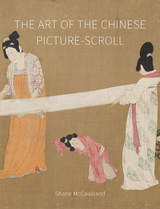
The Chinese picture-scroll, a long, horizontal painting or calligraphic work, has been China’s pre-eminent aesthetic form throughout the last two millennia. This first history of the picture-scroll explores its extraordinary longevity and adaptability to social, political, and technological change. The book describes what the picture-scroll demands of a viewer, how China’s artists grappled with its cultural power, and how collectors and connoisseurs left their marks on scrolls for later generations to judge.
READERS
Browse our collection.
PUBLISHERS
See BiblioVault's publisher services.
STUDENT SERVICES
Files for college accessibility offices.
RECENTLY PUBLISHED


UChicago Accessibility Resources
home | accessibility | search | about | contact us
BiblioVault ® 2001 - 2024
The University of Chicago Press