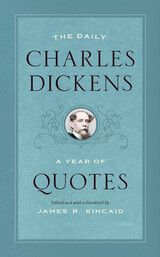
front cover of The Daily Charles Dickens
The Daily Charles Dickens
A Year of Quotes
Charles Dickens
University of Chicago Press, 2018
A charming memento of the Victorian era’s literary colossus, The Daily Charles Dickens is a literary almanac for the ages. Tenderly and irreverently anthologized by Dickens scholar James R. Kincaid, this collection mines the British author’s beloved novels and Christmas stories as well as his lesser-known sketches and letters for “an around-the-calendar set of jolts, soothings, blandishments, and soarings.”

A bedside companion to dip into year round, this book introduces each month with a longer seasonal quote, while concise bits of wisdom and whimsy mark each day. Hopping gleefully from Esther Summerson’s abandonment by her mother in Bleak House to a meditation on the difficult posture of letter-writing in The Pickwick Papers, this anthology displays the wide range of Dickens’s stylistic virtuosity—his humor and his deep tragic sense, his ear for repetition, and his genius at all sorts of voices. Even the devotee will find between these pages a mix of old friends and strangers—from Oliver Twist and Ebenezer Scrooge to the likes of Lord Coodle, Sir Thomas Doodle, Mrs. Todgers, and Edwin Drood—as well as a delightful assortment of the some of the novelist’s most famous, peculiar, witty, and incisive passages, tailored to fit the season. To give one particularly apt example: David Copperfield blunders, in a letter of apology to Agnes Wickfield, “I began one note, in a six-syllable line, ‘Oh, do not remember’—but that associated itself with the fifth of November, and became an absurdity.”

Never Pecksniffian or Gradgrindish, this daily dose of Dickens crystallizes the novelist’s agile humor and his reformist zeal alike. This is a book to accompany you through the best of times and the worst of times.
 
[more]

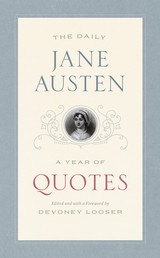
front cover of The Daily Jane Austen
The Daily Jane Austen
A Year of Quotes
Jane Austen
University of Chicago Press, 2019
It is a truth universally acknowledged that Jane Austen is eminently, delightfully, and delectably quotable. This truth goes far beyond the first line of Pride and Prejudice, which has muscled out many other excellent sentences. So many gems of wit and wisdom from her novels deserve to be better known, from Northanger Abbey on its lovable, naive heroine—“if adventures will not befal a young lady in her own village, she must seek them abroad”—to Persuasion’s moving lines of love from its regret-filled hero: “You pierce my soul. I am half agony, half hope. Tell me not that I am too late.”
 
Devoney Looser, a.k.a. Stone Cold Jane Austen, has drawn 378 genuine, Austen-authored passages from across the canon, resulting in an anthology that is compulsively readable and repeatable. Whether you approach the collection on a one-a-day model or in a satisfying binge read, you will emerge wiser about Austen, if not about life. The Daily Jane Austen will amuse and inspire skeptical beginners, Janeite experts, and every reader in between by showcasing some of the greatest sentences ever crafted in the history of fiction.
[more]

front cover of Daisy
Daisy
Poems
Rachel Feder
Northwestern University Press, 2025

A narrative-poetic retelling of The Great Gatsby from the perspective of a 1990s teen poet
 
Daisy: Poems is a captivating and imaginative take on The Great Gatsby that puts F. Scott Fitzgerald’s 1925 classic in the hands of a messy, ambitious, and possibly devious teen poet. From her privileged yet precarious perch in the roaring 1990s, Daisy navigates the expectations of her parents, boyfriend, and lover, alongside her own artistic ambitions, as she explores whether freedom is what she truly desires—and wonders if it’s even possible. Rachel Feder puts a new spin on beloved characters: Jay, longtime and secret lover; Nick, somewhat mysterious and always meddling cousin; and Jordyn, best friend and companion in doomed relationships. A meditation on juvenilia, constructions of femininity, the purity myth, and canonical literary silences, Daisy is told in sparse, evocative verse that pulsates with youthful passion and offers a new elegy for our lost American dreams.

[more]

front cover of A Dance to the Music of Time
A Dance to the Music of Time
First Movement
Anthony Powell
University of Chicago Press, 1995
Read the novel that is #43 on the Modern Library's 100 Best of the 20th Century list and the Guardian called "a comic masterpiece" and the New York Times praised as "immensely entertaining."

A Dance to the Music of Time is a landmark work of fiction, praised by readers and critics and other novelists throughout the 75 years since the first volume was published. Equal parts funny and heartbreaking, clever and moving, Anthony Powell's universally acclaimed epic encompasses a four-volume panorama of twentieth century London.

Hailed by Time as "brilliant literary comedy as well as a brilliant sketch of the times," A Dance to the Music of Time opens just after World War I and carries through the 1950s, with all the changes of society, characters, and relationships that those shifting eras bring.

Four very different young men on the threshold of manhood dominate this opening volume of A Dance to the Music of Time. The narrator, Jenkins—a budding writer—shares a room with Templer, already a passionate womanizer, and Stringham, aristocratic and reckless. Widmerpool, as hopelessly awkward as he is intensely ambitious, lurks on the periphery of their world. Amid the fever of the 1920s and the first chill of the 1930s, these four gain their initiations into sex, society, business, and art. A masterpiece of modern fiction, Powell's epic creates a rich portrait of life in England between the wars.

"Reading Powell," says the New York Times, "is like living someone else's life, inextricably entangled with your own." Give this first volume a try, and you'll find characters and scenes and insights that will stay with you for the rest of your life.

Includes these novels:
A Question of Upbringing
A Buyer's Market
The Acceptance World
 
[more]

front cover of A Dance to the Music of Time
A Dance to the Music of Time
Fourth Movement
Anthony Powell
University of Chicago Press, 1995
Read the novel that is #43 on the Modern Library's 100 Best of the 20th Century list and the Guardian called "a comic masterpiece" and the New York Times praised as "immensely entertaining."

A Dance to the Music of Time is a landmark work of fiction, praised by readers and critics and other novelists throughout the 75 years since the first volume was published. Equal parts funny and heartbreaking, clever and moving, Anthony Powell's universally acclaimed epic encompasses a four-volume panorama of twentieth century London. Hailed by Time as "brilliant literary comedy as well as a brilliant sketch of the times," A Dance to the Music of Time opens just after World War I and carries through the 1950s, with all the changes to society, character, and relationships those shifting eras bring.

In this final volume of A Dance to the Music of Time, Nick Jenkins describes a world of ambition, intrigue, and dissolution. England has won the war, but its costs, physical and moral, were vast. Widmerpool's wife sets a snare for the young writer X. Trapnel, while her husband suffers private agony and public humiliation. Set against a background of politics, business, high society, and the counterculture in England and Europe, this magnificent work of art sounds an unforgettable requiem for an age.

"Reading Powell," says the New York Times, "is like living someone else's life, inextricably entangled with your own." Give this first volume a try, and you'll find characters and scenes and insights that will stay with you for the rest of your life.

Includes these novels:
Books Do Furnish a Room
Temporary Kings
Hearing Secret Harmonies
 
[more]

front cover of A Dance to the Music of Time
A Dance to the Music of Time
Second Movement
Anthony Powell
University of Chicago Press, 1995
Read the novel that is #43 on the Modern Library's 100 Best of the 20th Century list and the Guardian called "a comic masterpiece" and the New York Times praised as "immensely entertaining."

A Dance to the Music of Time is a landmark work of fiction, praised by readers and critics and other novelists throughout the 75 years since the first volume was published. Equal parts funny and heartbreaking, clever and moving, Anthony Powell's universally acclaimed epic encompasses a four-volume panorama of twentieth century London. Hailed by Time as "brilliant literary comedy as well as a brilliant sketch of the times," A Dance to the Music of Time opens just after World War I and continues through the 1950s.

In the background of this second volume of A Dance to the Music of Time, the rumble of distant events in Germany and Spain presages the storm of World War II. In England, even as the whirl of marriages and adulteries, fashions and frivolities, personal triumphs and failures gathers speed, men and women find themselves on the brink of fateful choices.

"Reading Powell," says the New York Times, "is like living someone else's life, inextricably entangled with your own." Give this first volume a try, and you'll find characters and scenes and insights that will stay with you for the rest of your life


Includes these novels:
At Lady Molly's
Casanova's Chinese Restaurant
The Kindly Ones
[more]

front cover of A Dance to the Music of Time
A Dance to the Music of Time
Third Movement
Anthony Powell
University of Chicago Press, 1995
Read the novel that is #43 on the Modern Library's 100 Best of the 20th Century list and the Guardian called "a comic masterpiece" and the New York Times praised as "immensely entertaining."

A Dance to the Music of Time is a landmark work of fiction, praised by readers and critics and other novelists throughout the 75 years since the first volume was published. Equal parts funny and heartbreaking, clever and moving, Anthony Powell's universally acclaimed epic encompasses a four-volume panorama of twentieth century London. Hailed by Time as "brilliant literary comedy as well as a brilliant sketch of the times," A Dance to the Music of Time opens just after World War I and continues through the 1950s and all the changes to life, society, and relationships those shifting eras bring. 

In this third volume of A Dance to the Music of Time, we again meet Widmerpool, doggedly rising in rank; Jenkins, shifted from one dismal army post to another; Stringham, heroically emerging from alcoholism; Templer, still on his eternal sexual quest. Here, too, we are introduced to Pamela Flitton, one of the most beautiful and dangerous women in modern fiction. Wickedly barbed in its wit, uncanny in its seismographic recording of human emotions and social currents, this saga stands as an unsurpassed rendering of England's finest yet most costly hour.

"Reading Powell," says the New York Times, "is like living someone else's life, inextricably entangled with your own." Give Dance a try, and you'll find characters and scenes and insights that will stay with you for the rest of your life.

Includes these novels:
The Valley of Bones
The Soldier's Art
The Military Philosophers
[more]

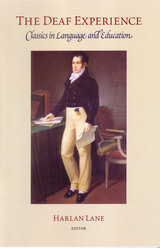
front cover of The Deaf Experience
The Deaf Experience
Classics in Language and Education
Harlan Lane
Gallaudet University Press, 2006
The seminal study of the antecedents of Deaf culture is now back in print. Edited by renowned scholar Harlan Lane, The Deaf Experience: Classics in Language and Education presents a selection of the earliest essays written by members of the nascent French Deaf community at the time of the Enlightenment, a rich period of education for deaf people.

The fifth volume in the Gallaudet Classics in Deaf Studies series features works written from 1764 up to1840. Pierre Desloges offers a stirring paean to sign language in an excerpt from his book, the first ever published by a deaf person. Saboureux de Fontenay and Jean Massieu, two prominent leaders, relate their respective experiences in autobiographical accounts. In separate essays, Charles-Michel de l’Epée and Roch-Ambroise Sicard describe systems for teaching manual French, followed by a critique of these methods by Roch-Ambroise Bébian, a well-known hearing friend of Deaf people during that era. Ferdinand Berthier, a renowned Deaf teacher and writer in the 19th century, concludes with a history of Deaf people up to that time.

The Deaf Experience shows clearly how this extraordinary era of French deaf education influenced the adoption of the manual method by the first schools for deaf students in America, in sharp contrast to the oral movement that repressed sign-language-centered education for nearly a century afterward. Deaf studies scholars and students alike will welcome the return of this invaluable resource.

[more]

logo for Harvard University Press
The Deaf Experience
Classics in Language and Education
Harlan Lane
Harvard University Press, 1984

front cover of The Deerslayer
The Deerslayer
James Fenimore Cooper
Harvard University Press, 2013

Though The Deerslayer (1841) was the last of Cooper’s five Leather-stocking tales to be written, it is the first in the chronology of Natty Bumppo’s life. Set in the 1740s before the start of the French and Indian War, when Cooper’s rugged frontiersman is in his twenties, Cooper’s novel shows us how “Deerslayer” becomes “Hawkeye.” It remains the best point of entry into the series for modern readers.

In his introduction, Ezra Tawil examines Cooper’s motivations in writing The Deerslayer, the static nature of Natty, and Cooper’s vexed racial politics. The John Harvard Library edition reproduces the authoritative text of The Deerslayer in The Writings of James Fenimore Cooper (State University of New York Press).

Since 1959 The John Harvard Library has been instrumental in publishing essential American writings in authoritative editions.

[more]

logo for Ohio University Press
Digenis Akritas
The Two-Blood Border Lord—The Grottaferrata Version
Denison B. Hull
Ohio University Press, 1986

Among the epic romances of post–Barbarian Europe, such as Roland and El Cid, Digenis Akritas has been the least known in the West—outside Greece. It is the story of a half-breed prince who guarded the eastern border of the Roman Empire of Byzantium on the Euphrates in the tenth century. His name and cognomen, Basil, the Two–Blood Border Lord, sum up the curious richness of his heritage: Roman by politics, Arab and Cappadocian by birth, Greek in language, and orthodox by faith.

On an incursion into Byzantine territory, an Arab Emir captures a Christian woman. Her relatives, in raiding to rescue her, convert the Emir and his people to Christianity and bring them back to the empire. Basil is born of this union. A prodigy of valor, his miraculous strength in hunting and in battle win him an Arab bride and the loyalty of her family. He settles in a splendid garden palace by the Euphrates, pacifies the Border, fights dragons and bandits only to die young at the same instant as his wife.

The poem in English verse translation is full of humor, fairytale, and a moving religious devotion. It recaptures an urbane vanished civilization.

The translator has collated all the known texts and supports the translation with commentary, a bibliography, and a map.
[more]

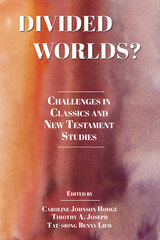
front cover of Divided Worlds? Challenges in Classics and New Testament Studies
Divided Worlds? Challenges in Classics and New Testament Studies
Caroline Johnson Hodge
SBL Press, 2023

This volume brings together scholars from New Testament studies and classics, whose fields of study have much in common but are not often in in conversation. The contributors explore how the ancient works they study can be resources for thinking critically and creatively about issues that matter today. The essays address our obligation to take positive moral stands on divisive issues of both the past and the present, including empire, racial/ethnic and religious difference, economic inequality, gender and sexuality, slavery, and disability. Contributors include Douglas Boin, Denise Kimber Buell, Gay L. Byron, Allen Dwight Callahan, Joy Connolly, Jennifer A. Glancy, Shelley P. Haley, Caroline Johnson Hodge, Katherine Lu Hsu, Timothy Joseph, Tat-siong Benny Liew, Yii-Jan Lin, Dominic Machado, Joseph A. Marchal, Thomas R. Martin, Candida R. Moss, Laura Salah Nasrallah, Jorunn Økland, and Abraham Smith.

[more]

logo for Central European University Press
The Doll
Boleslaw Prus
Central European University Press, 1997

The city of Warsaw, under Russian rule in the late 1870s, is the setting for this story. The middle-aged hero, Wokulski, bold and successful in business, is being destroyed by his obsessive love for the frigid, aristocratic society ‘doll’ Izabela. The embattled aristocracy, the new men of finance, Dickensian tradesmen and the urban poor all come vividly to life on the vast, superbly detailed canvas.

[more]


Send via email Share on Facebook Share on Twitter