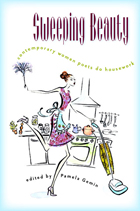
front cover of Sweeping Beauty
Sweeping Beauty
Contemporary Women Poets Do Housework
Pamela Gemin
University of Iowa Press, 2005
Thankless, mundane, and “never done,” housework continues to be seen as women's work, and contemporary women poets are still writing the domestic experience sometimes resenting its futility and lack of social rewards, sometimes celebrating its sensory delights and immediate gratification, sometimes cherishing the undeniable link it provides to their mothers and grandmothers. In Sweeping Beauty, a number of these poets illustrate how housekeeping's repetitive motions can free the imagination and release the housekeeper's muse. For many, housekeeping provides the key to a state of mind approaching meditation, a state of mind also conducive to making poems. The more than eighty contributors to Sweeping Beauty embrace this state and confirm that women are pioneers and inventors as well as life-givers and nurturers. “My fingers are forks, my tongue is a rose . . . / I turn silver spoons into rabbit stew / make quinces my thorny upholstery . . . / how else could the side of beef walk / with the sea urchin roe?” sings the cook in Natasha Sajé's ode to kitchen alchemy.“I love the notion that we can take our most poisonous angers, our most despairing or humiliated or stalemated moments, and make something good of them--something tensile and enduring,” says Leslie Ullman. Whether we are fully present in our tasks or “gone in the motion” of performing them, whether our stovetops are home to “stewpots of discontent” or grandmother's favorite jam, something is always cooking.
[more]

logo for Duke University Press
Winnowing
Suzanne Matson
Duke University Press, 2026
In Winnowing, Suzanne Matson examines our personal, cultural, and environmental relationship with material objects. Matson alternates between reflective essays on the nature of ownership and her own “Winnowing Log,” a day-by-day account of her attempts to reduce the items in her home. Sorting through the emotional value of mementos, the gendered dimensions of housekeeping, and the environmental cost of both mass production and disposal, she physically, mentally, and spiritually lightens her life while reflecting on the tethers that make winnowing so hard. She compares ideas of material impermanence in Stoicism, Buddhism, and Christianity, acknowledging that total renunciation of things is beyond most people’s goals or abilities, but also that reducing what we own, carry, and tend can clear space for spiritual lightness, aesthetic pleasure, and freedom. Rather than a celebration or condemnation of material goods, Winnowing is a meditation on the personal and universal struggles and rewards of separating the chaff from the grain.
[more]


Send via email Share on Facebook Share on Twitter