
 A SCHOLARLY BOOK REPOSITORY
11 start with A start with A
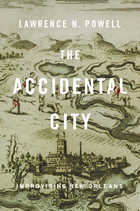
This is the story of a city that shouldn’t exist. In the seventeenth century, what is now America’s most beguiling metropolis was nothing more than a swamp: prone to flooding, infested with snakes, battered by hurricanes. But through the intense imperial rivalries of Spain, France, and England, and the ambitious, entrepreneurial merchants and settlers from four continents who risked their lives to succeed in colonial America, this unpromising site became a crossroads for the whole Atlantic world.
Lawrence N. Powell, a decades-long resident and observer of New Orleans, gives us the full sweep of the city’s history from its founding through Louisiana statehood in 1812. We see the Crescent City evolve from a French village, to an African market town, to a Spanish fortress, and finally to an Anglo-American center of trade and commerce. We hear and feel the mix of peoples, religions, and languages from four continents that make the place electric—and always on the verge of unraveling. The Accidental City is the story of land-jobbing schemes, stock market crashes, and nonstop squabbles over status, power, and position, with enough rogues, smugglers, and self-fashioners to fill a picaresque novel.
Powell’s tale underscores the fluidity and contingency of the past, revealing a place where people made their own history. This is a city, and a history, marked by challenges and perpetual shifts in shape and direction, like the sinuous river on which it is perched.
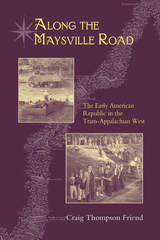
Along the Maysville Road details the life of the trail from its beginnings as a buffalo trace, through its role in populating and transforming an early American West, to its decline in regional and national affairs. This biography of a road thus serves as a microhistory of social and cultural change in the Early American Republic. Integral to this story are the people and groups who traveled and settled along the road: backcountry pioneers, refined Virginia gentry, poor and middling farmers, artisans and merchants from eastern cities, and of course the women and slaves who arrived with them. While these groups imported differing worldviews into the new American West, the merchant class’s commitment to commercial development, material acquisition, and individual achievement prophesied the triumph of a liberal economic order throughout nineteenth-century America. Alongside this individualistic impulse arose increasing pressure to abandon older identities based on regional origins and ethnic backgrounds and to accept a collective historical memory for the growing nation. Throughout the Early Republic, the call of the open road facilitated what it means to be “American.”
Craig Thompson Friend is associate professor of history at the University of Central Florida. He edits the Florida Historical Quarterly and is author of Kentucky Frontiers, 1750–1852 (forthcoming) and editor of The Buzzel About Kentuck: Settling the Promised Land.
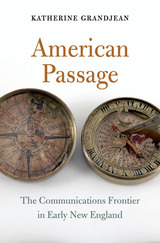
New England was built on letters. Its colonists left behind thousands of them, brittle and browning and crammed with curls of purplish script. How they were delivered, though, remains mysterious. We know surprisingly little about the way news and people traveled in early America. No postal service or newspapers existed—not until 1704 would readers be able to glean news from a “public print.” But there was, in early New England, an unseen world of travelers, rumors, movement, and letters. Unearthing that early American communications frontier, American Passage retells the story of English colonization as less orderly and more precarious than the quiet villages of popular imagination.
The English quest to control the northeast entailed a great struggle to control the flow of information. Even when it was meant solely for English eyes, news did not pass solely through English hands. Algonquian messengers carried letters along footpaths, and Dutch ships took them across waterways. Who could travel where, who controlled the routes winding through the woods, who dictated what news might be sent—in Katherine Grandjean’s hands, these questions reveal a new dimension of contest and conquest in the northeast. Gaining control of New England was not solely a matter of consuming territory, of transforming woods into farms. It also meant mastering the lines of communication.
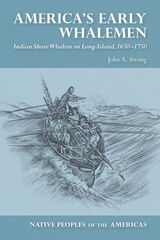
America’s Early Whalemen examines this early chapter of an iconic American historical experience. John A. Strong’s research draws on exhaustive sources, domestic and international, including little-known documents such as the whaling contracts of 340 Native American whalers, personal accounting books of whaling company owners, London customs records, estate inventories, and court records. Strong addresses labor relations, the role of alcohol and debt, the patterns of cultural accommodations by Native Americans, and the emergence of corporate capitalism in colonial America.
When Strong began teaching at Long Island University in 1964, he found little mention of the local Indigenous people in history books. The Shinnecocks and the neighboring tribes of Unkechaugs and Montauketts were treated as background figures for the celebratory narrative of the “heroic” English settlers. America’s Early Whalemen highlights the important contributions of Native peoples to colonial America.
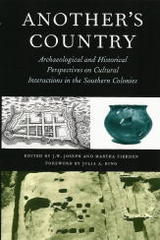
The 18th-century South was a true melting pot, bringing together colonists from England, France, Germany, Ireland, Switzerland, and other locations, in addition to African slaves—all of whom shared in the experiences of adapting to a new environment and interacting with American Indians. The shared process of immigration, adaptation, and creolization resulted in a rich and diverse historic mosaic of cultures.
The cultural encounters of these groups of settlers would ultimately define the meaning of life in the nineteenth-century South. The much-studied plantation society of that era and the Confederacy that sprang from it have become the enduring identities of the South. A full understanding of southern history is not possible, however, without first understanding the intermingling and interactions of the region’s eighteenth-century settlers. In the essays collected here, some of the South’s leading historical archaeologists examine various aspects of the colonial experience, attempting to understand how cultural identity was expressed, why cultural diversity was eventually replaced by a common identity, and how the various cultures intermeshed.
Written in accessible language, this book will be valuable to archaeologists and non-archaeologists alike. Cultural, architectural, and military historians, cultural anthropologists, geographers, genealogists, and others interested in the cultural legacy of the South will find much of value in this book.
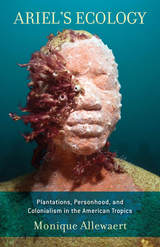
What happens if we abandon the assumption that a person is a discrete, world-making agent who acts on and creates place? This, Monique Allewaert contends, is precisely what occurred on eighteenth-century American plantations, where labor practices and ecological particularities threatened the literal and conceptual boundaries that separated persons from the natural world.
Integrating political philosophy and ecocriticism with literary analysis, Ariel’s Ecology explores the forms of personhood that developed out of New World plantations, from Georgia and Florida through Jamaica to Haiti and extending into colonial metropoles such as Philadelphia. Allewaert’s examination of the writings of naturalists, novelists, and poets; the oral stories of Africans in the diaspora; and Afro-American fetish artifacts shows that persons in American plantation spaces were pulled into a web of environmental stresses, ranging from humidity to the demand for sugar. This in turn gave rise to modes of personhood explicitly attuned to human beings’ interrelation with nonhuman forces in a process we might call ecological.
Certainly the possibility that colonial life revokes human agency haunts works from Shakespeare’s Tempest and Montesquieu’s Spirit of the Laws to Spivak’s theories of subalternity. In Allewaert’s interpretation, the transformation of colonial subjectivity into ecological personhood is not a nightmare; it is, rather, a mode of existence until now only glimmering in Che Guevara’s dictum that postcolonial resistance is synonymous with “perfect knowledge of the ground.”
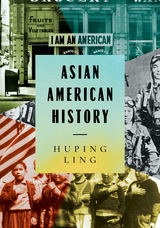
- Covers the major and minor Asian American ethnic groups. It presents the myriad and poignant stories of a diverse body of Asian Americans, from illiterate immigrants to influential individuals, within a broad and comparative framework, offering microscopic narratives as well as macroscopic analysis and overviews.
- Utilizes both primary and secondary sources, employs data and surveys, and incorporates most recent scholarly discourses.
- Attractive and accessible by incorporating voices and illustrations of the contemporaries and by using straightforward language and concise syntax, while maintaining a reasonable level of scholarly depth.
- Special features: Each chapter features Significant Events, Sidebars incorporating primary sources or scholarly debates, Review Questions, and Further Readings to aid and enhance student learning experience. Bibliographies, charts, maps, photographs and tables are included.
- Written by a preeminent historian with four decades of teaching, research, and publishing experiences in Asian American history, it is the best book on the subject to date.
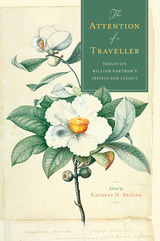
William Bartram, author of Travels through North and South Carolina, Georgia, East and West Florida, the Cherokee Country, the Extensive Territories of the Muscogulees, or Creek Confederacy, and the Country of the Chactaws, was colonial America’s first native born naturalist and artist, and the first author in the modern genre of writers who portrayed nature through personal experience as well as scientific observation. His book, first published in 1791, was based on his journeys through southern Indian nations and Britain’s southern colonies in the years just prior to the American Revolution and provides descriptions of the natural and cultural environments of what would soon become the American South. Scholars and general readers alike have long appreciated Bartram’s lush, vivid prose, his clarity of observation and evident wonder at the landscapes he traversed, and his engagement with the native nations whose lands he traveled through.
The Attention of a Traveller: Essays on William Bartram’s “Travels” and Legacy offers an interdisciplinary assessment of Bartram’s influence and evolving legacy, opening new avenues of research concerning the flora, fauna, and people connected to Bartram and his writings. Featuring 13 essays divided into five sections, contributors to the volume weave together scholarly perspectives from geology, art history, literary criticism, geography, and philosophy, alongside the more traditional Bartram-affiliated disciplines of biology and history. The collection concludes with a comprehensive treatment of the book as a material historical artifact.
READERS
Browse our collection.
PUBLISHERS
See BiblioVault's publisher services.
STUDENT SERVICES
Files for college accessibility offices.
RECENTLY PUBLISHED



UChicago Accessibility Resources
home | accessibility | search | about | contact us
BiblioVault ® 2001 - 2024
The University of Chicago Press