
 A SCHOLARLY BOOK REPOSITORY
13 start with I start with I
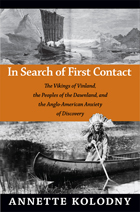
Kolodny considers what the sagas reveal about the Native peoples encountered by the Norse in Vinland around the year A.D. 1000, and she recovers Native American stories of first contacts with Europeans, including one that has never before been shared outside of Native communities. These stories contradict the dominant narrative of "first contact" between Europeans and the New World. Kolodny rethinks the lingering power of a mythic American Viking heritage and the long-standing debate over whether Leif Eiriksson or Christopher Columbus should be credited as the first discoverer. With this paradigm-shattering work, Kolodny shows what literary criticism can bring to historical and social scientific endeavors.
By July 1692, the witch hunt surrounding the town of Salem and Salem Village had been raging for four months. The Massachusetts Bay colony’s new governor, William Phips, had established a special court to try the suspected witches and the trials were well under way. No new arrests had taken place for nearly six weeks and residents had every reason to believe the crisis soon would be over. However, a middle-aged woman in nearby Andover lay gravely ill. Her husband suspected witchcraft as the cause and invited some of the afflicted girls from Salem Village to the town, thinking they could determine whether his suspicions were valid. Not surprisingly, they confirmed his supposition. The first person these girls accused in Andover—a frail and elderly widow bereaved by a series of family tragedies over the previous three years—not only confessed, but stated that there were more than three hundred witches in the region, five times more than the number of suspects already in jail. This touched off a new wave of accusations, confessions, and formal charges. Before the witchcraft crisis ended, forty-five residents of Andover found themselves jailed on suspicion of witchcraft—more than the combined total of suspects from Salem Village and the town of Salem. Of these, three were hanged and one died while awaiting execution.
Based on extensive primary source research, In the Shadow of Salem: The Andover Witch Hunt of 1692, by historian and archivist Richard Hite, tells for the first time the fascinating story of this long overlooked phase of the largest witch hunt in American history. Untangling a net of rivalries and ties between families and neighbors, the author explains the actions of the accusers, the reactions of the accused, and their ultimate fates. In the process, he shows how the Andover arrests prompted a large segment of the town’s population to openly oppose the entire witch hunt and how their actions played a crucial role in finally bringing the 1692 witchcraft crisis to a close.
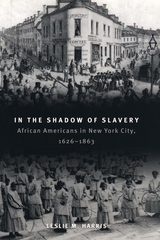
In 1991 in lower Manhattan, a team of construction workers made an astonishing discovery. Just two blocks from City Hall, under twenty feet of asphalt, concrete, and rubble, lay the remains of an eighteenth-century "Negro Burial Ground." Closed in 1790 and covered over by roads and buildings throughout the nineteenth and twentieth centuries, the site turned out to be the largest such find in North America, containing the remains of as many as 20,000 African Americans. The graves revealed to New Yorkers and the nation an aspect of American history long hidden: the vast number of enslaved blacks who labored to create our nation's largest city.
In the Shadow of Slavery lays bare this history of African Americans in New York City, starting with the arrival of the first slaves in 1626, moving through the turbulent years before emancipation in 1827, and culminating in one of the most terrifying displays of racism in U.S. history, the New York City Draft Riots of 1863. Drawing on extensive travel accounts, autobiographies, newspapers, literature, and organizational records, Leslie M. Harris extends beyond prior studies of racial discrimination by tracing the undeniable impact of African Americans on class, politics, and community formation and by offering vivid portraits of the lives and aspirations of countless black New Yorkers.
Written with clarity and grace, In the Shadow of Slavery is an ambitious new work that will prove indispensable to historians of the African American experience, as well as anyone interested in the history of New York City.
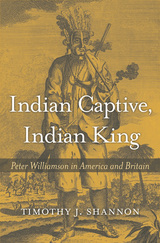
In 1758 Peter Williamson appeared on the streets of Aberdeen, Scotland, dressed as a Native American and telling a remarkable tale. He claimed that as a young boy he had been kidnapped from the city and sold into slavery in America. In performances and in a printed narrative he peddled to his audiences, Williamson described his tribulations as an indentured servant, Indian captive, soldier, and prisoner of war. Aberdeen’s magistrates called him a liar and banished him from the city, but Williamson defended his story.
Separating fact from fiction, Timothy J. Shannon explains what Williamson’s tale says about how working people of eighteenth-century Britain, so often depicted as victims of empire, found ways to create lives and exploit opportunities within it. Exiled from Aberdeen, Williamson settled in Edinburgh, where he cultivated enduring celebrity as the self-proclaimed “king of the Indians.” His performances and publications capitalized on the curiosity the Seven Years’ War had ignited among the public for news and information about America and its native inhabitants. As a coffeehouse proprietor and printer, he gave audiences a plebeian perspective on Britain’s rise to imperial power in North America.
Indian Captive, Indian King is a history of empire from the bottom up, showing how Williamson’s American odyssey illuminates the real-life experiences of everyday people on the margins of the British Empire and how those experiences, when repackaged in travel narratives and captivity tales, shaped popular perceptions about the empire’s racial and cultural geography.

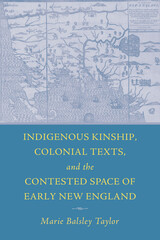
New England history often treats Indigenous people as minor or secondary actors within the larger colonial story. Focusing on those Native Americans who were sachems, or leaders, in local tribes when Europeans began arriving, Marie Balsley Taylor reframes stories of Indigenous and British interactions and illuminates the vital role that Indigenous kinship and diplomacy played in shaping the textual production of English colonial settlers in New England from the 1630s until King Philip’s War.
Taylor argues that genres like the conversion narrative, the post-sermon question and answer session, and scientific treatise—despite being written in English for European audiences—were jointly created by Indigenous sachems and settlers to facilitate interaction within the contested space of colonial New England. Analyzing the writings of Thomas Shepard, John Eliot, John Winthrop Jr., and Daniel Gookin and the relationships these English Protestants formed with Indigenous leaders like Wequash, Cutshamekin, Cassacinamon, and Waban, this innovative study offers a new approach to early American literature—indicating that Native thought and culture played a profound role in shaping the words and deeds of colonial writers.
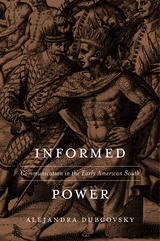
Informed Power maps the intricate, intersecting channels of information exchange in the early American South, exploring how people in the colonial world came into possession of vital knowledge in a region that lacked a regular mail system or a printing press until the 1730s.
Challenging the notion of early colonial America as an uninformed backwater, Alejandra Dubcovsky uncovers the ingenious ways its inhabitants acquired timely news through largely oral networks. Information circulated through the region via spies, scouts, traders, missionaries, and other ad hoc couriers—and by encounters of sheer chance with hunting parties, shipwrecked sailors, captured soldiers, or fugitive slaves. For many, content was often inseparable from the paths taken and the alliances involved in acquiring it. The different and innovative ways that Indians, Africans, and Europeans struggled to make sense of their world created communication networks that linked together peoples who otherwise shared no consensus of the physical and political boundaries shaping their lives.
Exchanging information was not simply about having the most up-to-date news or the quickest messenger. It was a way of establishing and maintaining relationships, of articulating values and enforcing priorities—a process inextricably tied to the region’s social and geopolitical realities. At the heart of Dubcovsky’s study are important lessons about the nexus of information and power in the early American South.
This reprint of Edwin Cannan's definitive 1904 edition of The Wealth of Nations includes Cannan's famous introduction, notes, and a full index, as well as a new preface written especially for this edition by the distinguished economist George J. Stigler. Mr. Stigler's preface will be of value for anyone wishing to see the contemporary relevance of Adam Smith's thought.
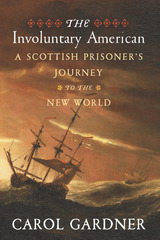
In the winter of 1650–51, one hundred fifty ragged and hungry Scottish prisoners of war arrived at Massachusetts Bay Colony, where they were sold as indentured laborers for 20 to 30 pounds each. Among them was Thomas Doughty, a common foot soldier who had survived the Battle of Dunbar, a forced marched of 100 miles without food or water, imprisonment in Durham Cathedral, and a difficult Atlantic crossing. An ordinary individual who experienced extraordinary events, Doughty was among some 420 Scottish soldiers who were captured during the War of the Three Kingdoms, transported to America, and sold between 1650 and 1651. Their experiences offer a fresh perspective on seventeenth-century life.
The Involuntary American: A Scottish Prisoner’s Journey to the New World by Carol Gardner describes Doughty’s life as a soldier, prisoner of war, exile, servant, lumberman, miller, and ultimately free landowner. It follows him and his peers through critical events: the apex of the Little Ice Age, the War of the Three Kingdoms, the colonization of New England, the burgeoning transatlantic trade in servants and slaves, King Philip’s and King William’s wars, and the Salem witch crisis. Firstperson accounts of individuals who lived through those events—Scottish, English, Puritan, Native American, wealthy, poor, working class, educated or not— provide rich period detail and a variety of perspectives.
The Involuntary American demonstrates how even individuals of humble circumstances were swept into the maelstrom of the First Global Age. It expands our understanding of immigration to the colonies, colonial servitude, the linkages and tensions between Europe, Massachusetts Bay, and America’s northeastern frontier, and of New England society in the early colonial period.
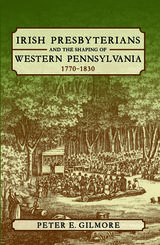
Rural Presbyterian Irish church elders emphasized community and ethnoreligious group solidarity in supervising congregants’ morality. Improved transportation and the greater reach of the market eliminated near-subsistence local economies and hastened the demise of religious traditions brought from Ireland. Gilmore contends that ritual and daily religious practice, as understood and carried out by migrant generations, were abandoned or altered by American-born generations in the context of major economic change.
READERS
Browse our collection.
PUBLISHERS
See BiblioVault's publisher services.
STUDENT SERVICES
Files for college accessibility offices.
RECENTLY PUBLISHED





UChicago Accessibility Resources
home | accessibility | search | about | contact us
BiblioVault ® 2001 - 2024
The University of Chicago Press