
 A SCHOLARLY BOOK REPOSITORY
9 start with N start with N

Contributors. Carolyn Arena, Arne Bialuschewski, Linford D. Fisher, George Edward Milne, Andrés Reséndez
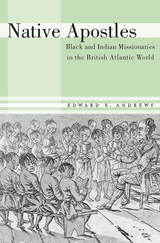
As Protestantism expanded across the Atlantic world in the seventeenth and eighteenth centuries, most evangelists were not white Anglo-Americans, as scholars have long assumed, but members of the same groups that missionaries were trying to convert. Native Apostles offers one of the most significant untold stories in the history of early modern religious encounters, marshalling wide-ranging research to shed light on the crucial role of Native Americans, Africans, and black slaves in Protestant missionary work. The result is a pioneering view of religion’s spread through the colonial world.
From New England to the Caribbean, the Carolinas to Africa, Iroquoia to India, Protestant missions relied on long-forgotten native evangelists, who often outnumbered their white counterparts. Their ability to tap into existing networks of kinship and translate between white missionaries and potential converts made them invaluable assets and potent middlemen. Though often poor and ostracized by both whites and their own people, these diverse evangelists worked to redefine Christianity and address the challenges of slavery, dispossession, and European settlement. Far from being advocates for empire, their position as cultural intermediaries gave native apostles unique opportunities to challenge colonialism, situate indigenous peoples within a longer history of Christian brotherhood, and harness scripture to secure a place for themselves and their followers.
Native Apostles shows that John Eliot, Eleazar Wheelock, and other well-known Anglo-American missionaries must now share the historical stage with the black and Indian evangelists named Hiacoomes, Good Peter, Philip Quaque, John Quamine, and many more.
Native Wills from the Colonial Americas showcases new testamentary sources from the sixteenth to the eighteenth centuries. It provides readers with translations and analyses of wills written in Spanish, Nahuatl, Yucatec Maya, K’iche’ Maya, Mixtec, and Wampanoag.
Divided into three thematic sections, the book provides insights and details that further our understanding of indigenous life in the Americas under colonial rule. Part One employs testaments to highlight the women of Native America and the ways their lives frequently challenged prescribed gender roles and statuses. Part Two uses testaments to illustrate the strategies of the elite in both negotiating and maintaining their power in a colonial, Spanish world. Part Three contributes to our understanding of the individual and collective nature of death by extracting from wills the importance of conversion, kinship, and societal ties in the colonial Americas. Capturing individual voices during dramatic periods of change, the documents presented here help us understand how cultures both adapt and persist.

By the middle of the eighteenth century the merchants were dominant figures in the northern American colonies, powerful economically, politically, and socially. But in New England this preeminence had not been present in the first years of settlement; it had been achieved in the course of three generations of social development as the merchants often Puritans themselves, rose within the Bible Commonwealths to challenge the domination of the Puritan fathers.
In lively detail Mr. Bailyn here presents the struggle of the merchants to achieve full social recognition as their successes in trade and in such industries as fishing and lumbering offered them avenues to power. Surveying the rise of merchant families, he offers a portrait in depth of the emergence of a new social group whose interests and changing social position powerfully affected the developing character of American society.
The story of this group is the story of people and of their many–sided interests. The merchants were united by the demands of their common devotion to trade, yet they did not form a socially homogeneous unit. In fact their social differences—created in the confusions and dislocations of the early days of settlement came to play an important role in their business and political activities. Moreover, their commercial ventures, successes, and failures affected their social and political situation. Internationalists by occupation, they were deeply affected by personal relations with Europeans as well as by events in the Old World.
Drawing on source material from many fields—business records, religious and political data, literary remains, and genealogical information—Mr. Bailyn has discovered much that is new about the merchants, and has brought it all together into a composite portrait of our economic founding fathers that is fascinating in itself and that will reorient our thinking about many aspects of early New England history.
During much of its existence, the "living museum" at Williamsburg has been considered a patriotic shrine, celebrating the upscale lifestyles of Virginia’s colonial-era elite. But in recent decades a new generation of social historians has injected a more populist and critical slant to the site’s narrative of nationhood. For example, in interactions with museum visitors, employees now relate stories about the experiences of African Americans and women, stories that several years ago did not enter into descriptions of life in Colonial Williamsburg. Handler and Gable focus on the way this public history is managed, as historians and administrators define historiographical policy and middle-level managers train and direct front-line staff to deliver this "product" to the public. They explore how visitors consume or modify what they hear and see, and reveal how interpreters and craftspeople resist or acquiesce in being managed. By deploying the voices of these various actors in a richly textured narrative, The New History in an Old Museum highlights the elements of cultural consensus that emerge from this cacophony of conflict and negotiation.
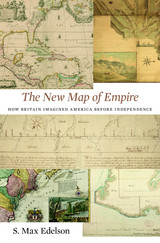
After the Treaty of Paris ended the Seven Years’ War in 1763, British America stretched from Hudson Bay to the Florida Keys, from the Atlantic coast to the Mississippi River, and across new islands in the West Indies. To better rule these vast dominions, Britain set out to map its new territories with unprecedented rigor and precision. Max Edelson’s The New Map of Empire pictures the contested geography of the British Atlantic world and offers new explanations of the causes and consequences of Britain’s imperial ambitions in the generation before the American Revolution.
Under orders from King George III to reform the colonies, the Board of Trade dispatched surveyors to map far-flung frontiers, chart coastlines in the Gulf of St. Lawrence, sound Florida’s rivers, parcel tropical islands into plantation tracts, and mark boundaries with indigenous nations across the continental interior. Scaled to military standards of resolution, the maps they produced sought to capture the essential attributes of colonial spaces—their natural capacities for agriculture, navigation, and commerce—and give British officials the knowledge they needed to take command over colonization from across the Atlantic.
Britain’s vision of imperial control threatened to displace colonists as meaningful agents of empire and diminished what they viewed as their greatest historical accomplishment: settling the New World. As London’s mapmakers published these images of order in breathtaking American atlases, Continental and British forces were already engaged in a violent contest over who would control the real spaces they represented.
Accompanying Edelson’s innovative spatial history of British America are online visualizations of more than 250 original maps, plans, and charts.
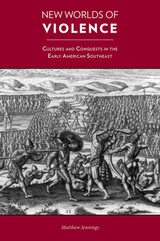
From the early 1500s to the mid-1700s, the American Southeast was the scene of continuous
tumult as European powers vied for dominance in the region while waging war on Native American communities. Yet even before Hernando de Soto landed his expeditionary
force on the Gulf shores of Florida, Native Americans had created their own “cultures of violence”: sets of ideas about when it was appropriate to use violence and what sorts of violence were appropriate to a given situation.
In New Worlds of Violence, Matthew Jennings offers a persuasive new framework for understanding the European–Native American contact period and the conflicts among indigenous peoples that preceded it. This pioneering approach posits that every group present in the Southeast had its own ideas about the use of violence and that these ideas changed over time as they collided with one another. The book starts with the Mississippian era and continues through the successive Spanish and English invasions of the Native South. Jennings argues that the English conquered the Southeast because they were able to force everyone else to adapt to their culture of violence, which, of course, changed over time as well. By 1740, a peculiarly Anglo-American culture of violence was in place that would profoundly influence the expansion of England’s colonies and the eventual southern United States. While Native and African violence were present in this world, they moved in circles defined by the English.
New Worlds of Violence concludes by pointing out that long-lasting violence bears long-lasting consequences. An important contribution to the growing body of work on the early Southeast, this book will significantly broaden readers’ understanding of America’s violent past.
Matthew Jennings is an assistant professor of history at Macon State College in Macon, Georgia. He is the author of “Violence in a Shattered World” in Mapping the Shatter Zone: The European Invasion and the Transformation of the Mississippian World, edited by Robbie Ethridge and Sheri Shuck-Hall. His work has also appeared in The Uniting States, The South Carolina Encyclopedia, A Multicultural History of the United States, and The Encyclopedia of Native American History.
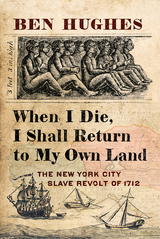
At 2 a.m. on April 7, 1712, a fire broke out in New York City’s North Ward. Unbeknown to the residents who roused themselves to combat the flames, the blaze had been started with murderous intent. A group of at least twenty-four enslaved West African men and women, mostly Akan from modern-day Ghana, had long plotted this moment. Armed with guns, daggers, swords, axes, and clubs, they fell upon their enslavers. In the next few frantic moments, eight Europeans were killed and seven were wounded. The perpetrators were rounded up, jailed, and put on public trial. Twenty enslaved men and one woman were executed or transported for carrying out the plot. As the first event of its kind to take place in the North American colonies, this revolt was the progenitor of those that followed—it inspired, the Stono Rebellion of 1739, the New York Conspiracy of 1741, and Nat Turner’s 1831 insurrection.
When I Die, I Shall Return to My Own Land: The 1712 New York City Slave Revolt is the first comprehensive investigation into this major event in the history of slavery in North America. Consulting court records, correspondence, and the minutes of the various colonial councils, as well as a wide range of sources related to eighteenth-century slavery, historian Ben Hughes vividly recreates early colonial New York, the lives of its enslaved inhabitants, the factionalism among the city’s Dutch and English elites, and their precarious hold on Manhattan Island in the face of French and Native American threats. Hughes traces the origins of the New York rebels, details how they came to be enslaved, and recreates the shadowy dealings that took place between African polities, European and American slavers, and New York merchants. The forerunners of a movement which continues to this day, the deeds of these original African American rebels have now been all but forgotten. Here, Hughes attempts to redress this imbalance by recovering their story.
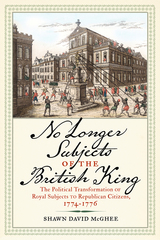
Historian Shawn McGhee offers a fresh perspective on the origins of American political identity. No Longer Subjects of the British King: The Political Transformation of Royal Subjects to Republican Citizens, 1774-1776reveals the crucial process by which the Continental Association organized American towns and counties into a protonational community of suffering to protect political identities they felt under threat. This work further demonstrates how those sacrificing for the common cause severed their bonds of allegiance to the British king and separated from the broader imperial nation. In this crucible of austerity, they formed an American political community, completing the political transformation from subject to citizen.
READERS
Browse our collection.
PUBLISHERS
See BiblioVault's publisher services.
STUDENT SERVICES
Files for college accessibility offices.
RECENTLY PUBLISHED




UChicago Accessibility Resources
home | accessibility | search | about | contact us
BiblioVault ® 2001 - 2024
The University of Chicago Press