
 A SCHOLARLY BOOK REPOSITORY
5 start with U start with U
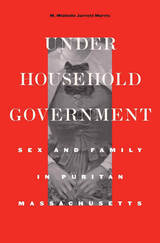
Seventeenth-century New Englanders were not as busy policing their neighbors’ behavior as Nathaniel Hawthorne or many historians of early America would have us believe. Keeping their own households in line occupied too much of their time. Under Household Government reveals the extent to which family members took on the role of watchdog in matters of sexual indiscretion.
In a society where one’s sister’s husband’s brother’s wife was referred to as “sister,” kinship networks could be immense. When out-of-wedlock pregnancies, paternity suits, and infidelity resulted in legal cases, courtrooms became battlegrounds for warring clans. Families flooded the courts with testimony, sometimes resorting to slander and jury-tampering to defend their kin. Even slaves merited defense as household members—and as valuable property. Servants, on the other hand, could expect to be cast out and left to fend for themselves.
As she elaborates the ways family policing undermined the administration of justice, M. Michelle Jarrett Morris shows how ordinary colonists understood sexual, marital, and familial relationships. Long-buried tales are resurrected here, such as that of Thomas Wilkinson’s (unsuccessful) attempt to exchange cheese for sex with Mary Toothaker, and the discovery of a headless baby along the shore of Boston’s Mill Pond. The Puritans that we meet in Morris’s account are not the cardboard caricatures of myth, but are rendered with both skill and sensitivity. Their stories of love, sex, and betrayal allow us to understand anew the depth and complexity of family life in early New England.
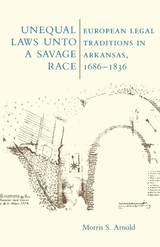
Partly because its colonial settlements were tiny, remote, and inconsequential, the early history of Arkansas has been almost entirely neglected. Even Arkansas Post, the principal eighteenth-century settlement, served mainly as a temporary place of residence for trappers and voyageurs. It was also an entrepot for travelers on the Mississippi—a place to be while on the way elsewhere. Only a very few inhabitants, true agricultural settlers, ever established themselves a or around the Post.
For most of the eighteenth century, Arkansas’s non-Indian population was less than one hundred, and never much exceeded five or six hundred. Its European residents of that era, mostly French, have left virtually no physical trace: the oldest buildings and the oldest marked graves in the state date from the 1820s. Drawing on original French and Spanish archival sources, Morris Arnold chronicles for the first time the legal institutions of colonial Arkansas, the attitude of its population towards European legal ideas as were current in Arkansas when Louisiana was transferred to the United States in 1803. Because he views the clash of legal traditions in the upper reaches of the Jefferson’s Louisiana as part of a more general cultural conflict, Arnold closely examines the social and economic characteristics of Arkansas’s early residents in order to explain why, following the American takeover, the common law was introduced into Arkansas with such relative ease.
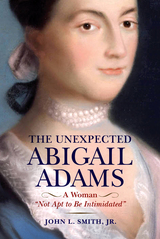
An Extraordinary Portrait of America’s Beloved Female Founder and First Lady
Abigail Adams, wife of John Adams, was an eyewitness to America’s founding, and helped guide the new nation through her observations and advice to her famously prickly husband, who cherished her. She met many important and significant figures of the period: George Washington and his wife Martha, Thomas Jefferson, Sally Hemings, Benjamin Franklin, Henry Knox, Samuel Adams, John Hancock, John Jay, Marquis de Lafayette, John Paul Jones, Alexander Hamilton, James Monroe, artist Patience Wright, and even King George III and Queen Charlotte of England, as well as King Louis XVI and Queen Marie Antoinette of France. In The Unexpected Abigail Adams: A Woman “Not Apt to Be Intimidated”, writer and researcher John L. Smith, Jr., draws on more than two thousand letters of Abigail’s spanning from the 1760s to her death in 1818, interweaving Abigail’s colorful correspondence—some of which has not appeared in print before—with a contextual narrative. In this priceless documentation of one of the most important periods of world history she comments on the varied personalities she encountered and, while her husband was away from home serving in the Continental Congresses and as a diplomatic envoy in Europe, she wrote him frequently about their home in Massachusetts, their family, national and local politics, and, during the early years of the war, crucial information concerning revolutionary activities around Boston. She was an advocate for education for women, a shrewd businesswoman, and had an unrivaled political acumen. Her strength in the face of disease, loss of children, and other hardships, and her poignant, beautiful, and often philosophical commentary, advice, and predictions allow Abigail to demonstrate her fully modern sensibilities. This major biography of Abigail, the first in over ten years, is a riveting, revealing portrait of a remarkable woman that readers will find very relatable—and one that transforms how she is perceived.
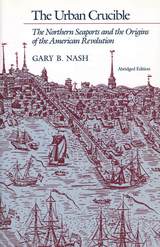
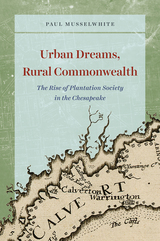
Paul Musselwhite details the unsuccessful urban development that defined the region from the seventeenth century through the Civil War, showing how places like Jamestown and Annapolis—despite their small size—were the products of ambitious and cutting-edge experiments in urbanization comparable to those in the largest port cities of the Atlantic world. These experiments, though, stoked ongoing debate about commerce, taxation, and self-government. Chesapeake planters responded to this debate by reinforcing the political, economic, and cultural authority of their private plantation estates, with profound consequences for the region’s laborers and the political ideology of the southern United States. As Musselwhite makes clear, the antebellum economy around this well-known waterway was built not in the absence of cities, but upon their aspirational wreckage.
READERS
Browse our collection.
PUBLISHERS
See BiblioVault's publisher services.
STUDENT SERVICES
Files for college accessibility offices.
RECENTLY PUBLISHED


UChicago Accessibility Resources
home | accessibility | search | about | contact us
BiblioVault ® 2001 - 2024
The University of Chicago Press