
 A SCHOLARLY BOOK REPOSITORY
Results by Title
5 books about Colonial Indonesia
5 books about Colonial Indonesia
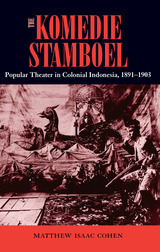
The Komedie Stamboel
Popular Theater in Colonial Indonesia, 1891–1903
Matthew Isaac Cohen
Ohio University Press, 2006
Winner of the 2008 Benda Prize
Originating in 1891 in the port city of Surabaya, the Komedie Stamboel, or Istanbul-style theater, toured colonial Indonesia, Singapore, and Malaysia by rail and steamship. The company performed musical versions of the Arabian Nights, European fairy tales and operas such as Sleeping Beauty and Aida, as well as Indian and Persian romances, Southeast Asian chronicles, true crime stories, and political allegories. The actors were primarily Eurasians, the original backers were Chinese, and audiences were made up of all races and classes. The Komedie Stamboel explores how this new hybrid theater pointed toward possibilities for the transformation of self in a colonial society and sparked debates on moral behavior and mixed-race politics.
While audiences marveled at spectacles involving white-skinned actors, there were also racial frictions between actors and financiers, sexual scandals, fights among actors and patrons, bankruptcies, imprisonments, and a murder.
Matthew Isaac Cohen's evocative social history situates the Komedie Stamboel in the culture of empire and in late nineteenth-century itinerant entertainment. He shows how the theater was used as a symbol of cross-ethnic integration in postcolonial Indonesia and as an emblem of Eurasian cultural accomplishment by Indische Nederlanders. A pioneering study of nineteenth-century Southeast Asian popular culture, The Komedie Stamboel gives a new picture of the region's arts and culture and explores the interplay of currents in global culture, theatrical innovation, and movement in colonial Indonesia.ABOUT THE AUTHOR---Matthew Isaac Cohen is senior lecturer in Drama and Theatre Studies at Royal Holloway University of London. His articles on Southeast Asian performance have appeared in New Theatre Quarterly, Asian Theatre Journal, Journal of the Royal Asiatic Society, and Archipel. As a practicing shadow puppeteer, he has performed in the United States, Europe, and Asia.
Originating in 1891 in the port city of Surabaya, the Komedie Stamboel, or Istanbul-style theater, toured colonial Indonesia, Singapore, and Malaysia by rail and steamship. The company performed musical versions of the Arabian Nights, European fairy tales and operas such as Sleeping Beauty and Aida, as well as Indian and Persian romances, Southeast Asian chronicles, true crime stories, and political allegories. The actors were primarily Eurasians, the original backers were Chinese, and audiences were made up of all races and classes. The Komedie Stamboel explores how this new hybrid theater pointed toward possibilities for the transformation of self in a colonial society and sparked debates on moral behavior and mixed-race politics.
While audiences marveled at spectacles involving white-skinned actors, there were also racial frictions between actors and financiers, sexual scandals, fights among actors and patrons, bankruptcies, imprisonments, and a murder.
Matthew Isaac Cohen's evocative social history situates the Komedie Stamboel in the culture of empire and in late nineteenth-century itinerant entertainment. He shows how the theater was used as a symbol of cross-ethnic integration in postcolonial Indonesia and as an emblem of Eurasian cultural accomplishment by Indische Nederlanders. A pioneering study of nineteenth-century Southeast Asian popular culture, The Komedie Stamboel gives a new picture of the region's arts and culture and explores the interplay of currents in global culture, theatrical innovation, and movement in colonial Indonesia.ABOUT THE AUTHOR---Matthew Isaac Cohen is senior lecturer in Drama and Theatre Studies at Royal Holloway University of London. His articles on Southeast Asian performance have appeared in New Theatre Quarterly, Asian Theatre Journal, Journal of the Royal Asiatic Society, and Archipel. As a practicing shadow puppeteer, he has performed in the United States, Europe, and Asia.
[more]

Magic’s Translations
Reality Politics in Colonial Indonesia
Margaret J. Wiener
Duke University Press, 2025
“Do you believe in magic?” This familiar question suggests magic is easily recognized but unreal. In Magic’s Translations, Margaret J. Wiener argues that such views are shaped by historical power struggles, especially in Europe’s relations with the wider world. Focusing on nineteenth- and twentieth-century Dutch interactions with Indonesians, Wiener reveals how colonial agents framed unfamiliar practices, practitioners, and objects as “magic,” rendering distinct phenomena fundamentally alike and advancing colonizing projects that deemed magic antithetical to reason and reality. While colonial authorities, including ethnologists, mobilized the concept of magic to differentiate Europeans from Indonesians, nature from culture, reason from superstition, and fact from fetish, their efforts produced unexpected outcomes: Some Indonesian artifacts and acts not only retained their power but invaded European experiences. As anthropologists were among the key translators of magic throughout the world, Wiener intersperses accounts of magic’s translations in the Indies with reflections on anthropology’s ongoing engagement with the concept. She demonstrates that magic became an object of expert knowledge, political control, and popular fascination, rather than a self-evident category or relic of naïve belief.
[more]
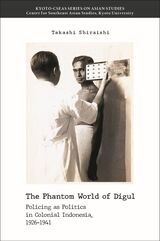
The Phantom World of Digul
Policing as Politics in Colonial Indonesia, 1926–1941
Takashi Shiraishi
National University of Singapore Press, 2020
Digul was an internment colony for political prisoners that was established in 1926 in West Papua. This book argues that Digul is the key to understanding Indonesia’s colonial governance between the failed communist rebellion of late 1926 and the declaration of independence in 1945, a time when the Dutch regime attempted to impose what they called “rust en orde,” or peace and order, on the Indonesian people via the suppression of politics by the police. The political policing regime the Dutch Indies state created, Takashi Shiraishi shows, was simultaneously a success and a failure. While unrest was to some degree put down, the native terrain was never completely pacified, as activists linked up with each other in fluid networks that cut across spatial and ideational boundaries.
How did the government deploy political policing to achieve its policy objectives? What were the consequences and challenges for Indonesian activists? How was the government able to fashion its policing apparatus as the most potent instrument to achieve peace and order when the Great Depression hit the Indies, nationalist and communist forces were gaining strength in other places of the world, and war was coming both in Europe and Asia? This book answers those questions and more, breaking new ground for our understanding of the history of the Dutch Indies state in the early part of the twentieth century.
How did the government deploy political policing to achieve its policy objectives? What were the consequences and challenges for Indonesian activists? How was the government able to fashion its policing apparatus as the most potent instrument to achieve peace and order when the Great Depression hit the Indies, nationalist and communist forces were gaining strength in other places of the world, and war was coming both in Europe and Asia? This book answers those questions and more, breaking new ground for our understanding of the history of the Dutch Indies state in the early part of the twentieth century.
[more]
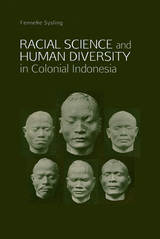
Racial Science and Human Diversity in Colonial Indonesia
Fenneke Sysling
National University of Singapore Press, 2016
Indonesia is home to diverse peoples who differ from one another in terms of physical appearance as well as social and cultural practices. The way such matters are understood is partly rooted in ideas developed by racial scientists working in the Netherlands Indies beginning in the late nineteenth century, who tried to develop systematic ways to define and identify distinctive races. Their work helped spread the idea that race had a scientific basis in anthropometry and craniology, and was central to people’s identity, but their encounters in the archipelago also challenged their ideas about race.
In this new monograph, Fenneke Sysling draws on published works and private papers to describe the way Dutch racial scientists tried to make sense of the human diversity in the Indonesian archipelago. The making of racial knowledge, it contends, cannot be explained solely in terms of internal European intellectual developments. It was ‘on the ground’ that ideas about race were made and unmade with a set of knowledge strategies that did not always combine well. Sysling describes how skulls were assembled through the colonial infrastructure, how measuring sessions were resisted, what role photography and plaster casting played in racial science and shows how these aspects of science in practice were entangled with the Dutch colonial Empire.
In this new monograph, Fenneke Sysling draws on published works and private papers to describe the way Dutch racial scientists tried to make sense of the human diversity in the Indonesian archipelago. The making of racial knowledge, it contends, cannot be explained solely in terms of internal European intellectual developments. It was ‘on the ground’ that ideas about race were made and unmade with a set of knowledge strategies that did not always combine well. Sysling describes how skulls were assembled through the colonial infrastructure, how measuring sessions were resisted, what role photography and plaster casting played in racial science and shows how these aspects of science in practice were entangled with the Dutch colonial Empire.
[more]

The Social World of Batavia
Europeans and Eurasians in Colonial Indonesia
Jean Gelman Taylor
University of Wisconsin Press, 2009
In the seventeenth century, the Dutch established a trading base at the Indonesian site of Jacarta. What began as a minor colonial outpost under the name Batavia would become, over the next three centuries, the flourishing economic and political nucleus of the Dutch Asian Empire. In this pioneering study, Jean Gelman Taylor offers a comprehensive analysis of Batavia’s extraordinary social world—its marriage patterns, religious and social organizations, economic interests, and sexual roles. With an emphasis on the urban ruling elite, she argues that Europeans and Asians alike were profoundly altered by their merging, resulting in a distinctive hybrid, Indo-Dutch culture.
Original in its focus on gender and use of varied sources—travelers’ accounts, newspapers, legal codes, genealogical data, photograph albums, paintings, and ceramics—The Social World of Batavia, first published in 1983, forged new paths in the study of colonial society. In this second edition, Gelman offers a new preface as well as an additional chapter tracing the development of these themes by a new generation of scholars.
Original in its focus on gender and use of varied sources—travelers’ accounts, newspapers, legal codes, genealogical data, photograph albums, paintings, and ceramics—The Social World of Batavia, first published in 1983, forged new paths in the study of colonial society. In this second edition, Gelman offers a new preface as well as an additional chapter tracing the development of these themes by a new generation of scholars.
[more]
READERS
Browse our collection.
PUBLISHERS
See BiblioVault's publisher services.
STUDENT SERVICES
Files for college accessibility offices.
RECENTLY PUBLISHED



UChicago Accessibility Resources
home | accessibility | search | about | contact us
BiblioVault ® 2001 - 2025
The University of Chicago Press