
 A SCHOLARLY BOOK REPOSITORY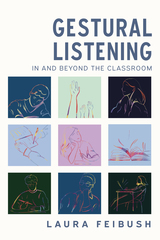
Attuned to the subtle choreographies of the classroom, Gestural Listening In and Beyond the Classroom investigates how students and instructors show that they are listening to each other—and, sometimes, that they are not. While rhetorical scholarship traditionally focuses on speaking and writing, listening can also be understood as a rhetorical force that makes things happen. Listening has the power to move, bring about, cause, and catalyze. This conductive aspect of listening is its embodied manifestation—termed “gestural listening.”
Laura Feibush first traces the roots of embodied listening through cultural and rhetorical history and then uses findings from a classroom study to inform an insightful discussion of respect, resistance, and self-regulation as the key dynamics that characterize listening in contemporary educational spaces. She reveals how the gestures of listening refract across identity categories in ways that have surprising effects on how classroom participants respond to one another. This accessibly written book attends to hands and faces, nodding and note-taking, and the presence of phones and laptops, as well as other forms of nonverbal backchanneling, such as where people sit, when they interrupt, and when they engage in impactful quietness.
The power of gestural listening is not limited to the classroom. Its quiet yet profound influence can elucidate many sites of interaction: in-person and virtual academic settings as well as those far beyond the educational space, such as scenes of protest, worship, and performance. Gestural Listening In and Beyond the Classroom shows how, when understood as possessing its own repertoire of impressive and expressive capacities, listening emerges as a fascinating site of study and offers exercises, activities, and other materials to help educators, counselors, and all those engaging in communicative work enact a new awareness of gestural listening as a rhetorical force.
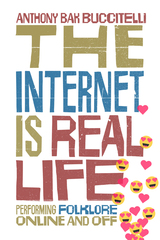
We often speak of a divide between online and offline cultures, despite growing recognition that the two are intertwined. Here, folklorist Anthony Bak Buccitelli challenges the idea of any divide at all in contemporary American culture. He argues that digital communications and behaviors are already deeply embedded in everyday expressive life and therefore are also already implicated in a variety of ways in the embodied performance and transmission of folklore. In other words, in contemporary American society, folklore seamlessly integrates online and offline.
By treating the digital interface as a site at which embodied performance can take shape rather than just a point of contact with the online, Buccitelli argues for a critical renewal of core folkloristic concepts to meet the challenges of understanding modern networked life.

Freedom of expression has long been regarded as the cornerstone of democratic theory, communication law, and human rights. Yet many of the rights that shape contemporary communication, including the right to receive information, the right to be heard, privacy, anonymity, memory, and the governance of digital platforms, sit uneasily within an expression-centred framework. The Rights of Communication: Beyond Free Speech argues that a Right to Communication should instead serve as the normative foundation for rights that sustain communication.
Drawing on philosophy, communication theory, legal scholarship, and media policy, Amit M. Schejter develops a theory of a foundational Right to Communication from which a coherent family of Communication Rights emerges. Rather than treating these rights as isolated doctrines or as extensions of free speech, the book shows how they protect the people, institutions, and conditions that make meaningful human communication possible.
The book examines rights associated with senders, receivers, media and platforms, the integrity of communication, information, privacy, non-communication, and memory, arguing that together they constitute a coherent architecture of Communication Rights. Combining normative theory with constitutional analysis and comparative perspectives from the United States, Europe, and international human rights law, it offers a new way of thinking about the relationship between communication and human rights.
The Rights of Communication: Beyond Free Speech will be of interest to scholars and students of communication, media, law, political science, and human rights, as well as policymakers and legal practitioners concerned with the future of democratic communication.
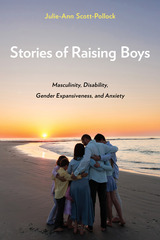
In her poignant, affecting autoethnography, Stories of Raising Boys, Julie-Ann Scott-Pollock investigates the meaning of disability, gender, race, and privilege in contemporary culture. Scott-Pollock is a white mother living with a physical disability raising four boys—Theo, a three-year-old risktaker; Tony, ten, who lives with seizures; Vinny, eight, who is gender expansive; and five-year-old Nico, who is also gender expansive and experiences anxiety. They live on the southeastern U.S. coast with their father, Evan, and their baby sister, Rosalie.
Through narrative analysis, Scott-Pollock compares and contrasts her circumstances to the ways in which adult interviewees manage the same lived experiences as her sons. She also includes their opinions about masculinity and identity, as well as parenting boys. In doing so, Stories of Raising Boys deepens the cultural complexity of parent–child relationships and expands our collective understanding of how they form and emerge. In addition, Scott-Pollock uses a metaphor of swimming through the ocean near her family’s home to illustrate resisting marginalization while also promoting strong cultural identities, especially in turbulent waters.
Stories of Raising Boys offers an absorbing cultural reflection on the intersectionality of identity, power, and privilege.
READERS
Browse our collection.
PUBLISHERS
See BiblioVault's publisher services.
STUDENT SERVICES
Files for college accessibility offices.
RECENTLY PUBLISHED




UChicago Accessibility Resources
home | accessibility | search | about | contact us
BiblioVault ® 2001 - 2026
The University of Chicago Press