
 A SCHOLARLY BOOK REPOSITORY
7 start with R start with R
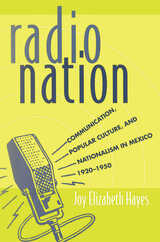
The role of mass communication in nation building has often been underestimated, particularly in the case of Mexico. Following the Revolution, the Mexican government used the new medium of radio to promote national identity and build support for the new regime. Joy Hayes now tells how an emerging country became a radio nation.
This groundbreaking book investigates the intersection of radio broadcasting and nation building. Hayes tells how both government-controlled and private radio stations produced programs of distinctly Mexican folk and popular music as a means of drawing the country's regions together and countering the influence of U.S. broadcasts.
Hayes describes how, both during and after the period of cultural revolution, Mexican radio broadcasting was shaped by the clash and collaboration of different social forces--including U.S. interests, Mexican media entrepreneurs, state institutions, and radio audiences. She traces the evolution of Mexican radio in case studies that focus on such subjects as early government broadcasting activities, the role of Mexico City media elites, the "paternal voice" of presidential addresses, and U.S. propaganda during World War II.
More than narrative history, Hayes's study provides an analytical framework for understanding the role of radio in building Mexican nationalism at a critical time in that nation's history. Radio Nation expands our appreciation of an overlooked medium that changed the course of an entire country.
"Professor Popkin has brought V.O. Key's contention that voters are rational into the media age. This book is a useful rebuttal to the cynical view that politics is a wholly contrived business, in which unscrupulous operatives manipulate the emotions of distrustful but gullible citizens. The reality, he shows, is both more complex and more hopeful than that."—David S. Broder, The Washington Post
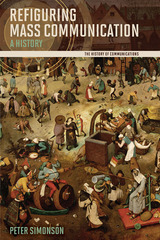
This unique inquiry into the history and ongoing moral significance of mass communication also represents a defense, extension, and overhaul of the idea and social form of the discipline. Organized around narrative accounts of individuals and their communicative worlds, Refiguring Mass Communication illuminates significant but overlooked rhetorical episodes in history to enable modern-day readers to rehabilitate and reinvigorate their own engagements with mass communication.
Coined in the 1920s as a way to describe radio, motion pictures, wide-circulation magazines, and the press, the term "mass communication" frequently is misused in the era of cable TV, niche marketing, and the Internet. In Refiguring Mass Communication, Peter Simonson compares his own vision of mass communication with distinct views articulated throughout history by Paul of Tarsus, Walt Whitman, Charles Horton Cooley, David Sarnoff, and Robert K. Merton, utilizing a collection of texts and tenets from a variety of time periods and perspectives. Drawing on textual and archival research as well as access to Merton's personal papers, Simonson broadly reconceives a sense of communication theory and what social processes might be considered species of mass communication. Simonson reveals the geographical and social contexts from which these visions have emerged and the religious and moral horizons against which they have taken shape. In a unique perspective, he considers the American county fair as an example of a live gathering and crucial site that is overlooked in contemporary forms of mass communication, urging a reconsideration of how individuals participate in and shape similar forms.

The Rhetoric of Cool addresses the disciplinary claim that composition studies underwent a rebirth in 1963. At that time, three writers reviewed technology, cultural studies, and visual writing outside composition studies and independently used the word cool to describe each position. Starting from these three positions, Rice focuses on chora, appropriation, commutation, juxtaposition, nonlinearity, and imagery—rhetorical gestures conducive to new media work-- to construct the rhetoric of cool.
An innovative work that approaches computers and writing issues from historical, critical, theoretical, and practical perspectives, The Rhetoric of Cool challenges current understandings of writing and new media and proposes a rhetorical rather than an instrumental response for teaching writing in new media contexts.
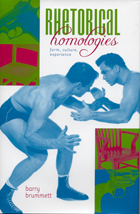
A highly developed study of the relationships between rhetoric and public culture.
One of the most widely used ideas in scholarship of the humanities and social sciences is that of homology: a formal pattern structuring different kinds of texts, ideas, and experiences. Rhetorical Homologies explores the central meaning of this form in a variety of discourses and also examines the kind of homologies that shape audience responses to personal, public, and political issues. Barry Brummett is most interested in homologies among very different orders of experience and texts: experiences on the battlefield that are homologous to those at a dining room table, for instance. What the common patterns that underlie such cases mean, why they are interesting, and why homology is rhetorical are the subjects of this study.
Brummett focuses on a wide range of topics, from the homologies between rhetoric and weapons throughout history to the homology of ritual injuries as manifested in representations of Christian martyrs, Laurel and Hardy films, the African-American practice of playing the dozens, and televised professional wrestling. Brummett also explores the homology of the Wise Woman, using rhetorical representations of Sojourner Truth and Oprah Winfrey. In a concluding chapter, Brummett argues that the idea of homology is important in understanding how social life is organized in general and that the centrality of discourse in organizing experience makes rhetorical homologies an important perspective for general knowledge beyond the boundaries of this study.

Ruthless Criticism was first published in 1993. Minnesota Archive Editions uses digital technology to make long-unavailable books once again accessible, and are published unaltered from the original University of Minnesota Press editions.
Ruthless Criticism offers perspectives and subjects largely outside traditional historiography. It broadens the concept of media history to include lesser-studied media, and offers alternative interpretations of traditional media.
This anthology of original research includes an array of scholarly and theoretical perspectives. Each addresses specific topic within a specific era. reflecting the diversity of U.S. mass media.
Solomon and McChesney begin by using critical theory and deconstruction to examine the meanings of print in the colonial era. Subsequent chapters study the media ecology of the antebellum press; the intense focus on profits of the post-Civil War mainstream press; gender images in the labor press; the diversity of political views within the working-class press; and the development of a commercial press in the black community.
The essays concerning the twentieth century focus on the rise of a culture industry and include studies on the origins of the broadcast ratings system and the commercial broadcast system and the commercial broadcast system, early television's portrayals of childhood, the televisions networks' close ties with the federal government, the government's key role in creating and developing the field of mass communication research, and teenage girls' popular culture from 1960–1968 as a formative influence on the feminist movement.
READERS
Browse our collection.
PUBLISHERS
See BiblioVault's publisher services.
STUDENT SERVICES
Files for college accessibility offices.
RECENTLY PUBLISHED



UChicago Accessibility Resources
home | accessibility | search | about | contact us
BiblioVault ® 2001 - 2024
The University of Chicago Press