
 A SCHOLARLY BOOK REPOSITORY
Results by Title
4 books about Constitutional Democracy
4 books about Constitutional Democracy
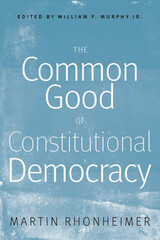
The Common Good of Constitutional Democracy
Essays in Political Philosophy and on Catholic Social Teaching
Martin Rhonheimer
Catholic University of America Press, 2013
The Common Good of Constitutional Democracy offers a rich collection of essays in political philosophy by Swiss philosopher Martin Rhonheimer. Like his other books in both ethical theory and applied ethics, which have recently been published in English, the essays included are distinguished by the philosophical rigor and meticulous attention to the primary and secondary literature of the various topics discussed
[more]

Constitutional Democracy
János Kis
Central European University Press, 2003
Constitutional democracy addresses the widely held belief that liberal democracy embodies an uneasy compromise of incompatible values: those of liberal rights on the one hand, and democratic equality on the other. Liberalism is said to compromise democracy, while democracy is said to endanger the values of liberalism. It is these theses that János Kis examines and tries to refute. Making the assumption that the alleged conflict is to be resolved at the level of institutions, he outlines a new theory of constitutional democracy. A wide range of problems encountered in constitutional democracy are discussed, such as the popular vote, popular sovereignty, and non-elected justices. The volume is composed of three parts. Part One, "Public Good and Civic Virtue", revisits the debate between liberals and democrats on how to interpret the democratic vote. In Part Two, "Liberal Democracy", the author proves that on the level of principles there is no incompatibility between liberalism and democracy and that liberal theory can demonstrate that democratic values follow from fundamental liberal values. In Part Three, "Constitutional Adjudication in a Democracy", the compatibility of democracy and judicial or constitutional review is analyzed and a theory of constitutionalism is outlined. This volume appeals to scholars in political philosophy, political science, and constitutional law, but is also recommended to all those interested in liberal and democratic theory, and the transition to democracy in Central and Eastern Europe.
[more]
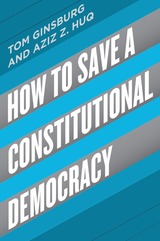
How to Save a Constitutional Democracy
Tom Ginsburg and Aziz Z. Huq
University of Chicago Press, 2018
Democracies are in danger. Around the world, a rising wave of populist leaders threatens to erode the core structures of democratic self-rule. In the United States, the tenure of Donald Trump has seemed decisive turning point for many. What kind of president intimidates jurors, calls the news media the “enemy of the American people,” and seeks foreign assistance investigating domestic political rivals? Whatever one thinks of President Trump, many think the Constitution will safeguard us from lasting damage. But is that assumption justified?
How to Save a Constitutional Democracy mounts an urgent argument that we can no longer afford to be complacent. Drawing on a rich array of other countries’ experiences with democratic backsliding, Tom Ginsburg and Aziz Z. Huq show how constitutional rules can both hinder and hasten the decline of democratic institutions. The checks and balances of the federal government, a robust civil society and media, and individual rights—such as those enshrined in the First Amendment—often fail as bulwarks against democratic decline. The sobering reality for the United States, Ginsburg and Huq contend, is that the Constitution’s design makes democratic erosion more, not less, likely. Its structural rigidity has had unforeseen consequence—leaving the presidency weakly regulated and empowering the Supreme Court conjure up doctrines that ultimately facilitate rather than inhibit rights violations. Even the bright spots in the Constitution—the First Amendment, for example—may have perverse consequences in the hands of a deft communicator who can degrade the public sphere by wielding hateful language banned in many other democracies. We—and the rest of the world—can do better. The authors conclude by laying out practical steps for how laws and constitutional design can play a more positive role in managing the risk of democratic decline.
How to Save a Constitutional Democracy mounts an urgent argument that we can no longer afford to be complacent. Drawing on a rich array of other countries’ experiences with democratic backsliding, Tom Ginsburg and Aziz Z. Huq show how constitutional rules can both hinder and hasten the decline of democratic institutions. The checks and balances of the federal government, a robust civil society and media, and individual rights—such as those enshrined in the First Amendment—often fail as bulwarks against democratic decline. The sobering reality for the United States, Ginsburg and Huq contend, is that the Constitution’s design makes democratic erosion more, not less, likely. Its structural rigidity has had unforeseen consequence—leaving the presidency weakly regulated and empowering the Supreme Court conjure up doctrines that ultimately facilitate rather than inhibit rights violations. Even the bright spots in the Constitution—the First Amendment, for example—may have perverse consequences in the hands of a deft communicator who can degrade the public sphere by wielding hateful language banned in many other democracies. We—and the rest of the world—can do better. The authors conclude by laying out practical steps for how laws and constitutional design can play a more positive role in managing the risk of democratic decline.
[more]
How to Save a Constitutional Democracy
Tom Ginsburg and Aziz Z. Huq
University of Chicago Press, 2018
This is an auto-narrated audiobook version of this book.
Democracies are in danger. Around the world, a rising wave of populist leaders threatens to erode the core structures of democratic self-rule. In the United States, the tenure of Donald Trump has seemed decisive turning point for many. What kind of president intimidates jurors, calls the news media the “enemy of the American people,” and seeks foreign assistance investigating domestic political rivals? Whatever one thinks of President Trump, many think the Constitution will safeguard us from lasting damage. But is that assumption justified?
How to Save a Constitutional Democracy mounts an urgent argument that we can no longer afford to be complacent. Drawing on a rich array of other countries’ experiences with democratic backsliding, Tom Ginsburg and Aziz Z. Huq show how constitutional rules can both hinder and hasten the decline of democratic institutions. The checks and balances of the federal government, a robust civil society and media, and individual rights—such as those enshrined in the First Amendment—often fail as bulwarks against democratic decline. The sobering reality for the United States, Ginsburg and Huq contend, is that the Constitution’s design makes democratic erosion more, not less, likely. Its structural rigidity has had unforeseen consequence—leaving the presidency weakly regulated and empowering the Supreme Court conjure up doctrines that ultimately facilitate rather than inhibit rights violations. Even the bright spots in the Constitution—the First Amendment, for example—may have perverse consequences in the hands of a deft communicator who can degrade the public sphere by wielding hateful language banned in many other democracies. We—and the rest of the world—can do better. The authors conclude by laying out practical steps for how laws and constitutional design can play a more positive role in managing the risk of democratic decline.
Democracies are in danger. Around the world, a rising wave of populist leaders threatens to erode the core structures of democratic self-rule. In the United States, the tenure of Donald Trump has seemed decisive turning point for many. What kind of president intimidates jurors, calls the news media the “enemy of the American people,” and seeks foreign assistance investigating domestic political rivals? Whatever one thinks of President Trump, many think the Constitution will safeguard us from lasting damage. But is that assumption justified?
How to Save a Constitutional Democracy mounts an urgent argument that we can no longer afford to be complacent. Drawing on a rich array of other countries’ experiences with democratic backsliding, Tom Ginsburg and Aziz Z. Huq show how constitutional rules can both hinder and hasten the decline of democratic institutions. The checks and balances of the federal government, a robust civil society and media, and individual rights—such as those enshrined in the First Amendment—often fail as bulwarks against democratic decline. The sobering reality for the United States, Ginsburg and Huq contend, is that the Constitution’s design makes democratic erosion more, not less, likely. Its structural rigidity has had unforeseen consequence—leaving the presidency weakly regulated and empowering the Supreme Court conjure up doctrines that ultimately facilitate rather than inhibit rights violations. Even the bright spots in the Constitution—the First Amendment, for example—may have perverse consequences in the hands of a deft communicator who can degrade the public sphere by wielding hateful language banned in many other democracies. We—and the rest of the world—can do better. The authors conclude by laying out practical steps for how laws and constitutional design can play a more positive role in managing the risk of democratic decline.
[more]
READERS
Browse our collection.
PUBLISHERS
See BiblioVault's publisher services.
STUDENT SERVICES
Files for college accessibility offices.
RECENTLY PUBLISHED



UChicago Accessibility Resources
home | accessibility | search | about | contact us
BiblioVault ® 2001 - 2025
The University of Chicago Press