
 A SCHOLARLY BOOK REPOSITORY
Results by Title
2 books about Constitutional Logic
2 books about Constitutional Logic

Blueprints for a House Divided
The Constitutional Logic of the Yugoslav Conflicts
Robert M. Hayden
University of Michigan Press, 2000
If a house divided against itself cannot stand, does it help to declare it a condominium? This book examines why the common Yugoslav and Bosnian houses came to be divided, and how international diplomatic activities to resolve the conflicts have been misconceived. Through an analysis that combines cultural examination and constitutional study, Robert Hayden argues that almost everything that has happened in the former Yugoslavia since 1989 is congruent with the logic of the politicians who won election in the free and fair elections of 1990 and with the constitutional structures that these politicians have created. Once the idea of a common state for all of the Yugoslav peoples lost electorally, the conflicts that followed were so logical as to be inescapable. Throughout, the analysis relies almost exclusively on materials from the former Yugoslavia itself and on what participants said to each other in their own languages rather than in English to the world community. Drawing on the work of Max Weber and Tzvetan Todorov, this book also discusses the ethical and moral dangers of ignoring the probable consequences of actions that might be desirable in the abstract. A major conclusion is that the actions of the international community were never likely to achieve their stated goals, because they were based on premises unrelated to those driving the Yugoslav peoples themselves. This book addresses issues of interest in anthropology, political science, international relations, law, ethics, East European studies, and policy making.
[more]
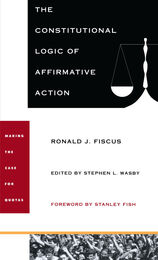
The Constitutional Logic of Affirmative Action
Ronald J. Fiscus
Duke University Press, 1992
Few issues are as mired in rhetoric and controversy as affirmative action. This is certainly no less true now as when Ronald J. Fiscus’s The Constitutional Logic of Affirmative Action was first published in 1992. The controversy has, perhaps, become more charged over the past few years. With this compelling and rigorously reasoned argument for a constitutional rationale of affirmative action, Fiscus clarifies the moral and legal ramifications of this complex subject and presents an important view in the context of the ongoing debate.
Beginning with a distinction drawn between principles of compensatory and distributive justice, Fiscus argues that the former, although often the basis for judgments made in individual discrimination cases, cannot sufficiently justify broad programs of affirmative action. Only a theory of distributive justice, one that assumes minorities have a right to what they would have gained proportionally in a nonracist society, can persuasively provide that justification. On this basis, the author argues in favor of proportional racial quotas—and challenges the charge of “reverse discrimination” raised in protest in the name of the “innocent victims” of affirmative action—as an action necessary to approach the goals of fairness and equality.
The Constitutional Logic of Affirmative Action focuses on Supreme Court affirmative action rulings from Bakke (1976) to Croson (1989) and includes an epilogue by editor Stephen L. Wasby that considers developments through 1995. General readers concerned with racial justice, affirmative action, and public policy, as well as legal specialists and constitutional scholars will find Fiscus’s argument passionate, balanced, and persuasive.
Beginning with a distinction drawn between principles of compensatory and distributive justice, Fiscus argues that the former, although often the basis for judgments made in individual discrimination cases, cannot sufficiently justify broad programs of affirmative action. Only a theory of distributive justice, one that assumes minorities have a right to what they would have gained proportionally in a nonracist society, can persuasively provide that justification. On this basis, the author argues in favor of proportional racial quotas—and challenges the charge of “reverse discrimination” raised in protest in the name of the “innocent victims” of affirmative action—as an action necessary to approach the goals of fairness and equality.
The Constitutional Logic of Affirmative Action focuses on Supreme Court affirmative action rulings from Bakke (1976) to Croson (1989) and includes an epilogue by editor Stephen L. Wasby that considers developments through 1995. General readers concerned with racial justice, affirmative action, and public policy, as well as legal specialists and constitutional scholars will find Fiscus’s argument passionate, balanced, and persuasive.
[more]
READERS
Browse our collection.
PUBLISHERS
See BiblioVault's publisher services.
STUDENT SERVICES
Files for college accessibility offices.
RECENTLY PUBLISHED






UChicago Accessibility Resources
home | accessibility | search | about | contact us
BiblioVault ® 2001 - 2026
The University of Chicago Press