
 A SCHOLARLY BOOK REPOSITORY
Results by Title
3 books about Consumer goods
3 books about Consumer goods
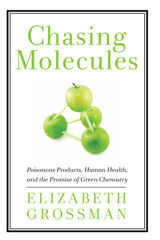
Chasing Molecules
Poisonous Products, Human Health, and the Promise of Green Chemistry
Elizabeth Grossman
Island Press, 2011
Each day, headlines warn that baby bottles are leaching dangerous chemicals, nonstick pans are causing infertility, and plastic containers are making us fat. What if green chemistry could change all that? What if rather than toxics, our economy ran on harmless, environmentally-friendly materials?
Elizabeth Grossman, an acclaimed journalist who brought national attention to the contaminants hidden in computers and other high tech electronics, now tackles the hazards of ordinary consumer products. She shows that for the sake of convenience, efficiency, and short-term safety, we have created synthetic chemicals that fundamentally change, at a molecular level, the way our bodies work. The consequences range from diabetes to cancer, reproductive and neurological disorders.
Yet it’s hard to imagine life without the creature comforts current materials provide—and Grossman argues we do not have to. A scientific revolution is introducing products that are “benign by design,” developing manufacturing processes that consider health impacts at every stage, and is creating new compounds that mimic rather than disrupt natural systems. Through interviews with leading researchers, Grossman gives us a first look at this radical transformation.
Green chemistry is just getting underway, but it offers hope that we can indeed create products that benefit health, the environment, and industry.
Elizabeth Grossman, an acclaimed journalist who brought national attention to the contaminants hidden in computers and other high tech electronics, now tackles the hazards of ordinary consumer products. She shows that for the sake of convenience, efficiency, and short-term safety, we have created synthetic chemicals that fundamentally change, at a molecular level, the way our bodies work. The consequences range from diabetes to cancer, reproductive and neurological disorders.
Yet it’s hard to imagine life without the creature comforts current materials provide—and Grossman argues we do not have to. A scientific revolution is introducing products that are “benign by design,” developing manufacturing processes that consider health impacts at every stage, and is creating new compounds that mimic rather than disrupt natural systems. Through interviews with leading researchers, Grossman gives us a first look at this radical transformation.
Green chemistry is just getting underway, but it offers hope that we can indeed create products that benefit health, the environment, and industry.
[more]

Redeeming Objects
A West German Mythology
Natalie Scholz
University of Wisconsin Press, 2023
Redeeming Objects traces the afterlives of things. Out of the rubble of World War II and the Holocaust, the Federal Republic of Germany emerged, and with it a foundational myth of the “economic miracle.” In this narrative, a new mass consumer society based on the production, export, and consumption of goods would redeem West Germany from its Nazi past and drive its rebirth as a truly modern nation. Turning this narrative on its head, Natalie Scholz shows that West Germany’s consumerist ideology took shape through the reinvention of commodities previously tied to Nazism into symbols of Germany’s modernity, economic supremacy, and international prestige.
Postwar advertising, film, and print culture sought to divest mass-produced goods—such as the Volkswagen and modern interiors—of their fascist legacies. But Scholz demonstrates that postwar representations were saturated with unacknowledged references to the Nazi past. Drawing on a vast array of popular and highbrow publications and films, Redeeming Objects adds a new perspective to debates about postwar reconstruction, memory, and consumerism.
Postwar advertising, film, and print culture sought to divest mass-produced goods—such as the Volkswagen and modern interiors—of their fascist legacies. But Scholz demonstrates that postwar representations were saturated with unacknowledged references to the Nazi past. Drawing on a vast array of popular and highbrow publications and films, Redeeming Objects adds a new perspective to debates about postwar reconstruction, memory, and consumerism.
[more]
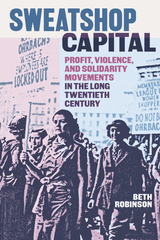
Sweatshop Capital
Profit, Violence, and Solidarity Movements in the Long Twentieth Century
Beth Robinson
Duke University Press, 2025
In Sweatshop Capital, Beth Robinson examines the brutal sweatshop labor conditions that produced American consumer goods from the late nineteenth through the early twenty-first centuries, as well as the labor and social movements that contested them. Arguing that sweatshop labor is a persistent feature of capitalism, she shows how manufacturers used both their influence in government and their mobility to sidestep US labor laws, maximize profits, and perpetuate abuses. She outlines how workers and their allies routinely confronted manufacturers by building solidarity networks across race, class, and national lines. Drawing on activists’ literature, news accounts, archival sources, and oral histories, Robinson presents the long history of the antisweatshop movements that responded to American capital’s pursuit of profit through hyperexploitation with a wide range of protest, legal action, and creativity. Beginning with the sweatshops and reformers of the Progressive Era, Robinson moves through the Great Depression and the activism of the Popular Front, the “free trade” globalization of the 1990s and its discontents, and, finally, the global cyber and gig economies of the twenty-first century and the growing movements to rein them in.
[more]
READERS
Browse our collection.
PUBLISHERS
See BiblioVault's publisher services.
STUDENT SERVICES
Files for college accessibility offices.
RECENTLY PUBLISHED






UChicago Accessibility Resources
home | accessibility | search | about | contact us
BiblioVault ® 2001 - 2025
The University of Chicago Press