
 A SCHOLARLY BOOK REPOSITORY
Results by Title
2 books about Crawford, Ronald Lyndsay
2 books about Crawford, Ronald Lyndsay
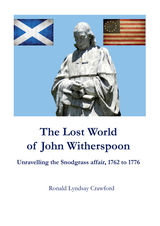
The Lost World of John Witherspoon
Unravelling the Snodgrass affair, 1762 to 1776
Ronald Lyndsey Crawford
Aberdeen University Press, 2015
John Witherspoon (1723 – 1794) is remembered today as one of only two Scots among the 56 ‘signers’ of the Declaration of American Independence and the only clergyman to have added his name to the list of founding fathers of the nation that was set to become the United States. On that basis alone, Witherspoon earns his place as an important figure in the early history of the ‘Empire of Liberty’ – even though he has been described by some American scholars as the ‘forgotten Founder.’
But Witherspoon had two careers. His American career (as College President at Princeton and an influential politician in the revolutionary and immediate post-revolutionary war period) has understandably tended to overshadow his earlier career in Scotland as a leading light within the Popular (or Evangelical) party in the Church of Scotland at a time when the Kirk was dominated by the Moderates led by such men as William Robertson, Hugh Blair and Alexander ‘Jupiter’ Carlyle. This study shows that he had few friends among the preponderance of Moderate ministerial colleagues in the Presbytery of Paisley.
The ground-breaking research underpinning this book reveals for the first time the full astonishing story of Witherspoon’s involvement in an action against him in the Court of Session in Edinburgh, a process that was begun by a lawyer, John Snodgrass, and five others in 1762 and was not determined until 1776, by which time the Paisley minister had long left Scotland for a new life as sixth President of the College of New Jersey. The process would engage the professional skills of some of the most celebrated figures in Scottish advocacy of the period, including George Wallace, Henry Dundas, David Dalrymple, Charles Hay and Andrew Crosbie.
In an important ‘Concluding Essay’ the author makes a convincing case for the Snodgrass affair having influenced Witherspoon’s decision to make a new life for himself and his family in America, demolishing the traditional view that it was somehow irrelevant to that decision.
But Witherspoon had two careers. His American career (as College President at Princeton and an influential politician in the revolutionary and immediate post-revolutionary war period) has understandably tended to overshadow his earlier career in Scotland as a leading light within the Popular (or Evangelical) party in the Church of Scotland at a time when the Kirk was dominated by the Moderates led by such men as William Robertson, Hugh Blair and Alexander ‘Jupiter’ Carlyle. This study shows that he had few friends among the preponderance of Moderate ministerial colleagues in the Presbytery of Paisley.
The ground-breaking research underpinning this book reveals for the first time the full astonishing story of Witherspoon’s involvement in an action against him in the Court of Session in Edinburgh, a process that was begun by a lawyer, John Snodgrass, and five others in 1762 and was not determined until 1776, by which time the Paisley minister had long left Scotland for a new life as sixth President of the College of New Jersey. The process would engage the professional skills of some of the most celebrated figures in Scottish advocacy of the period, including George Wallace, Henry Dundas, David Dalrymple, Charles Hay and Andrew Crosbie.
In an important ‘Concluding Essay’ the author makes a convincing case for the Snodgrass affair having influenced Witherspoon’s decision to make a new life for himself and his family in America, demolishing the traditional view that it was somehow irrelevant to that decision.
[more]
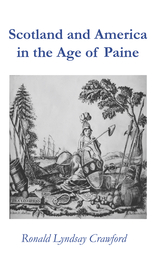
Scotland and America in the Age of Paine
Ronald Lyndsey Crawford
Aberdeen University Press, 2022
Thomas Paine is rightly regarded as among the most influential of English political iconoclasts. His two best-known works – Common Sense (1776) and Rights of Man (1791) – ensured his remarkable success in positioning himself, both literally and literarily, at the forefront of both the American and French revolutions. It is no exaggeration that Paine’s works lie at the heart of popular revolutionary sentiment as it came to express itself in the later eighteenth century. For that reason they were regarded at one level as manifestos of the crying need for social and political change, but at the same time by government and the law as dangerous instruments of sedition and republicanism. Ronald Crawford explores how, in both Scotland and America, Paine’s brand of radicalism took particular hold, though only for a limited period – the ‘Age of Paine’.
Part One of the book explores American themes discoverable in the works of Francis Hutcheson, David Hume, Adam Smith and Adam Ferguson; the explosive political impact within Scotland of Rights of Man (1776); and how Scottish precedents, through the writings of Benjamin Franklin and Thomas Jefferson, helped shape the educational system of the early United States.
Part Two examines the careers of four Scots emigrants who made distinguished contributions to the American ideal of liberty: the ‘bookman’ Robert Aitken who employed Paine as contributing editor of his Pennsylvania Magazine; John Witherspoon, President of the College of New Jersey, one of the signatories to the Declaration of Independence in 1776; the radical poet, Alexander Wilson, whose (very different) Scottish and American careers are re-examined with the help of newly found original sources; and the lawyer from Fife, James Wilson, another signer, whose remarkable contributions to the evolution of the US Constitution are considered from the point of view of his indebtedness to numerous Scottish sources.
Part One of the book explores American themes discoverable in the works of Francis Hutcheson, David Hume, Adam Smith and Adam Ferguson; the explosive political impact within Scotland of Rights of Man (1776); and how Scottish precedents, through the writings of Benjamin Franklin and Thomas Jefferson, helped shape the educational system of the early United States.
Part Two examines the careers of four Scots emigrants who made distinguished contributions to the American ideal of liberty: the ‘bookman’ Robert Aitken who employed Paine as contributing editor of his Pennsylvania Magazine; John Witherspoon, President of the College of New Jersey, one of the signatories to the Declaration of Independence in 1776; the radical poet, Alexander Wilson, whose (very different) Scottish and American careers are re-examined with the help of newly found original sources; and the lawyer from Fife, James Wilson, another signer, whose remarkable contributions to the evolution of the US Constitution are considered from the point of view of his indebtedness to numerous Scottish sources.
[more]
READERS
Browse our collection.
PUBLISHERS
See BiblioVault's publisher services.
STUDENT SERVICES
Files for college accessibility offices.
RECENTLY PUBLISHED




UChicago Accessibility Resources
home | accessibility | search | about | contact us
BiblioVault ® 2001 - 2026
The University of Chicago Press