
 A SCHOLARLY BOOK REPOSITORY
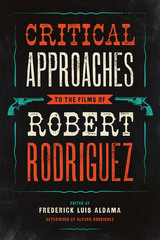
Frederick Aldama’s The Cinema of Robert Rodriguez (2014) was the first full-scale study of one of the most prolific and significant Latino directors making films today. In this companion volume, Aldama enlists a corps of experts to analyze a majority of Rodriguez’s feature films, from his first break-out success El Mariachi in 1992 to Machete in 2010. The essays explore the formal and thematic features present in his films from the perspectives of industry (context, convention, and distribution), the film blueprint (auditory and visual ingredients), and consumption (ideal and real audiences). The authors illuminate the manifold ways in which Rodriguez’s films operate internally (plot, character, and event) and externally (audience perception, thought, and feeling).
The volume is divided into three parts: “Matters of Mind and Media” includes essays that use psychoanalytic and cognitive psychology to shed light on how Rodriguez’s films complicate Latino identity, as well as how they succeed in remaking audiences’ preconceptions of the world. “Narrative Theory, Cognitive Science, and Sin City: A Case Study” offers tools and models of analysis for the study of Rodriguez’s film re-creation of a comic book (on which Frank Miller was credited as codirector). “Aesthetic and Ontological Border Crossings and Borderlands” considers how Rodriguez’s films innovatively critique fixed notions of Latino identity and experience, as well as open eyes to racial injustices. As a whole, the volume demonstrates how Rodriguez’s career offers critical insights into the filmmaking industry, the creative process, and the consuming and reception of contemporary film.

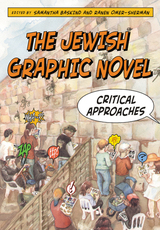
The Jewish Graphic Novel is a lively, interdisciplinary collection of essays that addresses critically acclaimed works in this subgenre of Jewish literary and artistic culture. Featuring insightful discussions of notable figures in the industryùsuch as Will Eisner, Art Spiegelman, and Joann Sfarùthe essays focus on the how graphic novels are increasingly being used in Holocaust memoir and fiction, and to portray Jewish identity in America and abroad
Featuring more than 85 illustrations, this collection is a compelling representation of a major postmodern ethnic and artistic achievement.
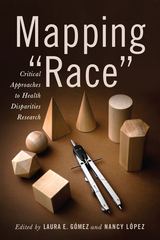
Contributors: John A. Garcia, Arline T. Geronimus, Laura E. Gómez, Joseph L. Graves Jr., Janet E. Helms, Derek Kenji Iwamoto, Jonathan Kahn, Jay S. Kaufman, Mai M. Kindaichi, Simon J. Craddock Lee, Nancy López, Ethan H. Mereish, Matthew Miller, Gabriel R. Sanchez, Aliya Saperstein, R. Burciaga Valdez, Vicki D. Ybarra
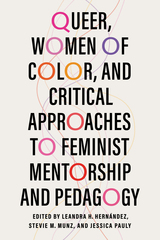
The first section draws upon the contributors’ unique and situated experiences of mentorship in academia. Essays explore their past and current experiences with feminist mentorship in relationships that take many forms: faculty members with fellow faculty members; faculty members with undergraduate and graduate students; and faculty members who feel as if they have become family with their mentors and mentees. In the second section, the contributors deeply interrogate the practices of feminist mentoring by problematizing practices and offering new ways, places, and formats that make space and consider new possibilities. A conclusion reflects on the future of feminist mentorship amidst contemporary debates and concerns in higher education.
Enriching and hopeful, Queer, Women of Color, and Critical Approaches to Feminist Mentorship and Pedagogy is a much-needed challenge to traditional forms of mentorship.

Ann Miller’s groundbreaking book not only parses bande dessinée as visual narrative art, but it shows readers how to study it, as she places these comic strips in the context of debates surrounding the form’s legitimization, approaches it from a cultural studies perspective, and examines bande dessinée in its relationship to subjectivity in the body. Miller here illuminates such disparate concepts as Astérix and the mythologizing of Frenchness, historical memory and the Algerian war, and characterizations of the new managerial bourgeoisie in the context of Francophone comic strips. Reading Bande Dessinée will help lay a scholarly foundation for the growing interest in this captivating art form in the Anglophone world.
“The work provides both a key analysis for scholars of the bande dessinée, as well as a manual for a modern application of critical theory.”—Dr. Laurence Grove, University of Glasgow
READERS
Browse our collection.
PUBLISHERS
See BiblioVault's publisher services.
STUDENT SERVICES
Files for college accessibility offices.
RECENTLY PUBLISHED




UChicago Accessibility Resources
home | accessibility | search | about | contact us
BiblioVault ® 2001 - 2025
The University of Chicago Press