
 A SCHOLARLY BOOK REPOSITORY

How ancient Greek democracies wrestled with the tension between egalitarianism and hierarchical structures necessary for organized government.
Democracy and egalitarianism are ever in tension. The ideal of direct democracy—equal participation in all aspects of governance—coexists with the reality that hierarchical structures are necessary to organize and stabilize the workings of the state. This tension consumed America’s founders. And two thousand years earlier, it had consumed the people of Athens.
King Demos shows how ancient Greek democracies wrestled with this problem, crafting what the Federalist Papers would later dream of, “a republican remedy for the diseases most incident to republican government.” As Athens grew and direct democracy became unwieldy, the Greeks developed a system of delegation, with the “people” (demos) conceived as a king with authority over a sprawling system of state officials whose day-to-day operation was handled by experts. Hierarchical structures became commonplace in the city, yet sovereign powers remained with the citizenry. Andrew Alwine argues that delegation was a stepping stone between direct and representative democracy and provided a crucial compromise, enabling the Greeks to benefit from the abilities of elite citizens while also keeping them under control.
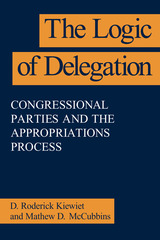
In The Logic of Delegation, however, D. Roderick Kiewiet and Mathew D. McCubbins persuasively argue that political scientists have paid far too much attention to what congressional parties can't do. The authors draw on economic and management theory to demonstrate that the effectiveness of delegation is determined not by how much authority is delegated but rather by how well it is delegated.
In the context of the appropriations process, the authors show how congressional parties employ committees, subcommittees, and executive agencies to accomplish policy goals. This innovative study will force a complete rethinking of classic issues in American politics: the "autonomy" of congressional committees; the reality of runaway federal bureaucracy; and the supposed dominance of the presidency in legislative-executive relations.
READERS
Browse our collection.
PUBLISHERS
See BiblioVault's publisher services.
STUDENT SERVICES
Files for college accessibility offices.
RECENTLY PUBLISHED







UChicago Accessibility Resources
home | accessibility | search | about | contact us
BiblioVault ® 2001 - 2026
The University of Chicago Press