
 A SCHOLARLY BOOK REPOSITORY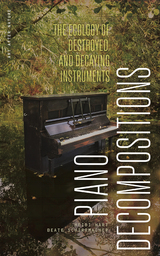
Examining musical instrument destruction through an ecological and intermedial lens
Musical instruments are typically seen as objects both used and maintained with ritualistic care. But what happens when they’re tossed from homes in mudslides, burned during ecstatic parties, or waterlogged by pop stars in viral videos—and how do these elemental interactions transform the way we see and play instruments? Piano Decompositions asks what happens when we let go of controlling musical instruments. What kind of meanings start to sound when instruments are moved out of the protected cultural space and engage with their surrounding elements?
Heidi Hart and Beate Schirrmacher trace the history of destroyed and decaying pianos, both sorting them within the realm of artistic violence against instruments and following their return journeys into water, sand, and soil. They parse the artistic vision of Annea Lockwood, whose iconic burning, drowning, and decaying Piano Transplants presented a novel means of drawing attention to the increasing threats of climate change in the 1960s and ’70s. Turning to instruments made from found materials and others played collaboratively with wind and water, they demonstrate how human sound making is entangled in the more-than-human world.
Showing how the piano can transform conversations around the Anthropocene and environmental destruction, Hart and Schirrmacher find the instrument to be a potent creative and ecological force, a medium to connect with environments in an explorative, attentive way. Piano Decompositions unearths new ways to relate our concepts of curiosity, pleasure, and music to the natural world.
Retail e-book files for this title are screen-reader friendly with images accompanied by short alt text and/or extended descriptions.
For three decades, Native American history has been dominated by two major themes. The first is "The Cant of Conquest," the notion that all native peoples who came into contact with Europeans suffered devastating effects due to disease, alcohol, and warfare. However, the argument can be made that in some cases native peoples controlled their own fortunes, at least for awhile. The other dominant theme is the "The Contest of Cultures," the idea that Native American history needs to be examined in the context of dealings with Europeans. Europeans changed the Americas, but this approach concerns colonialism and colonists as well as Native Americans.
The Renewed, the Destroyed, and the Remade examines the changing worldviews of the Huron and the Iroquois in the first half of the seventeenth century, during a period of increasing European contact. From Samuel de Champlain’s armed encounter with the Iroquois, in 1609, to the dispersal of the Huron in the mid-seventeenth century, Carpenter’s book traces the evolving thought worlds of Iroquoian peoples.
The Iroquois and the Huron-peoples with an intertwined history and many cultural similarities-reacted differently to European contact. The Huron thought world began to change when the French initiated intense trade and missionary activity early in the seventeenth century. French missionary efforts resulted in a split within the Huron nation between traditionalists and Christian converts. By contrast, the Iroquois were interested primarily in trade with the newcomers. The Iroquois, like the Huron, accepted European trade goods, but unlike the Huron, they rejected European religion.
The Renewed, the Destroyed, and the Remade differs from other works of Native American history on several counts. Native American historiography has not been overly comparative. This work is a comparative history of two culturally similar Native American nations. It also differs in that, rather than another history of Native-European contacts, it is an Indian-centered history.
READERS
Browse our collection.
PUBLISHERS
See BiblioVault's publisher services.
STUDENT SERVICES
Files for college accessibility offices.
RECENTLY PUBLISHED



UChicago Accessibility Resources
home | accessibility | search | about | contact us
BiblioVault ® 2001 - 2026
The University of Chicago Press