logo for Georgetown University Press
The China-India Rivalry in the Globalization Era
T.V. Paul, Editor
Georgetown University Press, 2018

As the aspirations of the two rising Asian powers collide, the China-India rivalry is likely to shape twenty-first-century international politics in the region and far beyond.

This volume by T.V. Paul and an international group of leading scholars examines whether the rivalry between the two countries that began in the 1950s will intensify or dissipate in the twenty-first century. The China-India relationship is important to analyze because past experience has shown that when two rising great powers share a border, the relationship is volatile and potentially dangerous. India and China’s relationship faces a number of challenges, including multiple border disputes that periodically flare up, division over the status of Tibet and the Dalai Lama, the strategic challenge to India posed by China's close relationship with Pakistan, the Chinese navy's greater presence in the Indian Ocean, and the two states’ competition for natural resources. Despite these irritants, however, both countries agree on issues such as global financial reforms and climate change and have much to gain from increasing trade and investment, so there are reasons for optimism as well as pessimism.

The contributors to this volume answer the following questions: What explains the peculiar contours of this rivalry? What influence does accelerated globalization, especially increased trade and investment, have on this rivalry? What impact do US-China competition and China’s expanding navy have on this rivalry? Under what conditions will it escalate or end? The China-India Rivalry in the Globalization Era will be of great interest to students, scholars, and policymakers concerned with Indian and Chinese foreign policy and Asian security.

[more]

logo for University of Illinois Press
The Dynamics of Enduring Rivalries
Edited by Paul F. Diehl
University of Illinois Press, 1998
It's hard to think of Israel without also remembering the country's long-standing problems with its Arab neighbors. Similarly, India and Pakistan have long been less than cordial to each other. The concept of enduring rivalries and conflicts tantamount to militarized competition between two states is rapidly emerging as a subject of research in international relations. The nine contributors to The Dynamics of Enduring Rivalries place the concept in its empirical and theoretical context, exploring how such rivalries arise, what influences their development, and when and how they may escalate to war.
[more]

logo for University of Illinois Press
Ecofeminist Literary Criticism
Theory, Interpretation, Pedagogy
Edited by Greta Gaard and Patrick D. Murphy
University of Illinois Press, 1998
Ecofeminist Literary Criticism is the first collection of its kind: a diverse anthology that explores both how ecofeminism can enrich literary criticism and how literary criticism can contribute to ecofeminist theory and activism.

Ecofeminism is a practical movement for social change that discerns interconnections among all forms of oppression: the exploitation of nature, the oppression of women, class exploitation, racism, colonialism. Against binary divisions such as self/other, culture/nature, man/woman, humans/animals, and white/non-white, ecofeminist theory asserts that human identity is shaped by more fluid relationships and by an acknowledgment of both connection and difference.

Once considered the province of philosophy and women's studies, ecofeminism in recent years has been incorporated into a broader spectrum of academic discourse. Ecofeminist Literary Criticism assembles some of the most insightful advocates of this perspective to illuminate ecofeminism as a valuable component of literary criticism.
[more]

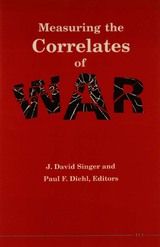
front cover of Measuring the Correlates of War
Measuring the Correlates of War
J. David Singer and Paul F. Diehl, Editors
University of Michigan Press, 1991
United in the conviction that effective theoretical inquiry in international relations requires the establishment of valid and reliable indicators, and the comprehensive data sets that derive from them, participants in the COW Project have developed and analyzed research methods of use to scholars in all areas of the social sciences.This collection of essays details the achievements of the COW Project in data generation and the construction of indicators for such elusive but key concepts as power, polarity, and war. The volume begins with an overview of the principles of data generation and measurement in the social sciences. Contributors discuss methodological difficulties and offer evaluation and comparison of key measures in relation to national attributes, systemic attributes, alliances among nations, and militarized disputes.Measuring the Correlates of War presents a broad and clear analysis of the efforts to improve the methodologies of conflict analysis and points the way for the evolution and direction of further research.
[more]

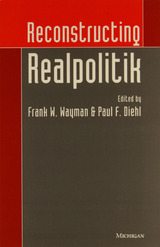
front cover of Reconstructing Realpolitik
Reconstructing Realpolitik
Frank W. Wayman and Paul F. Diehl, Editors
University of Michigan Press, 1994
Reconstructing Realpolitik assesses what there is of value in the realpolitik approach to understanding world politics, what must be amended ordiscarded, and what might be needed to replace the classic model. Calling realpolitik, or realism, a “cluster of models, assumptions, hunches, hypotheses, and parameter estimates” united only by their common focus on power, the editors challenged their contributors to test elements of the realpolitik model with empirical evidence and to suggest how the model might be revised to make it square with the evidence. The result is a wealth of original, rigorously tested, data-based findings that advance our understanding of this basic paradigm.The coverage is unusually comprehensive: chapters address the onset, escalation, and expansion phases of conflict; different conflict phenomena, such as economic sanctions, interventions, crisis bargaining, and decolonization, besides the more traditional concerns of military disputes, are examined; and the cases represent a variety of different spatial and temporal domains. In the end, Reconstructing Realpolitik shows that realpolitik factors and insights help to explain and predict a variety of international conflict phenomena while at the same time offen producing incorrect or exaggerated results. While realism remains a valuable proposition, it is clear that it fails to encompass several key factors that influence state behavior.Contributors include Robert A. Baumann, Bruce Bueno de Mesaquita, Gary Goertz, Athanasios Hristoulas, Paul Huth, Patrick James, Daniel M. Jones, Charles W. Kegley, Jr., David Lalman, Russell J. Leng, Frederic S. Pearson, Jeffrey J. Pickering, Brian M. Pollins, and Gregory A. Raymond.
[more]


Send via email Share on Facebook Share on Twitter