
 A SCHOLARLY BOOK REPOSITORY
In original articles encompassing a wide range of geographic and temporal locations, eminent scholars contest some of the primary preconceptions of their fields. The contributors tackle such topics as the paradoxical nature of American Civil War monuments, the figure of the “New Christian” in early seventeenth-century Peru, the implications of statistics for ethnography, and contemporary South Africa's “occult economies.” That anthropology and history have their provenance in—and have been complicit with—colonial formations is perhaps commonplace knowledge. But what is rarely examined is the specific manner in which colonial processes imbue and threaten the celebratory ideals of postcolonial reason or the enlightenment of today’s liberal practices in the social sciences and humanities.
By elaborating this critique, From the Margins offers diverse and powerful models that explore the intersections of historically specific local practices with processes of a world historical order. As such, the collection will not only prove valuable reading for anthropologists and historians, but also for scholars in colonial, postcolonial, and globalization studies.
Contributors. Talal Asad, Brian Keith Axel, Bernard S. Cohn, Jean Comaroff, John L. Comaroff, Nicholas B. Dirks, Irene Silverblatt, Paul A. Silverstein, Teri Silvio, Ann Laura Stoler, Michel-Rolph Trouillot
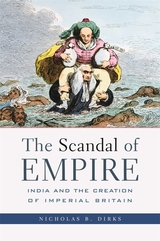
Many have told of the East India Company’s extraordinary excesses in eighteenth-century India, of the plunder that made its directors fabulously wealthy and able to buy British land and titles, but this is only a fraction of the story. When one of these men—Warren Hastings—was put on trial by Edmund Burke, it brought the Company’s exploits to the attention of the public. Through the trial and after, the British government transformed public understanding of the Company’s corrupt actions by creating an image of a vulnerable India that needed British assistance. Intrusive behavior was recast as a civilizing mission. In this fascinating, and devastating, account of the scandal that laid the foundation of the British Empire, Nicholas Dirks explains how this substitution of imperial authority for Company rule helped erase the dirty origins of empire and justify the British presence in India.
The Scandal of Empire reveals that the conquests and exploitations of the East India Company were critical to England’s development in the eighteenth century and beyond. We see how mercantile trade was inextricably linked with imperial venture and scandalous excess and how these three things provided the ideological basis for far-flung British expansion. In this powerfully written and trenchant critique, Dirks shows how the empire projected its own scandalous behavior onto India itself. By returning to the moment when the scandal of empire became acceptable we gain a new understanding of the modern culture of the colonizer and the colonized and the manifold implications for Britain, India, and the world.
READERS
Browse our collection.
PUBLISHERS
See BiblioVault's publisher services.
STUDENT SERVICES
Files for college accessibility offices.
RECENTLY PUBLISHED


UChicago Accessibility Resources
home | accessibility | search | about | contact us
BiblioVault ® 2001 - 2026
The University of Chicago Press