
 A SCHOLARLY BOOK REPOSITORY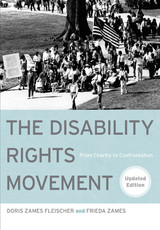
In this updated edition, Doris Zames Fleischer and Frieda Zames expand their encyclopedic history of the struggle for disability rights in the United States, to include the past ten years of disability rights activism.The book includes a new chapter on the evolving impact of the Americans with Disabilities Act, the continuing struggle for cross-disability civil and human rights, and the changing perceptions of disability.
The authors provide a probing analysis of such topics as deinstitutionalization, housing, health care, assisted suicide, employment, education, new technologies, disabled veterans, and disability culture.
Based on interviews with over one hundred activists, The Disability Rights Movement tells a complex and compelling story of an ongoing movement that seeks to create an equitable and diverse society, inclusive of people with disabilities.
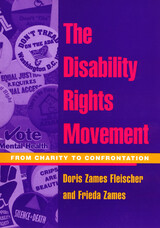
Referring to the Americans with Disabilities Act as "every American's insurance policy," the authors recount the genesis of this civil rights approach to disability, from the almost forgotten disability activism of the 1930s to the independent living movement of the 1970s to the call for disability pride of the 1990s. Like other civil rights struggles, the disability rights movement took place in the streets and in the courts as activists fought for change in the schools, the workplace, and in the legal system. They continue to fight for effective access to the necessities of everyday life -- to telephones, buses, planes, public buildings, restaurants, and toilets.
The history of disability rights mirrors the history of the country. Both World Wars sparked changes in disability policy and changes in medical technology as veterans without without limbs and with other disabilities return home. The empowerment of people with disabilities has become another chapter in the struggles over identity politics that began in the 1960s. Today, with the expanding ability of people with disabilities to enter the workforce, and a growing elderly population increasingly significant at a time when HMOs are trying to contain healthcare expenditures.
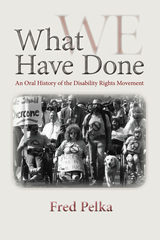
“Nothing about us without us” has been a core principle of American disability rights activists for more than half a century. It represents a response by people with disabilities to being treated with scorn and abuse or as objects of pity, and to having the most fundamental decisions relating to their lives—where they would live; if and how they would be educated; if they would be allowed to marry or have families; indeed, if they would be permitted to live at all—made by those who were, in the parlance of the movement, “temporarily able-bodied.”
In What We Have Done: An Oral History of the Disability Rights Movement, Fred Pelka takes that slogan at face value. He presents the voices of disability rights activists who, in the period from 1950 to 1990, transformed how society views people with disabilities, and recounts how the various streams of the movement came together to push through the Americans with Disabilities Act of 1990, the most sweeping civil rights legislation since passage of the Civil Rights Act of 1964. Beginning with the stories of those who grew up with disabilities in the 1940s and '50s, the book traces how disability came to be seen as a political issue, and how people with disabilities—often isolated, institutionalized, and marginalized—forged a movement analogous to the civil rights, women's rights, and gay rights movements, and fought for full and equal participation in American society.
READERS
Browse our collection.
PUBLISHERS
See BiblioVault's publisher services.
STUDENT SERVICES
Files for college accessibility offices.
RECENTLY PUBLISHED





UChicago Accessibility Resources
home | accessibility | search | about | contact us
BiblioVault ® 2001 - 2025
The University of Chicago Press