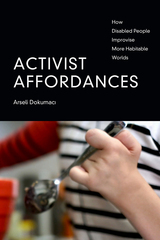
front cover of Activist Affordances
Activist Affordances
How Disabled People Improvise More Habitable Worlds
Arseli Dokumaci
Duke University Press, 2023
For people who are living with disability, including various forms of chronic diseases and chronic pain, daily tasks like lifting a glass of water or taking off clothes can be difficult if not impossible. In Activist Affordances, Arseli Dokumacı draws on ethnographic work with differently disabled people whose ingenuity, labor, and artfulness allow them to achieve these seemingly simple tasks. Dokumacı shows how they use improvisation to imagine and bring into being more habitable worlds through the smallest of actions and the most fleeting of movements---what she calls “activist affordances.” Even as an environment shrinks to a set of constraints rather than opportunities, the improvisatory space of performance opens up to allow disabled people to imagine that same environment otherwise. Dokumacı shows how disabled people’s activist affordances present the potential for a more liveable and accessible world for all of us.
[more]

front cover of Cheap Talk
Cheap Talk
Disability and the Politics of Communication
Joshua St. Pierre
University of Michigan Press, 2022
In Cheap Talk: Disability and the Politics of Communication, Joshua St. Pierre flips the script on communication disability, positioning the unruly, disabled speaker at the center of analysis to challenge the belief that more communication is unquestionably good. Working with Gilles Deleuze’s suggestion that “[w]e don’t suffer these days from any lack of communication, but rather from all the forces making us say things when we’ve nothing much to say,” St. Pierre brings together the unlikely trio of the dysfluent speaker, the talking head, and the troll to show how speech is made cheap—and produced and repaired within human bodies—to meet the inhuman needs of capital. The book explores how technologies, like social media and the field of speech-language pathology, create smooth sites of contact that are exclusionary for disabled speakers and looks to the political possibilities of disabled voices to “de-face” the power of speech now entwined with capital.
[more]

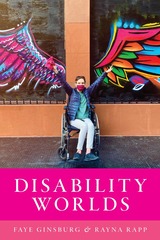
front cover of Disability Worlds
Disability Worlds
Faye Ginsburg and Rayna Rapp
Duke University Press, 2024
In Disability Worlds, Faye Ginsburg and Rayna Rapp chronicle and theorize two decades of immersion in New York City’s wide-ranging disability worlds as parents, activists, anthropologists, and disability studies scholars. They situate their disabled children’s lives among the experiences of advocates, families, experts, activists, and artists in larger struggles for recognition and rights. Disability consciousness, they show, emerges in everyday politics, practices, and frictions. Chapters consider dilemmas of genetic testing and neuroscientific research, reimagining kinship and community, the challenges of “special education,” and the perils of transitioning from high school. They also highlight the vitality of neurodiversity activism, disability arts, politics, and public culture. Disability Worlds reflects the authors’ anthropological commitments to recognizing the significance of this fundamental form of human difference. Ginsburg and Rapp’s conversations with diverse New Yorkers reveal the bureaucratic constraints and paradoxes established in response to the disability rights movement, as well as the remarkable creativity of disabled people and their allies who are opening pathways into both disability justice and disability futures.
[more]

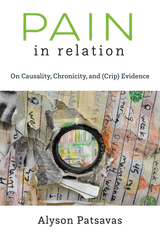
front cover of Pain in Relation
Pain in Relation
On Causality, Chronicity, and (Crip) Evidence
Alyson Patsavas
University of Michigan Press, 2026

Pain in Relation: On Causality, Chronicity, and (Crip) Evidence argues that the dominant stories circulating within contemporary US culture are marked by seemingly contradictory certainties: pain is at once subjective yet universal; that pain makes life unlivable and can be overcome with perseverance. These certainties graft onto pained people as impossible imperatives: the imperatives to live “despite” our pain and to defend the value of lives imagined to be compromised “because of” it. Alyson Patsavas outlines the harm these imperatives cause and draws on feminist, queer, and disability theory to offer alternative frameworks for making sense of and relating to pain.

The study fleshes out “crip autotheory” and experiments with evidencing practices, using anecdotes, journal entries, personal reflections, list-making, and photography to map “cripistemologies of pain,” or critical, disability-informed experiential ways of knowing pain. Equal parts cultural critique, intimate portrait of pained life, and commentary, Pain in Relation invites readers to challenge what they think they know about pain and explore new ways of relating to pain, pained life, and the futures we imagine for pained people.

[more]


Send via email Share on Facebook Share on Twitter