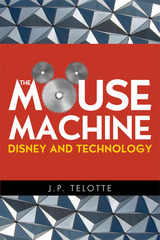
front cover of The Mouse Machine
The Mouse Machine
Disney and Technology
J. P. Telotte
University of Illinois Press, 2007
Throughout Disney's phenomenally successful run in the entertainment industry, the company has negotiated the use of cutting-edge film and media technologies that, J. P. Telotte argues, have proven fundamental to the company's identity. Disney's technological developments include the use of stereophonic surround sound for Fantasia, experimentation with wide-screen technology, inaugural adoption of three-strip Technicolor film, and early efforts at fostering depth in the animated image. Telotte also chronicles Disney's partnership with television, development of the theme park, and depiction of technology in science fiction narratives. An in-depth discussion of Disney's shift into digital filmmaking with its Pixar partnership and an emphasis on digital special effects in live-action films, such as the Pirates of the Caribbean series, also highlight the studio's historical investment in technology. By exploring the technological context for Disney creations throughout its history, The Mouse Machine illuminates Disney's extraordinary growth into one of the largest and most influential media and entertainment companies in the world. Hardback is unjacketed.

[more]

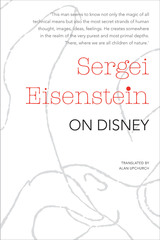
front cover of On Disney
On Disney
Sergei Eisenstein
Seagull Books, 2017
Few figures in cinema history are as towering as Russian filmmaker and theorist Sergei Mikhailovitch Eisenstein (1898–1948). Not only did Eisenstein direct some of the most important and lasting works of the silent era, including Strike, October, and Battleship Potemkin, as well as, in the sound era, the historical epics Alexander Nevsky and Ivan the Terrible—he also was a theorist whose insights into the workings of film were so powerful that they remain influential for both filmmakers and scholars today.

Seagull Books is embarking on a series of translations of key works by Eisenstein into English.  On Disney, which was begun in 1940 but was never finished, was part of a series of essays Eistenstein wrote on masters of cinema; for Eisenstein, Walt Disney offered a way to think about how such impulses and animism and totemism survived in modern consciousness and art. This edition presents the original, unfinished essay along with material on Disney that Eisenstein worked on in subsequent years but never succeeded in integrating with the original.
[more]


Send via email Share on Facebook Share on Twitter