
 A SCHOLARLY BOOK REPOSITORY
In The Banks We Deserve, journalist Oscar Perry Abello argues that community banking has a crucial role to play in addressing urgent social challenges, from creating a more racially just economy to preparing for a changing climate. At their best, community banks unleash the agency and aspirations of the communities that establish them. Abello challenges people working on racial justice, community development, or addressing climate change to start more community banks or credit unions as part of their work, while also calling for policies and regulatory reforms that will help tilt the landscape back in favor of community banking.
The Banks We Deserve tells the stories of new community banks — like Adelphi Bank, in Columbus, Ohio, the first new Black bank in 20 years; or Walden Mutual Bank in Concord, New Hampshire, the first new mutual bank since 1973 and the first chartered specifically to finance a more sustainable food system; or Climate First Bank, in St. Petersburg, Florida, which has grown exponentially since opening for business in 2021. He hopes these stories inspire others to take some of these same daunting-but-not-impossible steps.
For a community or industry that is being ignored by big banks, the idea of starting up a new bank or credit union rarely figures as an option. In The Banks We Deserve, Abello shows advocates, organizers, and innovators that it can be done, that it is being done, and describes a path to support more community banks and credit unions.
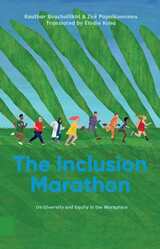
In The Inclusion Marathon, Kauthar Bouchallikht and Zoë Papaikonomou interview 41 practitioners and researchers about their knowledge and experience within the field of diversity, equity and inclusion in the Netherlands. These experts discuss different approaches and the bumps and barriers they come across. The Inclusion Marathon is a revealing book exploring the persistent lack of diversity and equity within many organisations. At the same time, it is a constructive, concrete guide to how organisations may become more diverse, equitable and inclusive.
The Inclusion Marathon is an extensive English summary of the Dutch book De inclusiemarathon.
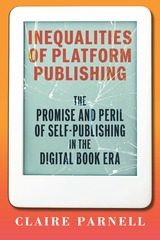
Uncovering race, gender, and sexual biases in popular self-publishing platforms
The average reader need not go far in a bookstore before, knowingly or not, they encounter authors who started their careers by self-publishing prior to achieving commercial success. Examples include Margaret Atwood, Andy Weir, Colleen Hoover, Anna Todd, E. L. James, Scarlett St. Clair, and many more. Such stories of self-made writers are compelling and seem more attainable to others with the accessibility of modern publishing platforms such as Amazon, Apple, Google, Kobo, Wattpad, Webtoon, Radish, Inkitt, Qidian, Tapas, and Swoon Reads. However, as Claire Parnell uncovers in her examination of the two most popular—Amazon and Wattpad—these services in fact perpetuate systemic racial, gender, and sexual bias against authors of color and queer authors through their technological, economic, social, and cultural structures.
At a time when there is a real reckoning with the discrimination that has resulted in publishing opportunities for only relatively few privileged authors—who are often White, upper class, and male—self-publishing presents itself as an equalizer of sorts. Exploring that idea, Parnell shows that these platforms are not just intermediaries for information; they structure content and users in multiple, often inequitable, ways through their ability to set market conditions and apply algorithmic sorting. Combining original interviews, walkthrough method, metadata analysis, and more, Parnell finds that self-publishing platforms reproduce challenges for authors from marginalized communities. Far from equalizing the market, the new platforms instead frequently perpetuate the stubborn barriers to mainstream success for BIPOC and queer authors.
READERS
Browse our collection.
PUBLISHERS
See BiblioVault's publisher services.
STUDENT SERVICES
Files for college accessibility offices.
RECENTLY PUBLISHED


UChicago Accessibility Resources
home | accessibility | search | about | contact us
BiblioVault ® 2001 - 2026
The University of Chicago Press