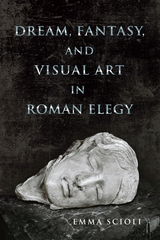
front cover of Dream, Fantasy, and Visual Art in Roman Elegy
Dream, Fantasy, and Visual Art in Roman Elegy
Emma Scioli
University of Wisconsin Press, 2015
The elegists, ancient Rome’s most introspective poets, filled their works with vivid, first-person accounts of dreams. Dream, Fantasy, and Visual Art in Roman Elegy examines these varied and visually striking textual dreamscapes, arguing that the poets exploited dynamics of visual representation to allow readers to share in the intensely personal experience of dreaming.
            By treating dreams as a mode for viewing, an analogy suggested by diverse ancient authors, Emma Scioli extracts new information from the poetry of Propertius, Tibullus, and Ovid about the Roman concept of “seeing” dreams. Through comparison with other visual modes of description, such as ekphrasis and simile, as well as with related types of visual experience, such as fantasy and voyeurism, Scioli demonstrates similarities between artist, dreamer, and poet as creators, identifying the dreamer as a particular type of both viewer and narrator.

[more]

front cover of Willing to Know God
Willing to Know God
Dreamers and Visionaries in the Later Middle Ages
Jessica Barr
The Ohio State University Press, 2010

Although authors of mystical treatises and dream visions shared a core set of assumptions about how visions are able to impart transcendent truths to their recipients, the modern divide between “religious” and “secular” has led scholars to study these genres in isolation. Willing to Know God addresses the simultaneous flowering of mystical and literary vision texts in the Middle Ages by questioning how the vision was thought to work. What preconditions must be met in these texts for the vision to transform the visionary? And when, as in poems such as Pearl, this change does not occur, what exactly has gone wrong?

 
Through close readings of medieval women’s visionary texts and English dream poems, Jessica Barr argues that the vision required the active as well as the passive participation of the visionary. In these texts, dreamers and visionaries must be volitionally united with the divine and employ their rational and analytic faculties in order to be transformed by the vision.
 
Willing to Know God proposes that the study of medieval vision texts demands a new approach that takes into account both vision literature that has been supposed to have a basis in lived experience and visions that are typically read as fictional. It argues that these two “genres” in fact complement and inform one another. Rather than discrete literary modes, they are best read as engaged in an ongoing conversation about the human mind’s ability to grasp the divine.
[more]


Send via email Share on Facebook Share on Twitter