
 A SCHOLARLY BOOK REPOSITORY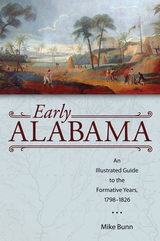
An illustrated guidebook documenting the history and sites of the state’s origins
Alabama’s territorial and early statehood years represent a crucial formative period in its past, a time in which the state both literally and figuratively took shape. The story of the remarkable changes that occurred within Alabama as it transitioned from frontier territory to a vital part of the American union in less than a quarter century is one of the most compelling in the state’s past. This history is rich with stories of charismatic leaders, rugged frontiersmen, a dramatic and pivotal war that shaped the state’s trajectory, raging political intrigue, and pervasive sectional rivalry.
Many of Alabama’s modern cities, counties, and religious, educational, and governmental institutions first took shape within this time period. It also gave way to the creation of sophisticated trade and communication networks, the first large-scale cultivation of cotton, and the advent of the steamboat. Contained within this story of growth and innovation is a parallel story, the dispossession of Native groups of their lands and the forced labor of slaves, which fueled much of Alabama’s early development.
Early Alabama: An Illustrated Guide to the Formative Years, 1798–1826 serves as a traveler’s guidebook with a fast-paced narrative that traces Alabama’s developmental years. Despite the great significance of this era in the state’s overall growth, these years are perhaps the least understood in all of the state’s history and have received relatively scant attention from historians. Mike Bunn has created a detailed guide—appealing to historians and the general public—for touring historic sites and structures including selected homes, churches, businesses, government buildings, battlefields, cemeteries, and museums..
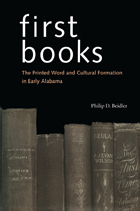
Early 19th-century Alabama was a society still in the making. Now Philip Beidler tells how the first books written and published in the state influenced the formation of Alabama's literary and political culture. As Beidler shows, virtually overnight early Alabama found itself in possession of the social, political, and economic conditions required to jump start a traditional literary culture in the old Anglo-European model: property-based class relationships, large concentrations of personal wealth, and professional and merchant classes of similar social, political, educational, and literary views.
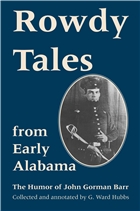
The rollicking tales of Old Southwestern humor were a distinctive contribution to American folk culture provided by the frontiersmen of the South and Southwest, a tradition brought to its highest form in the work of Mark Twain. Among the precursors of Twain was John Gorman Barr of Tuscaloosa, Alabama. Like Twain, Barr grew up in a river town, worked in a printing office, and traveled widely; and again like Twain, Barr drew upon the people and places of his home region as the primary sources for his tales.
In addition to the pure entertainment Barr’s stories provide, they also furnish a comprehensive picture of Tuscaloosa and western Alabama in the 1850s—the roaring river town coexisting uneasily with the intellectual sophistication of the recently established University of Alabama.
READERS
Browse our collection.
PUBLISHERS
See BiblioVault's publisher services.
STUDENT SERVICES
Files for college accessibility offices.
RECENTLY PUBLISHED





UChicago Accessibility Resources
home | accessibility | search | about | contact us
BiblioVault ® 2001 - 2026
The University of Chicago Press