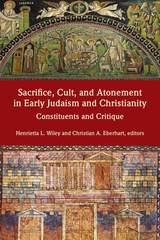
front cover of Sacrifice, Cult, and Atonement in Early Judaism and Christianity
Sacrifice, Cult, and Atonement in Early Judaism and Christianity
Constituents and Critique
Henrietta L. Wiley
SBL Press, 2016

Critical and creative studies that offer fresh perspectives on ancient ideas and practices

The contributions to this volume deal in various ways with the cult at the Jerusalem Temple that epitomized the religious, cultural, and socio-political identity of Judaism for many centuries. Some essays examine ancient constitutive practices and concepts, such as purification rituals, sacrifices, atonement, or sacred authorities at the temple, with the goal of interpreting their meanings for modern readers. Other essays explore alternatives to ancient cultic meaning and practice. Essays critique established traditions, attempt to renegotiate them, or use metaphor and spiritualization to expand the potential of these phenomena to serve as terminological and ideological resources. Thus they examine and affirm the continuing relevance of ancient Jewish cultic notions long after the destruction of the Second Temple in 70 CE.

  • An international group of scholars representing different fields and diverse religious backgrounds
  • A thorough examination of traditions as through the lens of contemporaneous interpretive traditions such as Jewish prophecy, the Dead Sea Scrolls, and Early Christian literature
  • Examination of topics such as purification, sacrifice, and atonement, and the depiction and development of sacred authority throughout the Bible
[more]

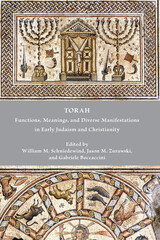
front cover of Torah
Torah
Functions, Meanings, and Diverse Manifestations in Early Judaism and Christianity
William M. Schniedewind
SBL Press, 2022

The present volume explores the ever-evolving understandings and diverse manifestations of the Hebrew notion of torah in early Jewish and Christian literature and the different roles torah played within those communities, whether in Judea or in the Hellenistic and early Roman diaspora. This collection of essays is purposefully wide-ranging, with contributors exploring and rethinking some of the most basic scholarly assumptions and preconceptions about the nature of torah in light of new critical approaches and methodologies. Contributors include Gabriele Boccaccini, Francis Borchardt, Calum Carmichael, Federico Dal Bo, Lutz Doering, Oliver Dyma, Paula Fredriksen, Robert G. Hall, Magnar Kartveit, Anne Kreps, David Lambert, Michael Legaspi, Jason A. Myers, Juan Carlos Ossandón Widow, Anders Klostergaard Petersen, Patrick Pouchelle, Jeremy Punt, Michael L. Satlow, Joachim Schaper, William Schniedewind, Elisa Uusimäki, Jacqueline Vayntrub, Jonathan Vroom, James W. Watts, Benjamin G. Wright III, and Jason M. Zurawski.


[more]


Send via email Share on Facebook Share on Twitter