logo for University of Minnesota Press
Autobiography in Early Modern Spain
Nicholas Spadaccini and Jenaro Talens, EditorsIntroduction by Nicholas Spadaccini and Jenaro Talens
University of Minnesota Press, 1991

Autobiography in Early Modern Spain was first published in 1991. Minnesota Archive Editions uses digital technology to make long-unavailable books once again accessible, and are published unaltered from the original University of Minnesota Press editions.

Autobiography in Early Modern Spain Nicholas Spadaccini and Jenaro Talens, Editors

Introduction. The Construction of the Self: Notes on Autobiography in Early Modern Spain

Nicholas Spadaccini and Jenaro Talens

Chapter 1. Narration and Argumentation in Autobiographical Discourse Antonio Gomez-Moriana

Chapter 2. A Clown at Court: Francesillo de Zuniga's Cronica burlesca George Mariscal

Chapter 3. A Methodological Prolegomenon to a Post-Modernist Reading of Santa Teresa's Autobiography

Patrick Dust

Chapter 4. Golden Age Autobiography: The Soldiers Margarita Levisi

Chapter 5. The Picaresque as Autobiography: Story and History Edward Friedman

Chapter 6. The Historical Function of Picaresque Autobiographies: Toward a History of Social Offenders

Anthony N. Zahareas

Chapter 7. Fortune's Monster and the Monarchy in Las relaciones de Antonio Perez Helen H. Reed

Chapter 8. The Woman at the Border: Some Thoughts on Cervantes and Autobiography Ruth El Saffar

Chapter 9. Poetry as Autobiography: Theory and Poetic Practice in Cervantes Jenaro Talens

Appendix Curriculum vitae

Miguel de Cervantes Saavedra
[more]

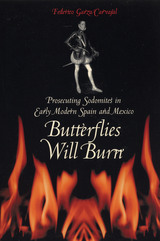
front cover of Butterflies Will Burn
Butterflies Will Burn
Prosecuting Sodomites in Early Modern Spain and Mexico
By Federico Garza Carvajal
University of Texas Press, 2003

As Spain consolidated its Empire in the sixteenth and seventeenth centuries, discourses about the perfect Spanish man or "Vir" went hand-in-hand with discourses about another kind of man, one who engaged in the "abominable crime and sin against nature"—sodomy. In both Spain and Mexico, sodomy came to rank second only to heresy as a cause for prosecution, and hundreds of sodomites were tortured, garroted, or burned alive for violating Spanish ideals of manliness. Yet in reality, as Federico Garza Carvajal argues in this groundbreaking book, the prosecution of sodomites had little to do with issues of gender and was much more a concomitant of empire building and the need to justify political and economic domination of subject peoples.

Drawing on previously unpublished records of some three hundred sodomy trials conducted in Spain and Mexico between 1561 and 1699, Garza Carvajal examines the sodomy discourses that emerged in Andalucía, seat of Spain's colonial apparatus, and in the viceroyalty of New Spain (Mexico), its first and largest American colony. From these discourses, he convincingly demonstrates that the concept of sodomy (more than the actual practice) was crucial to the Iberian colonizing program. Because sodomy opposed the ideal of "Vir" and the Spanish nationhood with which it was intimately associated, the prosecution of sodomy justified Spain's domination of foreigners (many of whom were represented as sodomites) in the peninsula and of "Indios" in Mexico, a totally subject people depicted as effeminate and prone to sodomitical acts, cannibalism, and inebriation.
[more]

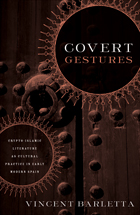
front cover of Covert Gestures
Covert Gestures
Crypto-Islamic Literature as Cultural Practice in Early Modern Spain
Vincent Barletta
University of Minnesota Press, 2005
Forcibly expelled from Spain in the early seventeenth century, the substantial Muslim community known as the moriscos left behind them a hidden yet extremely rich corpus of manuscripts. Copied out in Arabic script and concealed in walls, false floors, and remote caves, these little-known texts now offer modern readers an absorbing look into the cultural life of the moriscos during the hundred years between their forced conversion to Christianity and their eventual expulsion. Covert Gestures reveals how the traditional Islamic narratives of the moriscos both shaped and encoded a wide range of covert social activity characterized by a profound and persistent concern with time and temporality. Using a unique blend of literary analysis, linguistic anthropology, and phenomenological philosophy, Barletta explores the narratives as testimonials of past human experiences and discovers in them evidence of community resistance. In its interdisciplinary approach, Vincent Barletta's work is nothing less than a rewriting of the cultural history of Muslim Spain, as well as a replotting of the future course of medieval and early modern literary studies.
[more]

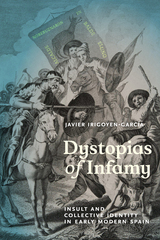
front cover of Dystopias of Infamy
Dystopias of Infamy
Insult and Collective Identity in Early Modern Spain
Javier Irigoyen-García
Bucknell University Press, 2022
Insults, scorn, and verbal abuse—frequently deployed to affirm the social identity of the insulter—are destined to fail when that language is appropriated and embraced by the maligned group. In such circumstances, slander may instead empower and reinforce the collective identity of those perceived to be a threat to an idealized society. In this innovative study, Irigoyen-Garcia examines how the discourse and practices of insult and infamy shaped the cultural imagination, anxieties, and fantasies of early modern Spain. Drawing on sixteenth- and seventeenth-century literary works, archival research, religious and political literature, and iconographic documents, Dystopias of Infamy traces how the production of insults haunts the imaginary of power, provoking latent anxieties about individual and collective resistance to subjectification. Of particular note is Cervantes’s tendency to parody regulatory fantasies about infamy throughout his work, lampooning repressive law for its paradoxical potential to instigate the very defiance it fears.
[more]

front cover of Lesbians in Early Modern Spain
Lesbians in Early Modern Spain
Sherry Velasco
Vanderbilt University Press, 2011
In this first in-depth study of female homosexuality in the Spanish Empire for the period from 1500 to 1800, Velasco presents a multitude of riveting examples that reveal widespread contemporary interest in women's intimate relations with other women. Her sources include literary and historical texts featuring female homoeroticism, tracts on convent life, medical treatises, civil and Inquisitional cases, and dramas. She has also uncovered a number of revealing illustrations from the period.


The women in these accounts, stories, and cases range from internationally famous transgendered celebrities to lesbian criminals, from those suspected of "special friendships" in the convent to ordinary villagers.


Velasco argues that the diverse and recurrent representations of lesbian desire provide compelling evidence of how different groups perceived intimacy between women as more than just specific sex acts. At times these narratives describe complex personal relationships and occasionally characterize these women as being of a certain "type," suggesting an early modern precursor to what would later be recognized as divergent lesbian, bisexual, and transgender identities.
[more]

front cover of The Librarian's Atlas
The Librarian's Atlas
The Shape of Knowledge in Early Modern Spain
Seth Kimmel
University of Chicago Press, 2024
A history of early modern libraries and the imperial desire for total knowledge.
 
Medieval scholars imagined the library as a microcosm of the world, but as novel early modern ways of managing information facilitated empire in both the New and Old Worlds, the world became a projection of the library. In The Librarian’s Atlas, Seth Kimmel offers a sweeping material history of how the desire to catalog books coincided in the sixteenth and seventeenth centuries with the aspiration to control territory. Through a careful study of library culture in Spain and Morocco—close readings of catalogs, marginalia, indexes, commentaries, and maps—Kimmel reveals how the booklover’s dream of a comprehensive and well-organized library shaped an expanded sense of the world itself.
[more]

front cover of Male Delivery
Male Delivery
Reproduction, Effeminacy, and Pregnant Men in Early Modern Spain
Sherry Velasco
Vanderbilt University Press, 2006
Using the one-act comedy El parto de Juan Rana (John Frog Gives Birth) as a point of departure, Velasco argues that the figure of the pregnant man in early modern Spanish culture was not merely comic entertainment, but also served an important role as a physical representation of the anxieties about the changing roles of men and women at the time.


Men were increasingly taking over medical duties--especially surrounding childbirth--usually left to women and, as their medical knowledge increased, they became aware of bodies and behaviors--both male and female--that transgressed gender norms. The anxieties about men who acted in ways seen as increasingly womanly (from acting effeminately to participating in homosexual activity) played out in the character of pregnant Juan Rana.


Then, Velasco turns to Hollywood and asks if we might not use the lessons of Juan Rana to help explain why contemporary America is also fascinated by the idea of male pregnancy--think Arnold Schwarzenegger in Junior--and our increasing anxiety over the changing face of masculinity in our own culture.

[more]

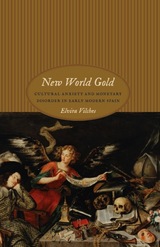
front cover of New World Gold
New World Gold
Cultural Anxiety and Monetary Disorder in Early Modern Spain
Elvira Vilches
University of Chicago Press, 2010

The discovery of the New World was initially a cause for celebration. But the vast amounts of gold that Columbus and other explorers claimed from these lands altered Spanish society. The influx of such wealth contributed to the expansion of the Spanish empire, but also it raised doubts and insecurities about the meaning and function of money, the ideals of court and civility, and the structure of commerce and credit. New World Gold shows that, far from being a stabilizing force, the flow of gold from the Americas created anxieties among Spaniards and shaped a host of distinct behaviors, cultural practices, and intellectual pursuits on both sides of the Atlantic.

Elvira Vilches examines economic treatises, stories of travel and conquest, moralist writings, fiction, poetry, and drama to reveal that New World gold ultimately became a problematic source of power that destabilized Spain’s sense of trust, truth, and worth. These cultural anxieties, she argues, rendered the discovery of gold paradoxically disastrous for Spanish society. Combining economic thought, social history, and literary theory in trans-Atlantic contexts, New World Gold unveils the dark side of Spain’s Golden Age.
[more]

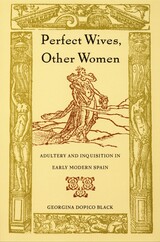
front cover of Perfect Wives, Other Women
Perfect Wives, Other Women
Adultery and Inquisition in Early Modern Spain
Georgina Dopico Black
Duke University Press, 2001
In Perfect Wives, Other Women Georgina Dopico Black examines the role played by women’s bodies—specifically the bodies of wives—in Spain and Spanish America during the Inquisition. In her quest to show how both the body and soul of the married woman became the site of anxious inquiry, Dopico Black mines a variety of Golden Age texts for instances in which the era’s persistent preoccupation with racial, religious, and cultural otherness was reflected in the depiction of women.
Subject to the scrutiny of a remarkable array of gazes—inquisitors, theologians, religious reformers, confessors, poets, playwrights, and, not least among them, husbands—the bodies of perfect and imperfect wives elicited diverse readings. Dopico Black reveals how imperialism, the Inquisition, inflation, and economic decline each contributed to a correspondence between the meanings of these human bodies and “other” bodies, such as those of the Jew, the Moor, the Lutheran, the degenerate, and whoever else departed from a recognized norm. The body of the wife, in other words, became associated with categories separate from anatomy, reflecting the particular hermeneutics employed during the Inquisition regarding the surveillance of otherness.
Dopico Black’s compelling argument will engage students of Spanish and Spanish American history and literature, gender studies, women’s studies, social psychology and cultural studies.
[more]

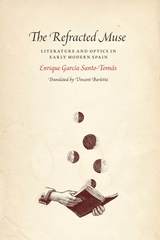
front cover of The Refracted Muse
The Refracted Muse
Literature and Optics in Early Modern Spain
Enrique Garcia Santo-Tomas
University of Chicago Press, 2017
Galileo never set foot on the Iberian Peninsula, yet, as Enrique García Santo-Tomás unfolds in The Refracted Muse, the news of his work with telescopes brought him to surprising prominence—not just among Spaniards working in the developing science of optometry but among creative writers as well.
 
While Spain is often thought to have taken little notice of the Scientific Revolution, García Santo-Tomás tells a different story, one that reveals Golden Age Spanish literature to be in close dialogue with the New Science. Drawing on the work of writers such as Cervantes, Lope de Vega, Calderón de la Barca, and Quevedo, he helps us trace the influence of science and discovery on the rapidly developing and highly playful genre of the novel. Indeed, García Santo-Tomás makes a strong case that the rise of the novel cannot be fully understood without taking into account its relationship to the scientific discoveries of the period.
[more]

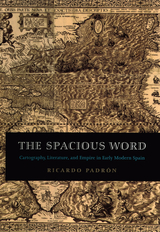
front cover of The Spacious Word
The Spacious Word
Cartography, Literature, and Empire in Early Modern Spain
Ricardo Padrón
University of Chicago Press, 2004
The Spacious Word explores the history of Iberian expansion into the Americas as seen through maps and cartographic literature, and considers the relationship between early Spanish ideas of the world and the origins of European colonialism. Spanish mapmakers and writers, as Padrón shows, clung to a much older idea of space that was based on the itineraries of travel narratives and medieval navigational techniques.

Padrón contends too that maps and geographic writings heavily influenced the Spanish imperial imagination. During the early modern period, the idea of "America" was still something being invented in the minds of Europeans. Maps of the New World, letters from explorers of indigenous civilizations, and poems dramatizing the conquest of distant lands, then, helped Spain to redefine itself both geographically and imaginatively as an Atlantic and even global empire. In turn, such literature had a profound influence on Spanish ideas of nationhood, most significantly its own.

Elegantly conceived and meticulously researched, The Spacious Word will be of enormous interest to historians of Spain, early modern literature, and cartography.
[more]

front cover of To Embody the Marvelous
To Embody the Marvelous
The Making of Illusions in Early Modern Spain
Esther Fernández
Vanderbilt University Press, 2022
Winner of the Vern Williamsen Comedia Book Prize, Association for Hispanic Classical Theater, 2023
Winner of the Nancy Staub Award, UNIMA-USA (Union Internationale de la Marionnette), 2023


In its exploration of puppetry and animation as the performative media of choice for mastering the art of illusion, To Embody the Marvelous engages with early modern notions of wonder in religious, artistic, and social contexts.

From jointed, wood-carved figures of Christ, saintly marionettes that performed hagiographical dramas, experimental puppets and automata in Cervantes' Don Quixote, and the mechanical sets around which playwright Calderón de la Barca devised secular magic shows to deconstruct superstitions, these historical and fictional artifacts reenvisioned religious, artistic, and social notions that led early modern society to critically wrestle with enchantment and disenchantment.

The use of animated performance objects in Spanish theatrical contexts during the sixteenth and seventeenth centuries became one of the most effective pedagogical means to engage with civil society. Regardless of social strata, readers and spectators alike were caught up in a paradigm shift wherein belief systems were increasingly governed by reason—even though the discursive primacy of supernatural doxa and Christian wonder remained firmly entrenched. Thanks to their potential for motion, religious and profane puppets, automata, and mechanical stage props deployed a rationalized sense of wonder that illustrates the relationship between faith and reason, reevaluates the boundaries of fiction in art and entertainment cultures, acknowledges the rise of science and technology, and questions normative authority.
[more]

front cover of To Embody the Marvelous
To Embody the Marvelous
The Making of Illusions in Early Modern Spain
Esther Fernández
Vanderbilt University Press, 2021
Winner of the Vern Williamsen Comedia Book Prize, Association for Hispanic Classical Theater, 2023
Winner of the Nancy Staub Award, UNIMA-USA (Union Internationale de la Marionnette), 2023


In its exploration of puppetry and animation as the performative media of choice for mastering the art of illusion, To Embody the Marvelous engages with early modern notions of wonder in religious, artistic, and social contexts.

From jointed, wood-carved figures of Christ, saintly marionettes that performed hagiographical dramas, experimental puppets and automata in Cervantes' Don Quixote, and the mechanical sets around which playwright Calderón de la Barca devised secular magic shows to deconstruct superstitions, these historical and fictional artifacts reenvisioned religious, artistic, and social notions that led early modern society to critically wrestle with enchantment and disenchantment.

The use of animated performance objects in Spanish theatrical contexts during the sixteenth and seventeenth centuries became one of the most effective pedagogical means to engage with civil society. Regardless of social strata, readers and spectators alike were caught up in a paradigm shift wherein belief systems were increasingly governed by reason—even though the discursive primacy of supernatural doxa and Christian wonder remained firmly entrenched. Thanks to their potential for motion, religious and profane puppets, automata, and mechanical stage props deployed a rationalized sense of wonder that illustrates the relationship between faith and reason, reevaluates the boundaries of fiction in art and entertainment cultures, acknowledges the rise of science and technology, and questions normative authority.
[more]

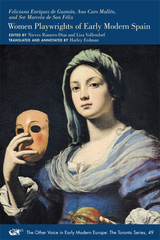
front cover of Women Playwrights of Early Modern Spain
Women Playwrights of Early Modern Spain
Feliciana Enríquez de Guzmán, Ana Caro Mallén, and Sor Marcela de San Félix
Iter Press, 2016

This volume presents ten plays by three leading women playwrights of Spain’s Golden Age. Included are four bawdy and outrageous comic interludes; a full-length comedy involving sorcery, chivalry, and dramatic stage effects; and five short religious plays satirizing daily life in the convent. A critical introduction to the volume positions these women and their works in the world of seventeenth-century Spain.
[more]

front cover of Women Warriors in Early Modern Spain
Women Warriors in Early Modern Spain
A Tribute to Barbara Mujica
Susan L. Fischer
University of Delaware Press, 2019
Although scholars often depict early modern Spanish women as victims, history and fiction of the period are filled with examples of women who defended their God-given right to make their own decisions and to define their own identities. The essays in Women Warriors in Early Modern Spain examine many such examples, demonstrating how women battled the status quo, defended certain causes, challenged authority, and broke barriers. Such women did not necessarily engage in masculine pursuits, but often used cultural production and engaged in social subversion to exercise resistance in the home, in the convent, on stage, or at their writing desks.

Published by University of Delaware Press. Distributed worldwide by Rutgers University Press.
 
[more]


Send via email Share on Facebook Share on Twitter