
 A SCHOLARLY BOOK REPOSITORY
Results by Title
2 books about Earned income tax credit
2 books about Earned income tax credit

Child Benefits
The Smart Investment for America's Future
Jane Waldfogel
Russell Sage Foundation, 2025
The United States has one of the highest child poverty rates among wealthy countries and stands out among its peers as the only country that does not offer a child benefit – regular payments from the government to most or all families with children, not conditioned on parental employment. During the temporary expansion of the Child Tax Credit (CTC) in 2021, the CTC functioned as a child benefit, and the child poverty rate fell to the lowest level ever recorded in the United States. Despite this decrease, the CTC expansion was not renewed. Concerns about enacting a child benefit include the cost, the possibility of misuse of money by parents, and how it might affect parental employment and fertility. In Child Benefits, social policy scholar Jane Waldfogel details the history and origins of child benefits around the world and comprehensively assesses how child benefits affect family spending, fertility, employment, child poverty, and child wellbeing to address such concerns and to determine the benefits of enacting such a policy permanently.
Drawing on research from peer countries in the Organization for Economic Cooperation and Development as well as the United States, Waldfogel shows that a child benefit would prevent poverty and hardship and protect children from deep poverty and income instability. The research is clear that families would spend the money from a child benefit on food, clothing, and other items for their children and that a child benefit would not have large negative impacts on parental employment or family decisions about fertility. It also shows that a child benefit would promote short- and longer-term child and family wellbeing. Child benefits have been shown to enhance opportunity and benefit society through healthier and better-educated young adults and stronger and more stable families. And rigorous benefit-cost analyses indicate that a child benefit, while costly, would more than pay for itself, yielding a large return on investment.
Waldfogel evaluates four current, major proposals for a child benefit and provides recommendations for a policy that would deliver the best outcomes for children and families and the best return on investment. She argues that such a policy would be more generous, not tied to parental employment or earnings, available to all parents but phased out for higher-income families, delivered in monthly payments through the tax system, and provided in addition to existing social programs.
Child Benefits provides fascinating insights on the history and impacts of child benefits and makes a clear and definitive argument for the establishment of a child benefit in the United States.
Drawing on research from peer countries in the Organization for Economic Cooperation and Development as well as the United States, Waldfogel shows that a child benefit would prevent poverty and hardship and protect children from deep poverty and income instability. The research is clear that families would spend the money from a child benefit on food, clothing, and other items for their children and that a child benefit would not have large negative impacts on parental employment or family decisions about fertility. It also shows that a child benefit would promote short- and longer-term child and family wellbeing. Child benefits have been shown to enhance opportunity and benefit society through healthier and better-educated young adults and stronger and more stable families. And rigorous benefit-cost analyses indicate that a child benefit, while costly, would more than pay for itself, yielding a large return on investment.
Waldfogel evaluates four current, major proposals for a child benefit and provides recommendations for a policy that would deliver the best outcomes for children and families and the best return on investment. She argues that such a policy would be more generous, not tied to parental employment or earnings, available to all parents but phased out for higher-income families, delivered in monthly payments through the tax system, and provided in addition to existing social programs.
Child Benefits provides fascinating insights on the history and impacts of child benefits and makes a clear and definitive argument for the establishment of a child benefit in the United States.
[more]
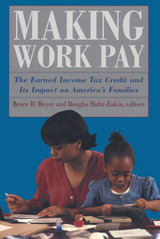
Making Work Pay
Bruce D. Meyer
Russell Sage Foundation, 2001
Since its inception under President Ford in 1975, the Earned Income Tax Credit (EITC) has become the largest antipoverty program for the non-elderly in the United States. In 1998, more than nineteen million families received EITC payments, and the program lifted over four million Americans above the poverty line. Despite the rapid growth of the EITC throughout the 1990s, little has been written about how the program works or how it affects low-income families. Making Work Pay provides the first full-scale examination of the EITC, exploring its effects on income distribution, poverty, work, and marriage. Making Work Pay opens with a history of the EITC—its emergence in the 1970s as a pro-work, low-cost antipoverty program and its expansion through the 1980s and 1990s. The central chapters in the volume look at the substantial impact of the EITC on work incentives in recent years and show that the program, in combination with welfare reform and a strong economy, has led to an unprecedented increase in the employment of single mothers. In one study, researchers conclude that the EITC—with its stipulation that one family member be a wage earner—was the most important change in work incentives for single mothers between 1984 and 1996, a period when the employment rate of single mothers rose sharply. Several chapters outline proposals for reforming the program, addressing the concerns by policymakers about the work disincentives that rise as benefits fall with increasing income. Finally, Making Work Pay examines how EITC recipients view the credit and what they do with it once they get it. The contributors find that not only does EITC's lump-sum payment increase consumption but it also allows recipients to make changes in economic status. Many families use the end-of-the-year payment as a form of forced savings, enabling them to save for home improvement, a new car, or other purchases to improve their lives, and providing the extra economic cushion needed to move beyond mere day-to-day survival. Comprehensive in scope, Making Work Pay is an indispensable resource for policymakers, administrators, and researchers seeking to understand the ramifications of the country's largest programs for aiding the working poor.
[more]
READERS
Browse our collection.
PUBLISHERS
See BiblioVault's publisher services.
STUDENT SERVICES
Files for college accessibility offices.
RECENTLY PUBLISHED




UChicago Accessibility Resources
home | accessibility | search | about | contact us
BiblioVault ® 2001 - 2026
The University of Chicago Press