
 A SCHOLARLY BOOK REPOSITORY
Rather than structural inevitability, these breakdowns stem from contingent choices: negotiated transitions, successor party dominance, and technocratic insulation created fertile ground for popularism, a top-down appropriation of populist rhetoric to dismantle liberal norms. From Orbán’s Hungary to Chávez’s Venezuela, the analysis reveals how democratic procedures can hollow out democracy itself.
In an era of global democratic backsliding, this book offers a timely framework for understanding the fragility of liberal democracy and the decisive role of political agency in preventing breakdown or enabling renewal.


Deals with the period of takeover and of ‘high Stalinism’ in Eastern Europe (1945–1955). These years are considered to be fundamentally characterized by institutional and ideological transfers based upon the premise of radical transformism and of cultural revolution. Both a balance-sheet and a politico-historical synthesis that reflects the archival and thematic novelties which came about in the field of communism studies after 1989.
Contains contributions analyzing various aspects related these topics for each country of the former Soviet bloc (with the exception of Albania). The essays are based on new archival research, some are reassessments of the author’s previous research and others are critical appraisals of the specific literature published on issues related to the main topic. A path-breaking comparative framework for interpreting the relationship between late Stalinism and the communist takeovers in former Eastern Europe. A bonus for the volume is that it also provides detailed, sectorial analyses for the Romanian case, something that the field paritcularly lacks.
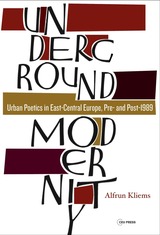
The literary scholar Alfrun Kliems explores the aesthetic strategies of Eastern European underground literature, art, film and music in the decades before and after the fall of communism, ranging from the ‘father’ of Prague Underground, Egon Bondy, to the neo-Dada Club of Polish Losers in Berlin.
The works she considers are "underground" in the sense that they were produced illegally, or were received as subversive after the regimes had fallen. Her study challenges common notions of ‘Underground’ as an umbrella term for nonconformism. Rather, it depicts it as a sociopoetic reflection of modernity, intimately linked to urban settings, with tropes and aesthetic procedures related to Surrealism, Dadaism, Expressionism, and, above all, pop and counterculture.
The author discusses these commonalities and distinctions in Czech, Polish, Slovak, Ukrainian, Russian, and German authors, musicians, and filmmakers. She identifies intertextual relations across languages and generations, and situates her findings in a transatlantic context (including the Beat Generation, Susan Sontag, Neil Young) and the historical framework of Romanticism and modernity (including Baudelaire and Brecht).
Despite this wide brief, the book never loses sight of its core message: Underground is no arbitrary expression of discontent, but rather the result of a fundamental conflict at the socio-philosophical roots of modernity.
READERS
Browse our collection.
PUBLISHERS
See BiblioVault's publisher services.
STUDENT SERVICES
Files for college accessibility offices.
RECENTLY PUBLISHED




UChicago Accessibility Resources
home | accessibility | search | about | contact us
BiblioVault ® 2001 - 2026
The University of Chicago Press