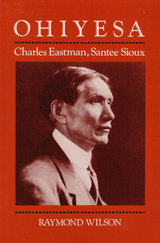
front cover of Ohiyesa
Ohiyesa
Charles Eastman, Santee Sioux
Raymond Wilson
University of Illinois Press, 1983
The far-ranging life and work of the popular Native American author

Charles Eastman, called Ohiyesa in Santee, came of age amidst increasing tensions and violence between Native and European colonizers. Though raised to be a hunter-warrior, Eastman was persuaded by his Christian father to enter white society. Eastman graduated from Dartmouth and the Boston University School of Medicine. His career included service as the government physician at the Pine Ridge Agency, where he tended casualties at Wounded Knee; as an Inspector for the Bureau of Indian Affairs; as Indian secretary for the YMCA; and as one of the cofounders of the Boy Scouts of America.

Raymond Wilson examines these accomplishments while also delving into the writings that expressed Eastman’s determination to hold onto his Santee roots. Popular works like Indian Boyhood, The Soul of the Indian, and Indian Heroes and Chieftains reconfirmed his heritage and aimed at making white society aware of Indigenous peoples’ contribution to American civilization.
[more]

front cover of Sovereign Selves
Sovereign Selves
American Indian Autobiography and the Law
David J. Carlson
University of Illinois Press, 2005
This book is an exploration of how American Indian autobiographers' approaches to writing about their own lives have been impacted by American legal systems from the Revolutionary War until the 1920s. Historically, Native American autobiographers have written in the shadow of "Indian law," a nuanced form of natural law discourse with its own set of related institutions and forms (the reservation, the treaty, etc.). In Sovereign Selves, David J. Carlson develops a rigorously historicized argument about the relationship between the specific colonial model of "Indian" identity that was developed and disseminated through U.S. legal institutions, and the acts of autobiographical self-definition by the "colonized" Indians expected to fit that model.

Carlson argues that by drawing on the conventions of early colonial treaty-making, nineteenth- and early twentieth-century Indian autobiographers sought to adapt and redefine the terms of Indian law as a way to assert specific property-based and civil rights. Focusing primarily on the autobiographical careers of two major writers (William Apess and Charles Eastman), Sovereign Selves traces the way that their sustained engagement with colonial legal institutions gradually enabled them to produce a new rhetoric of "Indianness."


[more]


Send via email Share on Facebook Share on Twitter