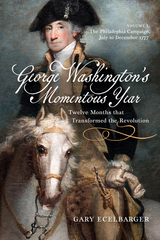
front cover of George Washington's Momentous Year
George Washington's Momentous Year
Twelve Months that Transformed the Revolution, Vol. I: The Philadelphia Campaign, July to December 1777
Gary Ecelbarger
Westholme Publishing, 2024

WINNER OF THE 2025 FRAUNCES TAVERN MUSEUM BOOK AWARD
On July 4, 1777, George Washington was so consumed with where the British would strike that he ignored the nation’s first birthday. One year later, Washington created an independence celebration so spectacular that soldiers proudly recalled it in their old age. As historian Gary Ecelbarger explains in George Washington’s Momentous Year: Twelve Months that Transformed the Revolution, it was between these two antithetical anniversaries where the fight for independence under Washington’s leadership changed from a precarious regional struggle to a global conflict. In August 1777, the British landed at Head of Elk, Maryland, and defeated the Continentals at Brandywine, White Horse Tavern, and Paoli, before occupying Philadelphia. Over the next several months, the forces clashed at Germantown, Red Bank, and White Marsh, and in December, Washington and his troops fell back to Valley Forge. Despite the immediacy of the Philadelphia campaign, Washington remained in charge of the entire Continental effort, and welcomed the American victory at Saratoga that secured an alliance with France. In the new year, British forces were ordered back to New York, and as they set out across New Jersey, a newly invigorated American army engaged them at Monmouth Courthouse. This was Washington’s final time leading troops in battle and ended with his Continentals masters of the field.

In the first of this history’s two volumes, the author narrates the personalities, decisions, and battles of the Philadelphia campaign, primarily from the perspective of Washington. Based on a fresh analysis of primary sources, the author demonstrates that Washington was an offensive-minded commander seeking avenues of attack during a very mobile campaign. Throughout, we follow the growing relationships between the commander in chief and his “military family,” including well-known personalities such as Alexander Hamilton and Marquis De Lafayette, as well as less-heralded volunteers like, Tench Tilghman, Caleb Gibbs, John Cadwalader, and Joseph Reed. During this period, from July to December 1777, Washington had to juggle logistics for his army as well as those far afield, fend off challenges to his leadership, and direct the greater war effort—all the while preparing to engage enemy forces at his front. The result is a new and compelling look at America’s most famous military figure and his truly momentous campaign.
[more]

front cover of George Washington's Momentous Year
George Washington's Momentous Year
Twelve Months that Transformed the Revolution—Vol. 2: Valley Forge to Monmouth, January to July 1778
Gary Ecelbarger
Westholme Publishing, 2025
The second volume of George Washington’s Momentous Year picks up where Volume 1 concluded, in the wake of the Battle of Whitemarsh in early December 1777, with the British army returning to Philadelphia and French officials opening formal negotiations with American diplomats, primarily as a result of what they felt was a surprising and successful Philadelphia campaign by George Washington. Washington’s army now moved westward, across the Schuylkill River, to the most iconic encampment in American history: Valley Forge. Here the story is new and dynamic. Gary Ecelbarger’s original research revises the history of this crucial period, presenting for the first time Washington’s aggressive plan to attack Philadelphia soon after arriving at Valley Forge and the fact that the encamped army was much larger than previously understood. During this time, Washington confronted challenges to his military authority while deftly solving crises of supply and recruitment. With the aid of Baron von Steuben, he established and trained the first American professional army. Following the Valley Forge encampment, the author takes the reader with the reinvigorated Continental army as it marches across the Schuylkill and Delaware Rivers and into New Jersey to confront Sir Henry Clinton’s crown forces on their way from Philadelphia to New York City. Having ordered an advance corps of veterans to engage the British, they make contact at Monmouth Courthouse near Freehold, New Jersey. As Washington approaches the action, he confronts thousands of his troops retreating around him. In one of the most stirring events of the Revolution, Washington is able to rally his men, reclaim the battlefield and achieve a hard-fought victory. The battle gave notice to the British that the American army would be a formidable foe going forward. 
This engrossing history of the most significant twelve months of the American Revolution enables the reader to understand and appreciate the astounding accomplishment of George Washington and his military aides: the simultaneous emergence of a new, capable army and a strategy that would win the War for Independence.
 
 
[more]


Send via email Share on Facebook Share on Twitter